

Workers at the Mochovce plant began loading fuel into the site’s fourth unit this week, thirty-nine years after construction started under Soviet planners. Commercial output is expected by the end of summer.
Slovakia already draws roughly two-thirds of its electricity from the atom, trailing only France among nuclear-dependent nations. Once the new unit runs at full output, Slovakia’s nuclear share will climb to seventy-seven percent, ahead of France’s figure near sixty-nine percent.
This single plant, financed at a combined cost of EUR 6.7 billion, forms one thread in a broader European pattern. Countries once cautious about the atom, and once neutral toward nuclear arms, are shedding old restraints together.
Bratislava’s Reactor Overtakes Paris
That pattern begins with electricity itself. Slovakia’s annual production will reach around 37 terawatt-hours against domestic consumption of 28, turning a country that imported power after closing older reactors into a net exporter.
Prime Minister Robert Fico has already floated a further reactor at Bohunice, an investment estimated between EUR12 billion and EUR15 billion, with Washington and Westinghouse named as likely partners.
Slovenské elektrárne still buys fuel from Russia’s TVEL for the Soviet-designed units, though it plans to shift toward Framatome and Westinghouse supply from 2028.
A Twelve-Nation Alliance For Atoms
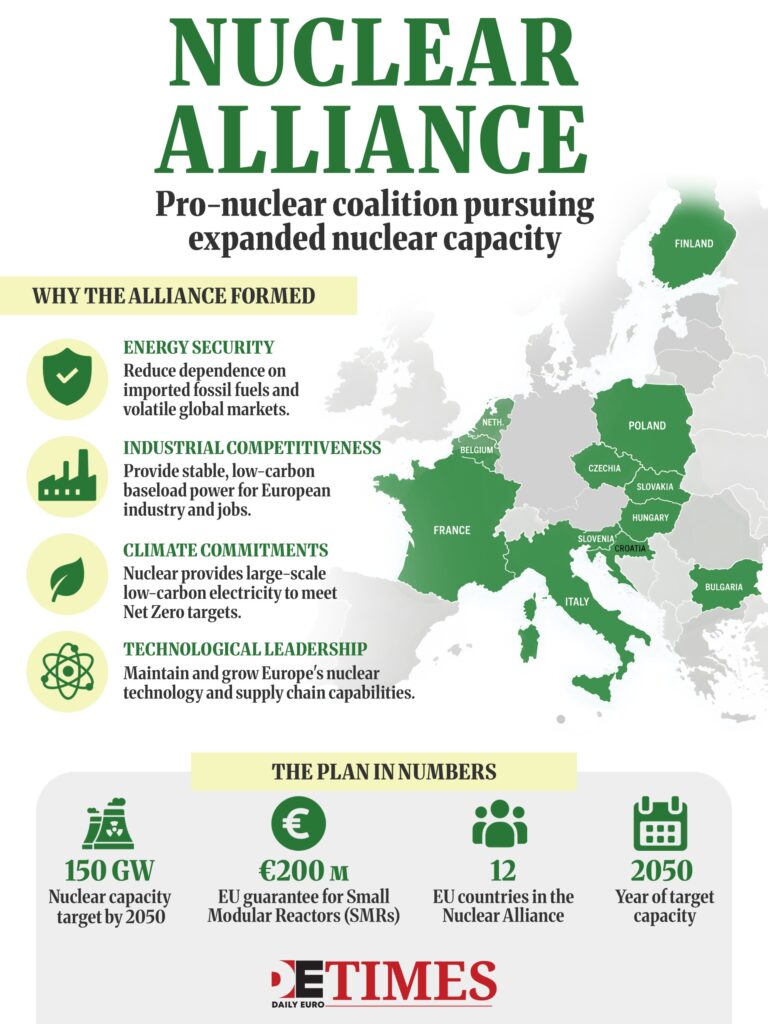
Slovakia’s rise sits inside a wider institutional push. Twelve EU states, from Poland and Finland to Belgium and Italy, formed a Nuclear Alliance seeking 150 gigawatts of nuclear capacity by 2050, financed partly through a EUR200 million Commission guarantee for small modular reactors.
Germany leads a rival bloc, the Friends of Renewables, resisting any formal equivalence between nuclear and wind or solar power.
Commission President Ursula von der Leyen described Europe’s earlier retreat from the atom as a strategic mistake, a judgement the Mochovce project now seems to vindicate.
Energy security has become the organising principle, and nuclear power sits at its centre for a growing number of governments.
Neutrality Gives Way to Nuclear Weapons
The same security logic now reaches beyond power stations into weapons themselves. Finland’s government has moved to remove its 1987 legal ban on hosting nuclear weapons, a restriction adopted under Soviet-era neutrality and kept even after joining NATO.
Lithuania followed within weeks: fifty members of parliament submitted an amendment repealing the constitutional ban on stationing nuclear weapons on Lithuanian soil. President Gitanas Nauseda insisted no deployment is planned, framing the change as a hedge against a security climate he called worse than before.
Finnish opposition leader Antti Lindtman warned the shift would separate Finland from the nuclear policies long shared by its Nordic neighbours.
Both governments describe the moves as precautionary rather than operational, a distinction that may not survive the next crisis.
Paris Offers Deterrent Umbrella
France supplies the framework tying these decisions together. President Emmanuel Macron’s “forward deterrence” doctrine envisages French nuclear-capable aircraft deploying temporarily to allied territory in moments of danger, while French decision-making stays sovereign.
Nine countries, including Poland, Sweden, Germany and Belgium, now hold bilateral nuclear dialogues with Paris. Poland has gone further still: President Karol Nawrocki backed strengthening national security “even on a base of a nuclear potential,” and Prime Minister Donald Tusk said Poland would not “remain passive” on nuclear questions.
Warsaw stops short of seeking its own arsenal, but its language now overlaps with that of states weighing NATO nuclear-sharing arrangements once reserved for founding allies.
A Fragile New Normal Ahead
Austria’s veteran disarmament diplomat Thomas Hajnoczi has cautioned that several non-nuclear states are already discussing withdrawal from the Non-Proliferation Treaty, a warning that gives Slovakia’s civilian milestone a sharper edge.
Nothing in Bratislava’s achievement points toward weapons proliferation, and officials in Helsinki and Vilnius insist their legal changes remain precautionary. But governments that spent decades limiting their nuclear footprint now treat both reactors and warheads as tools for managing a less predictable neighbourhood.
Keep up with Daily Euro Times for more updates
Read also:
Europe’s Nuclear Turn Carries a French Accent
Start to Finish: Ukraine Peace and Nuclear Arms Race
A Nuclear Divorce: Sweden and Russia