
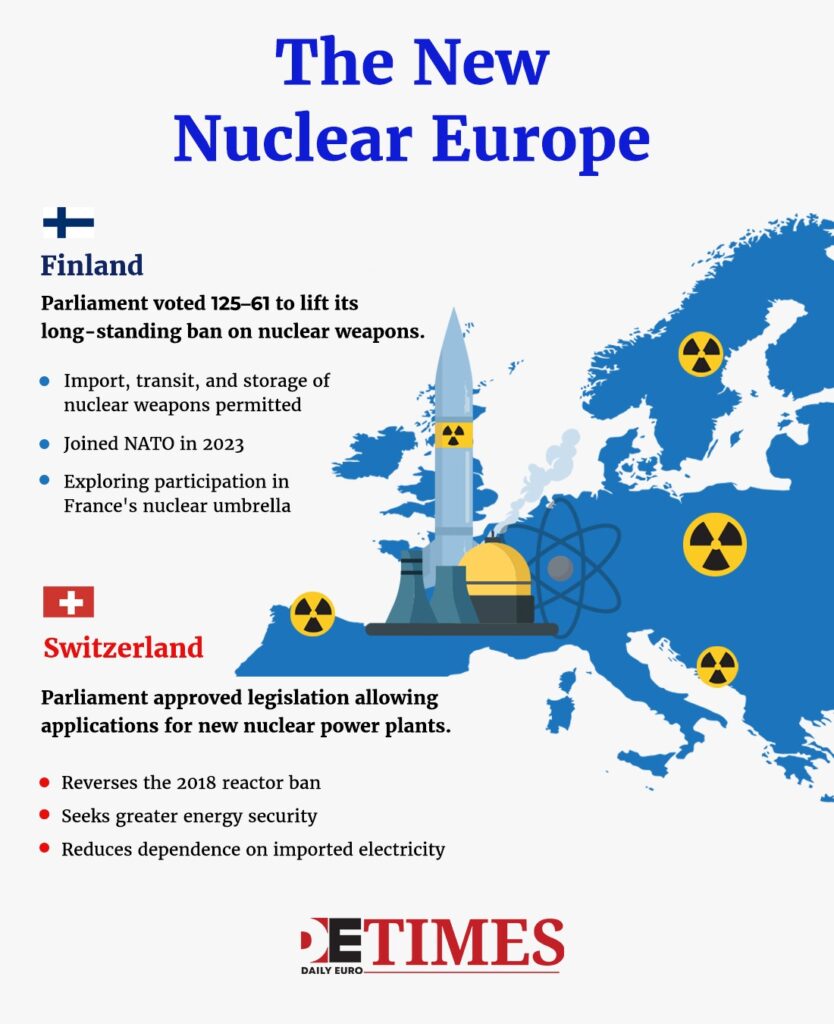
Finland’s parliament has voted 125 to 61 to lift its decades-old ban on nuclear weapons. The new law allows the import, transit and storage of warheads on Finnish soil at any point the country’s defence dictates it.
Helsinki abandoned military non-alignment and joined NATO, in 2023, a step taken after Russia’s full-scale assault on Ukraine, which doubled the alliance’s territorial border with Moscow.
Switzerland, a country with no defence alliance at all, acted in step days later, as its parliament approved a separate bill letting firms apply to build new nuclear power stations, reversing a ban dating from 2018.
Both votes point towards Paris. France runs Europe’s largest nuclear fleet, exports its reactor designs across the continent, and has spent the past year promoting its atomic arsenal as a shield for countries without one of their own.
A Familiar Trajectory Among Neutral States
Finland and Switzerland share a history of neutrality that recent events have steadily worn away.
Finland’s neutrality ended formally in 2023, whereas Switzerland’s military neutrality survives even as its energy policy pivots towards the exact reactors it once banned.
Norway, never neutral but long cautious about nuclear weapons on its territory, signed an agreement in May to shelter under France’s nuclear umbrella, citing Russia’s growing rearmament.
President Emmanuel Macron unveiled a doctrine of forward deterrence in March, promising a larger arsenal, nuclear-capable aircraft on allied soil, and closer co-operation with European partners, retaining sole authority over any decision to fire.
Finland was conspicuously absent from that first list of partners, despite sharing thirteen hundred kilometres of border with Russia. Prime Minister Petteri Orpo has since confirmed Helsinki’s interest in joining the French scheme, with a decision expected in autumn.
The Industrial Rationale Behind Paris’s Offer
Behind Macron’s gesture sits an industry that needs customers. Électricité de France, wholly owned by the French state, designed the reactor now running at Finland’s Olkiluoto plant and hopes to sell its smaller Nuward design across the continent within the next decade.
The European Commission’s nuclear roadmap estimates that meeting Brussels’s atomic ambitions will demand around €241 billion in investment by 2050, funds that French firms are well placed to secure given decades of reactor-building experience.
Switzerland already draws on French nuclear electricity to cover its winter shortfalls, through long-term contracts with EDF signed years before the current referendum discourse began.
A country voting on whether to build its own reactors is, in some sense, voting on how much longer it wants to pay a neighbour for borrowed power.
Nuclear’s Own Case For Itself
Evidently, Switzerland fears blackouts linked to climate-driven shortages and to events such as the war between the United States, Israel and Iran, and nuclear plants supply low-carbon, dispatchable electricity precisely at the times such fears peak.
Finland’s defence planners, observing Russian forces expand bases at Pechenga and Petrozavodsk, see deterrence value in the identical calculations that pushed Norway towards French co-operation.
The atom offers something rare in 2026, a technology that satisfies environmental goals and defence budgets at once, and that fact alone explains much of its renewed popularity, regardless of who happens to sell the reactors.
A Continent Rebuilding Around One Supplier
Even a genuinely sound technology can still concentrate power in the hands of whoever masters it first. France holds an estimated 290 warheads and the only sovereign nuclear deterrent inside the EU, giving Paris a near-monopoly on the continent’s conversation about broadened deterrence.
Twelve EU members already operate reactors, and most lean on French expertise, French fuel-cycle services, or French-trained engineers somewhere along the supply chain.
France produces about 70% of its own electricity from nuclear power, a proportion no other large European economy approaches.
Finland and Switzerland are, in fact, choosing the route that happens to run through France because few credible options exist on the continent.
What Helsinki And Bern Should Expect
French interest and atomic practicality point in a shared direction, which is why both policies proved easy to sell at home.
Finland gains deterrence value without manufacturing a single warhead. Switzerland gains supply security without exporting a single franc abroad until any reactor is actually built. France gains customers, partners and the political authority Paris has sought since the era of Charles de Gaulle.
Now, the question for Helsinki and Bern, and for every other capital weighing a similar choice, is whether today’s convenience imperceptibly narrows tomorrow’s options, once France becomes Europe’s default answer to every energy and security shortfall.
Keep up with Daily Euro Times for more updates
Read also:
Start to Finish: Ukraine Peace and Nuclear Arms Race
Sahel’s New Power Broker Speaks Nuclear
Britain Goes Nuclear: Europe’s New Security Leader

