

Volodymyr Zelenskyy confirmed the sinking of the Russian corvette Merkury at Benghazi’s naval base over the weekend, crediting seven Ukrainian-made naval drones and calling it “an exemplary Ukrainian operation” in the latest round of escalation against the Ukraine war.
Eastern Libyan officials say the drones left a base that Ukrainian forces operate in western Libya under a covert deal with the Tripoli government.
A drone had already hit a Russian cargo ship bound for Kaliningrad in the Gulf of Finland. Reports of explosions near the Baltic Fleet base at Baltiysk added to the alarm, though they remain unverified.
Ukraine is widening its war for strategic reasons, and Europe’s eastern flank and Libya’s divided governments are keeping a wary eye on how the conflict evolves.
Why Kyiv Is Widening the Target List
Ukrainian strikes in the Black Sea forced Moscow to adapt, limiting further targets and pushing Ukrainian planners towards more ambitious ones, according to reporting in April.
Libya offers a Mediterranean launch point against vessels serving Russian operations in Africa, and earlier reporting counted over 6,600 tonnes of equipment that Russia had sent to Libya since 2024.
Diplomatic considerations also drive the widening conflict. Talks in Abu Dhabi earlier this month gave Kyiv reason to raise Moscow’s price for delay.
A collapsed section of the Crimean Bridge, which Ukraine says Russia needs a year to remove, adds pressure.
Kyiv also aims to deter Russian shipping, which can no longer assume safe harbour in friendly ports. The Kremlin responded with a restrained acknowledgement of the Libyan strike, which leaves its options open.
Libya Faces Foreign Rivalries
Libya faces the most immediate consequences. Ukrainian drone specialists reportedly work at Misrata, Tripoli and Zawiya with Tripoli’s consent, and the eastern authorities allied to Khalifa Haftar receive Russian arms.
In March, a Russian gas tanker sank between Libya and Malta, and Moscow blamed Ukrainian sea drones from the Libyan coast.
Jalel Harchaoui of the Royal United Services Institute called the strikes “exceptionally brazen and provocative”. The United Nations mission in Libya has warned against dragging the country into a war that is not its own.
Russian retaliation, if it materialises, would probably fall on Libyan ports and political actors who never chose a side. Ordinary Libyans would pay for a foreign rivalry that recalls the competition among outside powers after 2011.
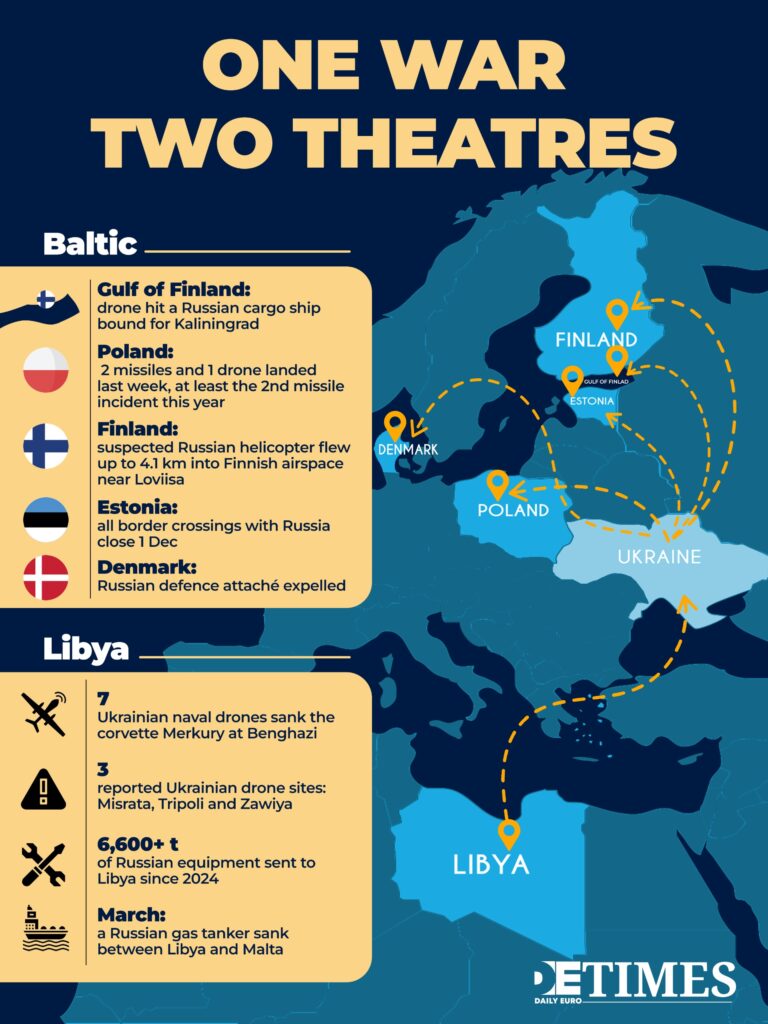
Ukraine War Spreads from Baltic Theatre into Africa
Eastern authorities have already asked investigators to establish whether Ukrainian personnel operate on Libyan soil, a demand Tripoli will find hard to ignore.
The covert deal reportedly enjoys Western backing, and a United States adviser has drafted a settlement proposal that keeps Abdulhamid al-Dbeibah as prime minister.
Western governments therefore have a direct interest in restraint, since a sovereignty dispute in Libya would undermine the diplomacy they favour.
Libya also hosts Russia’s southern Mediterranean foothold, which gives Moscow leverage over energy and migration routes towards Europe.
Spillover Reaches the Baltic
While Libya absorbs the distant consequences, the Baltic region faces the nearer ones. Two Russian missiles and a jet-powered drone fell on Polish territory last week, at least the second missile incident on Polish soil this year, a Swedish Gripen pilot with authority to shoot down a suspected missile held fire in poor weather, and Danish intelligence attributed a foiled September plot to kill a Ukrainian-American rapper to Russian services, which used a local gang. Copenhagen expelled Russia’s defence attaché in response.
Estonia blamed Russian military intelligence for an attempted arson attack on a drone manufacturer and will close every border crossing with Russia from 1 December. Foreign Minister Margus Tsahkna said “Russia’s hostile actions have a price”.
Finland suspects a Russian helicopter flew up to 4.1 kilometres into its airspace near Loviisa, and its defence minister drew a possible link to the cargo ship strike.
Attribution remains contested in several incidents, since Russian jamming from Kaliningrad has diverted Ukrainian drones into Baltic airspace.
Lithuania insists it never authorised its airspace for attacks on Russian targets. Its intelligence community warned in August about the possibility of Russia using Ukrainian drones to strike Baltic targets.
The Baltic states have issued drone alerts for months, and each additional incident raises the chance of a misjudged response.
Keep up with Daily Euro Times for more updates
Read also:
Iran and Ukraine’s Wars Are Converging
Moscow’s Outsourced War Widens Fronts
Poland Firearm Licences Rise With Frontline War Anxiety