

South African police detained nine Zimbabwean men last weekend at OR Tambo International Airport and a Johannesburg hotel as they allegedly prepared to board flights to Russia. Officers soon arrested a tenth suspect.
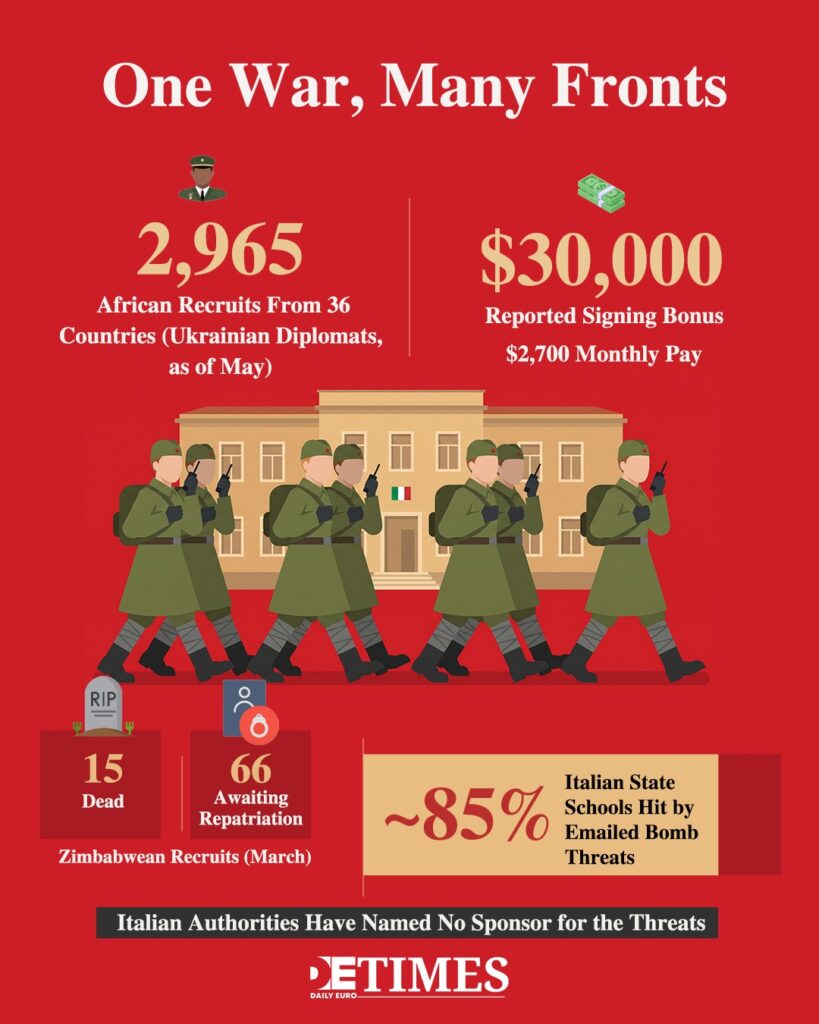
A different form of external pressure hit Italy’s schools, with emailed bomb threats flooding the inboxes of about 85% of state schools. Investigators traced the messages to hijacked accounts in Asia.
Ukrainian diplomats count at least 2,965 recruits from 36 African countries as of May, and they warn the true total may be higher. Moscow’s hybrid warfare, a blend of cyberattacks, disinformation and sabotage, has long sought deniability at low expense.
Russia might be increasingly using foreign intermediaries and compromised accounts. But Italian authorities have so far named no sponsor. Still, outsourcing expands the Ukraine war at low cost and weakens Moscow’s control over how it unfolds.
Poverty Becomes Russia’s Recruiting Lever
The Zimbabwean arrests illustrate the first factor: poverty. Recruiters target unemployed young men and former security personnel, then pass them to handlers operating under aliases. Signing bonuses reported at up to $30,000 and monthly salaries of $2,700 attract desperate people.
The cost is measured in casualties. In March, Zimbabwe’s information minister counted 15 recruits dead, with 66 others alive and awaiting repatriation. At the front, Russian recruits survive only minutes once commanders send them into assaults, a casualty rate no wage can justify.
It is also worth noting that Ukraine has recruited foreign nationals, including Africans. The European Parliament, however, has described a Russian chain running through state-linked companies, intermediaries and embassy officials, an organisation of a scale no freelance recruiter could muster.
Moscows Outsourced War Widens the Front
Hijacked Inboxes Spread Fear
If poverty supplies recruits for the front line, compromised servers spread fear. The Italian message carried the signature Mikhail Andropov, leader of the self-styled Vilayat di Misoginistan. It originated in the compromised account of a former Taiwanese student. Later waves used Philippine domains, among them hijacked Department of Education addresses, with Pakistani university domains also in play.
The disruption was real even though no bombs were found. Hundreds of schools evacuated, Education Minister Giuseppe Valditara judged the risk virtually nonexistent, and opposition leaders backed the government and demanded more cybersecurity funding.
Some Italian commentators detect the Kremlin’s hand, others suspect imitators hunting notoriety. Hijacking a mailbox in Manila is inexpensive, while a school in Milan loses a morning to evacuation.
Low-Cost Tactics Make a Less Controlled War
Regardless of who is responsible, low-cost external tactics change how the Ukraine war unfolds. The conflict spreads geographically first, as a Johannesburg hotel, a Philippine ministry server and an Italian school corridor all become secondary sites of operation.
Deniability increases next. Researchers at the Atlantic Council observe the Kremlin calibrates hybrid tactics to stay below the threshold of a unified European response, and hired hands make the threshold easier to respect.
Control weakens last. Hired recruits improvise, and recruiters have duped some about their destination. The Andropov signature, with its theatrical Misoginistan, invites copycats as readily as it invites fear. Italian experts quoted in the press do not rule out imitators.
Keep up with Daily Euro Times for more updates
Read also:
Fridge Hack: Who Did It and What’s Targeted Next?
Tehran Eyes Europe as Trump Tightens Economic Warfare
Fico and Stubb: War Fatigue Finds a Political Voice