

Over the past fortnight, a technical fault grounded flights across the United States and took the National Security Agency’s classified network offline. Officials insisted that cyberattacks had not caused the outages. Reported causes, mostly software faults, did not involve satellites.
Commentators nevertheless viewed the disruption as a small-scale rehearsal for the “Space Pearl Harbor” that Washington’s defence planners have feared for a quarter of a century.
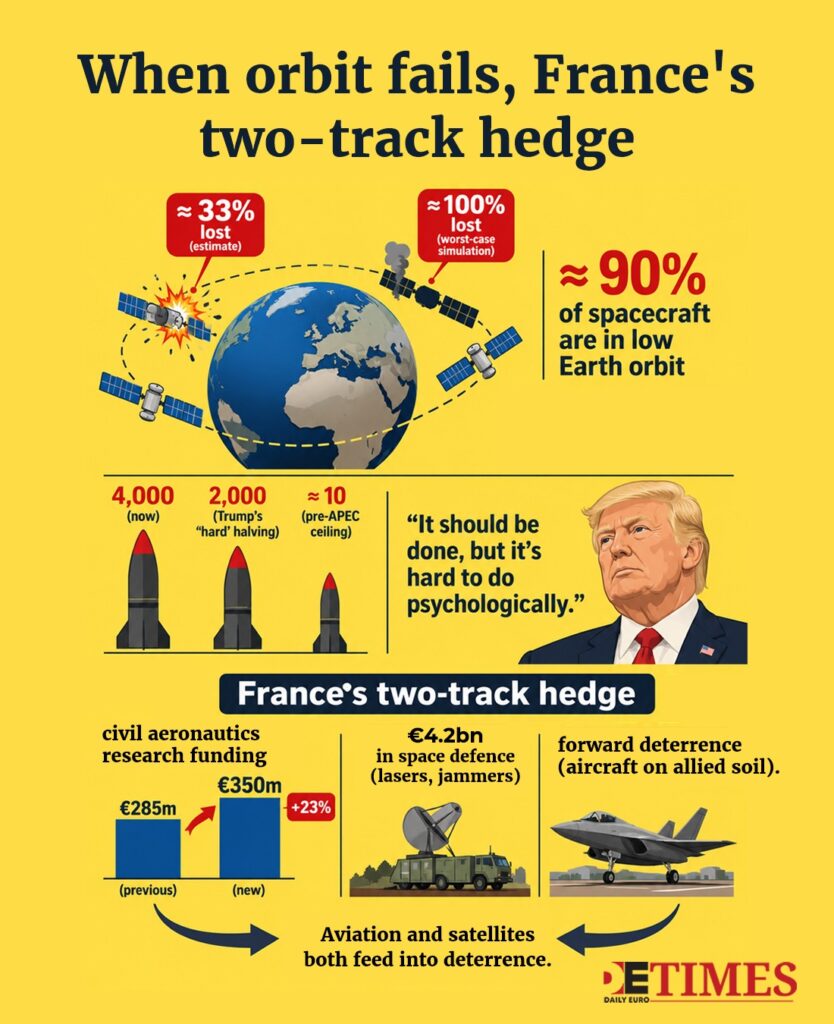
Estimates of the damage vary widely. Some assessments suggest that a single nuclear detonation in low Earth orbit could disable a third of the satellites there. The worst simulations predict the loss of nearly all of them.
Paris has reason to treat orbital vulnerability as an industrial concern. Macron’s recent aviation pledge could provide a strategic hedge by strengthening France’s aerospace engineering base.
Trump’s Divided Nuclear Message
Shenzhen provided the nuclear backdrop to Paris’s calculations last week. At the Asia-Pacific Economic Cooperation summit, Trump held three-way talks with Xi Jinping and Vladimir Putin on limiting nuclear weapons.
On the flight home, he told journalists that he supported the concept but found it difficult to ask any government to halve a stockpile of 4,000 warheads. “It should be done, but it’s hard to do psychologically,” he said.
Before the summit, Trump had proposed a much lower ceiling, saying nuclear powers needed only about 10 weapons. Chinese state television reported that Xi favours a world free of nuclear weapons.
The gap between these ambitions and the negotiating positions suggests that large nuclear arsenals will remain. The threat of attacks on satellites used for warning, navigation and communications will persist alongside them.
Satellites Make the Threat Tangible
The nuclear stalemate poses considerable risks in orbit. The American Foreign Policy Council warned in June that nearly 90% of spacecraft operate in low Earth orbit. A relatively modest nuclear device detonated at the right altitude could cripple American and allied interests, the organisation said.
Estimates of potential damage differ. The commander of Germany’s space command has put losses at up to a third of low-orbit satellites within weeks or months. One recent simulation predicted the destruction of nearly every satellite, which may explain why some commentators cite losses above 90%.
Military preparations remain limited. A war game involving former American officials, reported in September, found Washington unprepared in every scenario. The exercise also found that the United States lacked a tested plan to detect or recover from a nuclear device in orbit.
Recent technical outages brought these vulnerabilities closer to home for Americans. Flights, banks and military networks experienced disruptions within days of one another, although the reported causes had no connection to satellites.
France Hedges With Aeronautics Money
Paris is assessing these risks against the strengths of its domestic aerospace industry. Macron confirmed yesterday at an Airbus plant in Toulouse that the state would allocate €350m to civil aeronautics research, up from €285m in 2025.
He also announced plans for special industrial zones with simplified administrative procedures.
The funding supports civil research, so its contribution to orbital resilience is indirect. Its strategic value lies in the shared engineering base of France’s aircraft and space industries.
France’s defence budget provides a more direct response. Last year, Macron committed an additional €4.2bn to space defence, including lasers and jammers, at the opening of a space command centre in Toulouse.
France’s nuclear doctrine adds another element. Macron unveiled a policy of forward deterrence in March, promising a larger arsenal and nuclear-capable aircraft on allied soil.
Aircraft-based deterrence depends on a strong aviation industry. It also relies on satellites that can survive long enough to provide early warning and support command operations. The two areas of investment could contribute to the same broader defence strategy.
Keep up with Daily Euro Times for more updates
Read also:
FCAS: Bilateral Deals Break Expensive Collective Defence
EU Bets Big on Space: IRIS² Constellation to Challenge U.S. and China by 2030
Europe’s Fragile Outpost: Unrest and Security Challenges in French Guiana