

Yemeni government forces have announced a pullback from the Bab el-Mandeb Strait, leaving the Houthis in control of the southern gate to the Red Sea.
The retreat ends a six-week counteroffensive that began after Houthi forces swept down the coast in September, and it leaves Aden, the government’s main base, vulnerable.
Italy’s defence minister, Guido Crosetto, said last week European governments had taken no concrete steps to reinforce the Aspides naval mission. EU countries cannot stop the Houthis with the fleet it has.
Italy Presses Brussels for Reinforcements
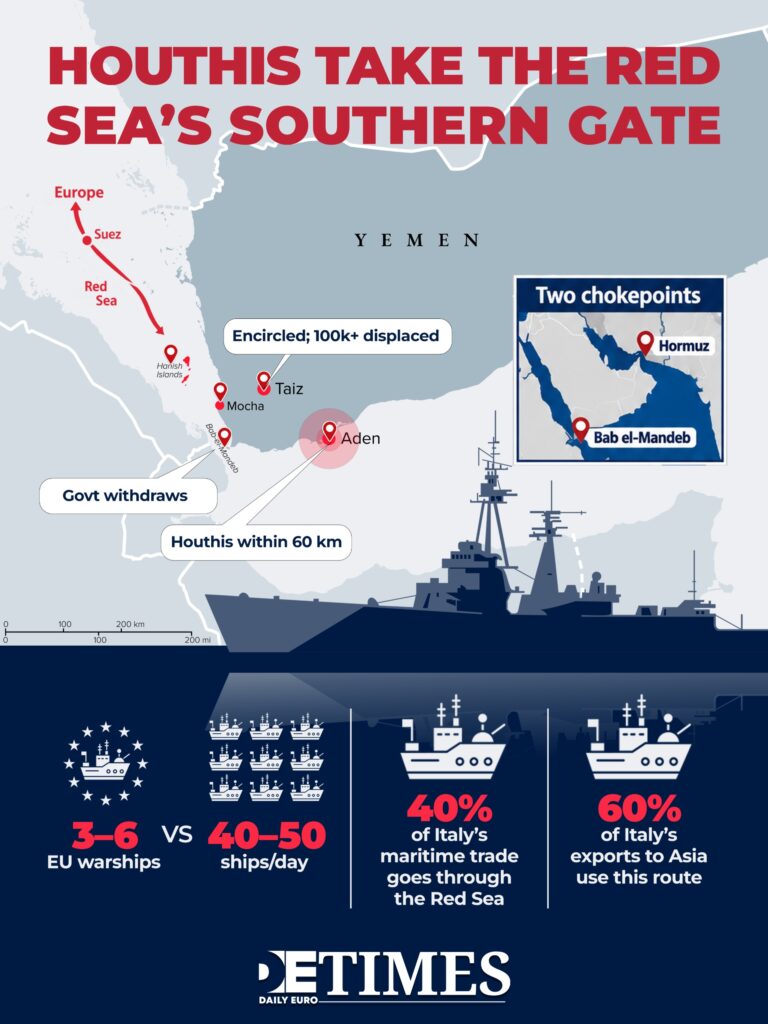
Rome has reason for impatience. Roughly 40% of Italy’s maritime trade and 60% of its exports to Asia pass through the Red Sea, according to Foreign Minister Antonio Tajani, who wants the mission renewed. Crosetto announced Italian warships for the strait in September.
Crosetto has pressed the EU to reinforce Aspides, and last week he lamented, “I have yet to see anything concrete”. He says Italy’s contribution underpins about one third of European operations.
Kaja Kallas, the EU’s foreign policy chief, has urged ministers to act and has floated a wider mandate, and still the frigates are missing. Reports of inconclusive talks point to members with thin budgets reluctant to commit ships. Merchant vessels reportedly queue for escorts, since warships are scarce.
The Mission’s Defensive Mandate Limits Action
Rome’s frustration conflicts with the mission’s own design. Aspides is purely defensive. Almost three years ago, EU officials said it would carry out no attacks on Yemeni soil, and its commander has distanced it from American strikes on the Houthis.
The EU does not officially recognise the movement, so its messages travel through intermediaries. The fleet usually amounts to between three and six vessels, a thin escort for the 40 or 50 ships Admiral Gryparis once counted in the strait each day.
Politics adds a second barrier. Intervention on Yemeni soil would need unanimity among 27 governments, standing forces the bloc does not field and a legal mandate no capital appears to have proposed.
Even Italy insists it is “not at war”, and Tajani calls Aspides a defensive mission.
Defensive Postures Leave Houthi Red Sea Stranglehold Unchecked
Houthi Gains Change Red Sea Security
Europe’s inertia contrasts with the momentum of September’s lightning Houthi advance, which took Mocha, the Hanish islands and the coast beside the strait.
Houthi forces have advanced to within 60 km of Aden, the closest since the early months of the 2015 war, according to military sources. Houthi forces have encircled Taiz, Yemen’s third-largest city, since early October, displacing over 100,000 people.
Strikes on Aden’s presidential palace and airport last month hit the seat of government itself. Government forces redeployed to al-Suqyah, 150 km west of Aden, and still try to dislodge Houthi fighters from nearby coastal areas.
The strait carries trade between Asia and Europe via the Suez Canal. Iran, which keeps disrupting traffic through the Strait of Hormuz on the opposite side of the Arabian Peninsula, gains a second pressure point from Houthi control.
Houthi attacks on Saudi airports and energy facilities have bolstered Iran’s hand in the wider Middle East conflict the United States and Israel launched earlier this year.
What Kind of State Would the Houthis Build?
The retreat raises the question of what kind of state the Houthis would build. Mahmoud Shehrah, a Yemeni political specialist at Chatham House, sees similarities with the Taliban in social control.
The Sana’a Center for Strategic Studies warned three years ago of a Zaidi Taliban state, a hybrid of Taliban theocracy and a police state. Others see Tehran in the blueprint.
Laura Silvia Battaglia, an Italian journalist with long experience in Yemen, says the Houthis modelled their governance on Iran and Hezbollah. A Houthi spokesperson said two years ago Abdel Malek al-Houthi would keep absolute power in any future government.
Keep up with Daily Euro Times for more updates
Read also:
Riyadh Weighs a Yemen Offensive Against a Shrinking Economy
The Gulf Rift Over Yemen: Shared Interest in Managed Partition
Houthis Recruit Military Yemenis for Russian Frontlines in New Development