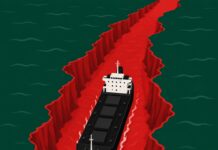

A sailor was killed at the weekend when a Ukrainian drone hit a commercial vessel anchored off Russia’s Volga estuary in the Caspian Sea. The ship had left Astrakhan for the Iranian port of Anzali; Tehran said another crew member was wounded.
Volodymyr Zelensky announced that his forces had struck vessels carrying Iranian military cargo, as well as a warship. Iran’s government called the strike criminal and hostile, and promised to hit back.
For three years, the war over Ukraine and the war involving Iran sat in separate columns of the news. That line is now blurring fast.
A Sea Turns Into a Front
Striking a target this far from its own borders shows a strategy Kyiv has already tried elsewhere.
The Caspian, the world’s largest inland body of water, has become a vital corridor in the deepening partnership between Iran and Russia, moving drone parts one way and reconstruction supplies the other.
Ukraine has spent recent months proving its drones can reach deep into Russian territory, hitting refineries and storage depots. The Caspian attack stretches that same reach to Iranian shipping.
Zelensky paired the strike with an accusation that Moscow is feeding Tehran satellite images of military sites across the Gulf, naming bases in Bahrain, Jordan and Kuwait as targets of Russian surveillance. Whether or not the claim is watertight, Kyiv is assembling a picture of Iran and Russia as a single military partnership with shared war aims.
Tehran Weighs a Reply
Abbas Araghchi, Iran’s foreign minister, said the killing of the sailor “cannot go unanswered.” He phoned Brussels and Moscow, leaving Kyiv out of the conversation entirely, a choice that sends its own signal. Tehran seems to want Europe and Moscow to hold Ukraine back on its behalf.
A direct military response from Iran’s own coastline carries real risk for an uncertain reward. A government still counting the cost of a bruising war with Washington and Israel has little appetite for opening a second front over a single cargo ship.
Iran’s more immediate leverage is closer to home, in the diplomatic notes it keeps sending to European capitals that host American aircraft.
Europe’s Bases Draw Warnings
Both Britain and Bulgaria have heard from Tehran.
Iran’s Revolutionary Guard Corps declared RAF Fairford a legitimate target after American B-1 bombers flew missions from the Gloucestershire base, and the foreign ministry separately condemned Britain for continuing to host American aircraft.
Bulgaria received an even sharper message. After Sofia’s parliament approved the stationing of American refuelling planes at Bezmer, Iranian officials warned that decision-makers “must bear responsibility for the dangerous decision.” It was Tehran’s third such warning to Bulgaria this year.
Neither London nor Sofia has budged. Both governments say their role is purely defensive. For now, Iran’s warnings, made without any strike on European soil since the drone that hit Cyprus in March, act mainly as a tool to keep pressure on domestic opinion in Bulgaria and Britain.
Romania’s Skies Fill With Drones
Romania’s problem comes from the opposite direction. Bucharest’s air force shot down three drones that crossed into its airspace over three days. The foreign ministry summoned Russia’s ambassador, expelled an embassy staff member and recalled its own envoy from Moscow.
Investigators identified the wreckage as Russian in origin, and President Nicusor Dan called the repeated breaches intolerable. These incidents come from Russia’s own drone fleet, not Tehran, unlike the warnings sent to London and Sofia.
Romania’s long Black Sea coastline and its 650-kilometre border with Ukraine leave it exposed no matter how things play out between Kyiv and Tehran. By shooting down the drones itself, Romania has set a firmer precedent than neighbours who have handled similar incursions more cautiously.
Keep up with Daily Euro Times for more updates
Read also:
Iran is Splitting the West Like Ukraine Did
The Iran War Outlives Its Architects
Caspian Bottleneck: All Roads Lead to Baku