
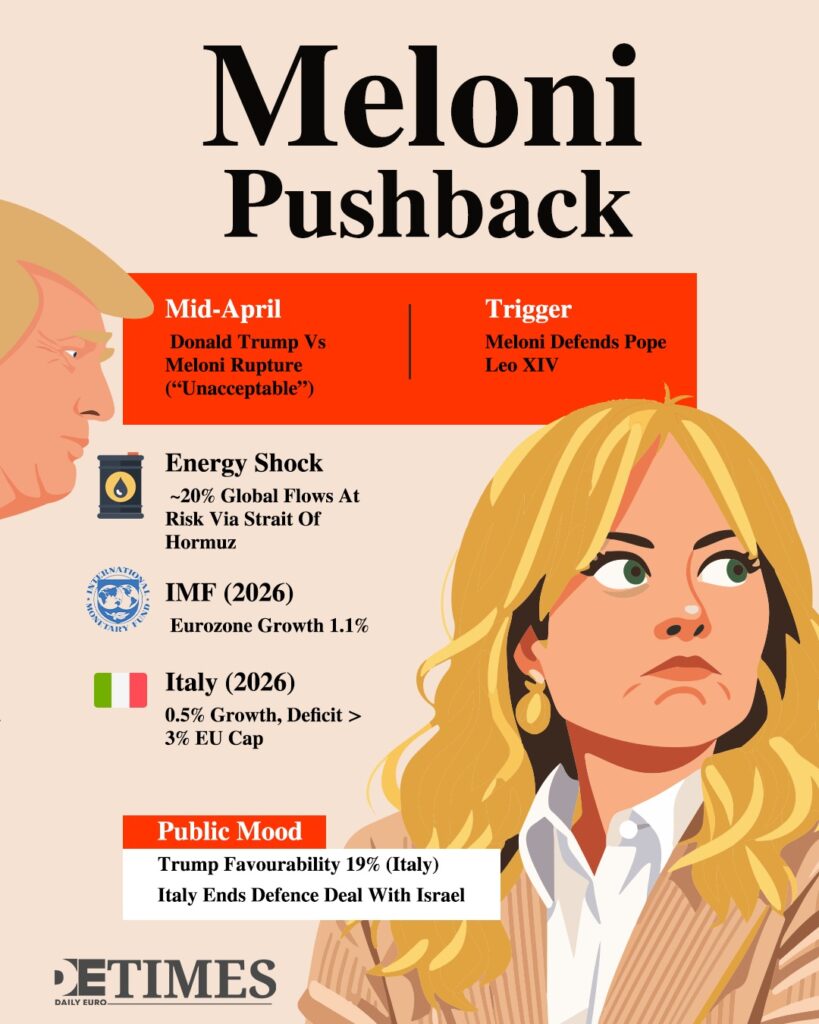
In mid-April, Donald Trump’s phone interview with Italy’s Corriere della Sera rattled European governments. “I’m shocked at her. I thought she had courage, but I was wrong,” Trump said of Giorgia Meloni, calling her “unacceptable.”
The fallout began after Meloni objected to Trump’s attacks on Pope Leo XIV, who had repeatedly asked for a halt to fighting in the Middle East. In a harsh attack on the Vatican’s plea, Trump posted on Truth Social that the pontiff was “WEAK on Crime” and “terrible for Foreign Policy,” telling him to “focus on being a Great Pope, not a Politician.” Meloni called the remarks “unacceptable.”
Trump had once praised Meloni as “one of the real leaders of the world” and “full of energy, fantastic.” But he replied with force: “She is the one who is unacceptable.”
The end of such a warm friendship shows the transatlantic link was never as strong as it seemed. Meloni was the only EU head of government at Trump’s inauguration in January 2025, and she had met him at Mar-a-Lago the month before.
During 2025, she acted as Europe’s secret link to the White House, an informal Trump whisperer. Roberto D’Alimonte, a political science professor at Luiss University in Rome, assessed the strategy plainly: “She wanted to play the role of the bridge between Trump and European allies, and this initially looked like a good idea. But today it has become a liability and she is trying to correct this.”
That burden surfaced in late February. Washington and Tel Aviv launched strikes on Iran, leaving European capitals entirely out of the planning. The action dragged the continent into a war it had no part in shaping.
The War Europe’s Governments Turned Down
Once Iran shut the Strait of Hormuz, through which about a fifth of the world’s oil and gas flows, Europe’s energy bills rose to levels last seen during the Russian gas crisis of 2022. The IMF cut its eurozone growth forecast for 2026 to 1.1% and warned that a prolonged closure and more damage to oil sites would harm the world economy for years.
For Italy, the Bank of Italy predicted just 0.5% growth in 2026. The country’s deficit exceeded the EU’s 3% limit, meaning it could not exit the bloc’s rule-breakers list before elections.
Polls found most Italians opposed the Iran war. Trump’s favourability fell to just 19%.
Europe’s Unexpected Hand
Trump grew angry at Europe’s restraint. He called NATO a “paper tiger” and “one-way street.” Secretary of State Marco Rubio said Washington would have to “re-examine the value of NATO for our country.”
The German government gave a clinical cold reply. “This war has nothing to do with NATO. It is not NATO’s war. Participation has not been considered before the war and is not being considered now,” a spokesman for Chancellor Friedrich Merz told reporters.
Defence Minister Boris Pistorius put the question plainly: “What does… Trump expect a handful or two handfuls of European frigates to do in the Strait of Hormuz that the powerful US Navy cannot do?”
Though British Prime Minister Keir Starmer had been on good terms with Trump, the war broke their link. He told parliament he was “fed up” with the high energy bills his people endured as a result.
Trump’s fury, paradoxically, proved how much Europe’s geography mattered to Washington. The US campaign in Iran required European military installations; without them, the war would have been far harder. An outburst at a March Cabinet meeting made plain how bitterly Trump wanted Europe to do more.
Matthias Matthijs of the Council on Foreign Relations noticed a shift in Europe’s mood: “Europe has realized a lot of these threats are empty. There is a little more shrug of the shoulders. In 2025, there was immediate panic.”
Such composure led to a new policy. As Julien Barnes-Dacey of the ECFR put it: “The fact that Trump is not focused on Ukraine and is giving Russia sanctions waivers increasingly weakens the argument that aligning with Trump is a pathway towards securing European interests in Ukraine.” Trying to please Trump had only created more problems.
Europe as an Independent Diplomatic Actor
The Iran crisis revives a question European capitals long postponed: the continent starting to make its own security decisions. Steven Everts, writing for the EU Institute for Security Studies, explained the choice: “Helplessness is not fate, and irrelevance is not either. Both are the result of choices.”
Everts noted that Iran trusts Europe more than a US government that is busy escalating the fight. That trust could help start talks that Washington and Tel Aviv could not manage alone.
Ursula von der Leyen urged the EU to stop letting a single member block foreign policy votes. Such a change would speed up the EU’s moves. Italy confirmed it was ending its defence deal with Israel.
Foreign Minister Antonio Tajani defended Meloni’s new stance: “We are and remain staunch supporters of Western unity and steadfast allies of the United States, but this unity is built on mutual loyalty, respect, and honesty.”
“As is normal among allies, we must clearly say even when we do not agree,” Meloni told the Italian parliament. Former Serbian president Boris Tadić, speaking in March, gave the wider European view: “The White House and [US President] Donald Trump, they are failing, underestimating Iran.”
Keep up with Daily Euro Times for more updates
Read also:
Roman Angel Resembling Meloni Painted Over
Meloni in Manama: The Sakhir Declaration and Gulf Security
A Martyr is Political Capital: Meloni Links Kirk Assassination to Red Brigades