

Uisce Éireann’s water conservation order, once limited to Dublin and five neighbouring counties, expanded to all twenty-six counties from midnight on 24 July, running until 26 August.
The utility pointed to groundwater sources across the country showing reduced yields, in some places none at all, after weeks of exceptionally warm, dry weather.
Máiread Conlon of Uisce Éireann said early figures suggest the order is working, noting that “water usage in the Greater Dublin Area” is beginning to decrease, though pressures remain high nationally.
Ireland rationing garden hoses feels novel for a country known for rain, yet it places Dublin inside a pattern already familiar across southern Europe.
The order marks the first time water restrictions have applied to the whole island simultaneously, and its arrival this particular summer is no coincidence.
A River that Lost Two Thirds Of Its Flow
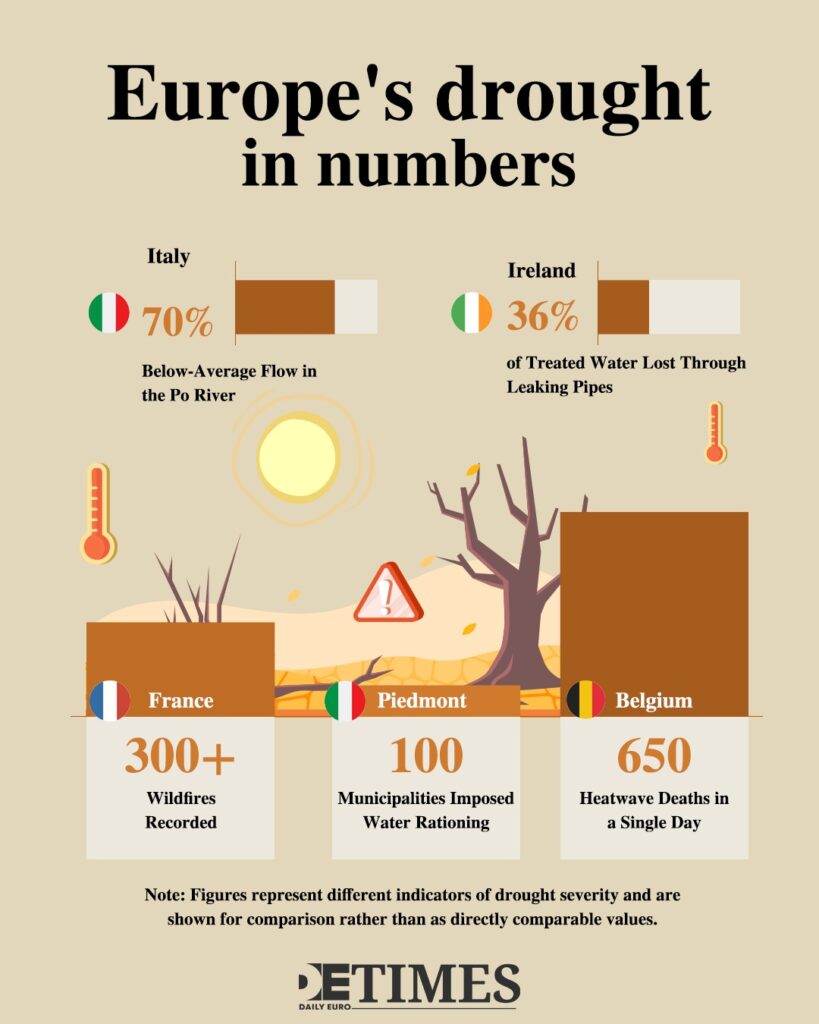
Northern Italy offers the starker version of the same story. The Po River’s flow at Cremona measured 278 cubic metres a second in early July, roughly 70% below its long-term average, prompting Veneto to declare a state of emergency.
Lake Maggiore has been losing four centimetres of depth daily and sat at less than half capacity, while roughly a hundred municipalities in Piedmont introduced water rationing for farmland.
Rome and Florence have avoided formal restrictions so far, keeping the emergency concentrated in the north rather than spread evenly across the country.
Ireland’s ban and Italy’s river collapse differ enormously in scale, yet both trace back to the same dry, hot spring and summer pattern settling over the continent since April.
One Heat Dome, Many Local Emergencies
France has recorded more than three hundred wildfires this year against an annual average closer to ninety, forcing over 250,000 evacuations in Gironde and neighbouring departments.
Romania’s Danube fell to its lowest level in three decades, stranding shipping, while the Netherlands raised its national drought response to Level 2 as rainfall failed to keep pace with demand. Belgium counted 650 deaths on a single day during a June heatwave, its second deadliest day of the century.
Each country is responding to a version of the same deficit with its own tools, hosepipe bans in Ireland, irrigation limits in Romania, groundwater pumping cuts under consideration in the Netherlands. This leaves no shared playbook for a European problem.
Old Pipes and New Demand
Some of Ireland’s strain is self-inflicted rather than purely climatic. Uisce Éireann has acknowledged that 36% of treated water disappears between reservoir and tap through leaking infrastructure, even as households remain the largest category of users.
Warm weather alone lifts domestic demand by roughly 20%, a jump the network was never built to absorb on top of existing losses. Italy’s difficulty is different in kind: a river basin feeding agriculture, hydropower and drinking water simultaneously, with little slack once snowmelt and rainfall both fall short.
Neither country can fix its exposure with rationing alone, since rationing treats the symptom of a season while the underlying networks and river systems remain unprepared for a drier climate becoming ordinary rather than exceptional.
Adaptation Without a Common Plan
Researchers tracking the continent’s drought conditions describe 2026 as one of Europe’s most significant heat and drought years in recent memory, with below-average rainfall stretching from Portugal to southern Finland between April and June.
The scale of deficit makes local fixes, a hosepipe ban here, an irrigation limit there, look increasingly like triage rather than management.
Water scarcity in Malta and Cyprus has pushed both islands toward desalination investment for years; Ireland’s sudden restrictions suggest the same pressure is reaching countries that never expected to need it.
Ireland’s ban is due to lift on 26 August if supplies recover, and Italy’s emergency will ease once autumn rain returns to the Alps and the Po basin. Neither relief solves the pattern driving both crises, and European governments still lack a coordinated water strategy matching the coordinated nature of the drought itself.
Until leak-riddled networks are rebuilt and river basins are managed as shared resources rather than national afterthoughts, each hot, dry spring will likely produce the same scramble, felt differently in Dublin, Rome and Bucharest, but rooted in one continental deficit.
Keep up with Daily Euro Times for more updates
Read also:
Europe’s Safe Water Face a Growing Rulebook
Heat Drives Europe to the Water as Bacteria Follow
Private Capital Steps Up as Gulf Water Risks Mount