

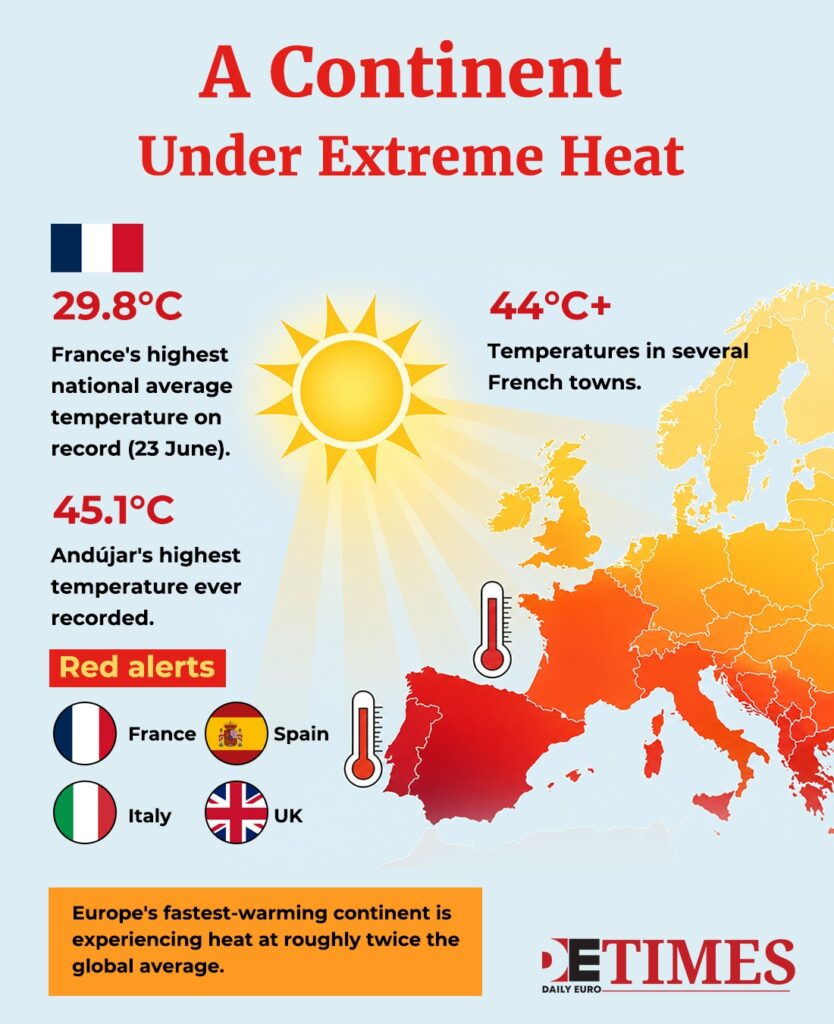
This week, Europe’s early-summer heatwave broke far beyond the usual language of inconvenience. France registered its hottest day since records began in 1947, with the national thermal average reaching 29.8°C on 23 June and temperatures in some towns climbing above 44°C.
Red alerts spread across France, the UK, Spain and Italy; the Eiffel Tower and the Louvre restricted visiting hours; and at least 40 people drowned in France whilst swimming in unsupervised areas to seek relief from the heat. Spain, meanwhile, recorded 45.1°C in Andújar, the highest temperature measured there since records began.
In that context, the beach becomes less a luxury than an instinctive refuge. When cities trap heat and monuments close early, people head for water. But this summer there is a cruel complication: warmer coastal waters are also helping spread Vibrio bacteria, including strains that can cause severe infections and have already led to beach closures or warnings across parts of southern Europe. The same warming trend that makes the coast feel necessary is altering the biology waiting there.
The Coast Becomes the New Refuge
The heatwave’s scale explains why beaches are becoming even more central to summer behaviour.
NPR reported widespread closures and disruptions at major attractions because conditions had become physically unsafe for staff, tourists and public events; hundreds of schools closed across France and the UK, and train operators urged passengers to travel only if absolutely necessary.
Paris, London, Madrid and Rome were not simply hot; they were struggling to function normally under the temperature load. Europe is the world’s fastest-warming continent, with temperatures rising at roughly twice the global average rate, and much of its housing and infrastructure was designed for a cooler climate.
When cities become hostile environments, people move towards spaces that feel breathable. Water offers not only cooling, but psychological relief: a coastline suggests openness, breeze and a break from asphalt that has been storing heat for weeks. Europe’s tourism model still depends heavily on the assumption that Mediterranean and surrounding coasts remain stable environments for leisure. That assumption is becoming harder to sustain when the same forces raising inland temperatures are also warming shallow coastal waters and changing the microbial conditions found there.
Warmer Seas Change the Risk
The bacteria story is easy to sensationalise, but it should not be dismissed.
Euronews reported that the European Centre for Disease Prevention and Control has formally warned of an increased risk of Vibrio infections throughout the summer season, especially during heatwaves and in shallow coastal waters.
Vibrio occurs naturally in warm, brackish marine environments; most strains cause only mild illness, but Vibrio vulnificus can trigger necrotising fasciitis, sepsis and in severe cases the loss of a limb, particularly in people with open wounds or weakened immune systems. Several beaches in southern Europe have already closed as a precaution this summer.
The scale of the global trend is striking. According to the Lancet Countdown, each of the past three years has set a new record for vibriosis cases worldwide: an estimated 609,000 infections in 2022, 692,000 in 2023 and 722,780 in 2024.
Warmer waters are now spreading infection risk to areas where it was not historically present, including northern Europe. In public imagination, coastal risk has always meant jellyfish, pollution or rough seas. Climate change is replacing that familiar vocabulary with something less expected.
This is Not About El Niño Alone
One of the more useful arguments in this week’s coverage was that El Niño has become a distraction.
Scientists and advisers increasingly reject the idea that Europe’s current heat extremes can be explained away as a cyclical weather anomaly. The deeper driver is long-term warming, which makes heatwaves more intense, more frequent and more structurally embedded. Of the dozen heatwaves Spain’s weather service Aemet has recorded in June since it started tracking them in 1975, half have occurred since 2015. Human-caused climate change is making the ongoing heatwave up to 4°C hotter, according to analysis from Climameter.
This connects the inland and coastal stories directly. If the heat were merely a passing anomaly, the beach bacteria issue might look like a freak seasonal add-on. Because the continent is entering a hotter baseline climate, both the urban crisis and the marine-health problem belong to the same transformation. Europe is not having a bad week. It is learning to live in a hotter system whose side effects now spill from cities into water, tourism, work and public health alike.
Summer Gets Harder to Read
The bigger shift is not that beaches have suddenly become more dangerous than cities.
It is that Europe’s summer map is becoming harder to trust as a whole. Inland attractions shut because of heat. Dense cities trap people in rising night-time temperatures. Coastal waters warm into conditions that support new health risks. The places people flee and the places they flee to are being shaped by the same climate pressure, and the old assumption of the beach as an uncomplicated escape is one of the quieter casualties of that process.
The framing of “escape” needs rethinking. People can still find relief by the sea, and most beaches will still function as places of leisure. But climate change is reducing the number of environments that remain uncomplicatedly safe. The beach will still draw crowds this summer and may still be the best option on many punishing days. Climate change is not merely taking comfort away.
It is making even comfort more conditional.
Keep up with Daily Euro Times for more updates
Read also:
Southern Europe Drying: How Real Is the Water Crisis?
Alps Without Snow: Winter Tourism Tries Reinvention
Russia Burns Ukraine’s Most Sacred Monastery