

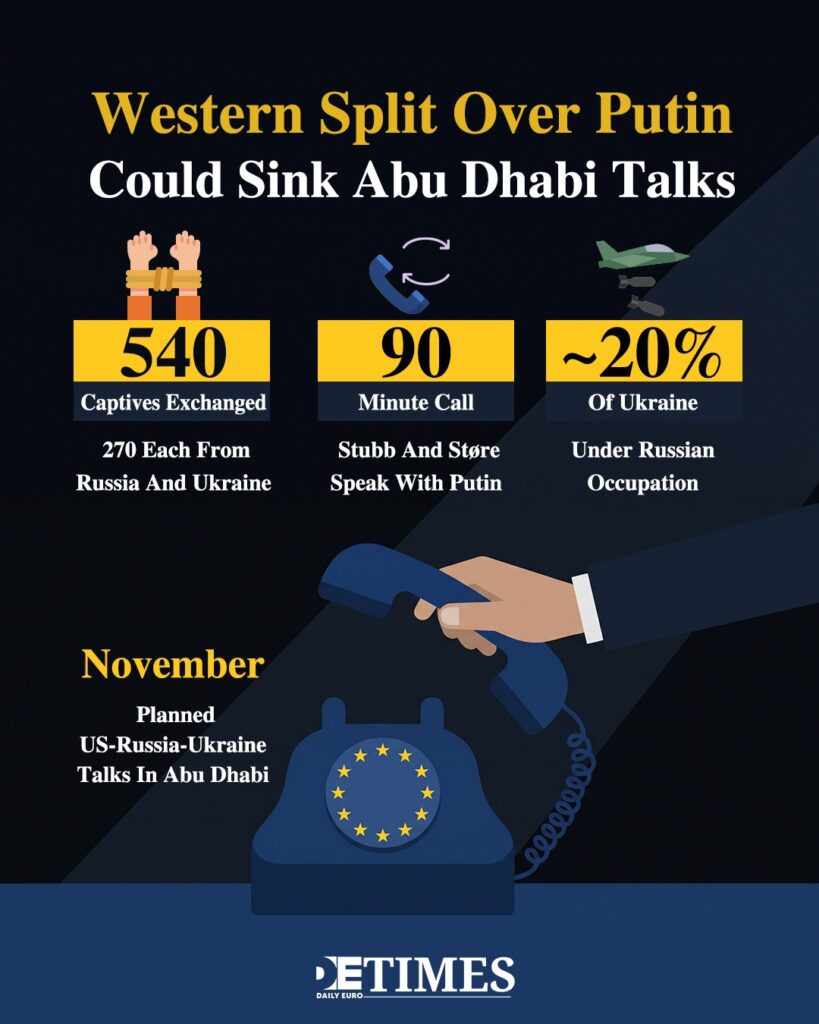
Russia and Ukraine freed 270 captives each last week after mediation by the United Arab Emirates. Moscow and Kyiv then confirmed trilateral talks with Washington in Abu Dhabi for the first half of November.
Negotiations had lapsed for months as Washington turned to its war on Iran, while a meeting expected earlier this month never materialised. Moscow still demands all of Donbas, and Kyiv refuses to cede territory it holds.
Abu Dhabi’s Convening Role
Emirati mediators have brokered repeated exchanges since the war began. The latest swap of 540 captives gave diplomats a tangible result before any delegation took a seat.
In February, the Emirati capital produced a 314-person swap, and Steve Witkoff admitted the exchanges were only a start with hard work ahead. Such patient hospitality builds trust where grander formats falter.
Zelensky has tabled an energy ceasefire, grain agreements and an all-for-all prisoner exchange as next deliverables, and he urges keeping sanctions until a settlement is signed. A final peace, he adds, requires a meeting of leaders, so Abu Dhabi can only prepare the ground.
The Controversial Nordic Call
The question of who speaks for Europe grows pressing. Finland’s president, Alexander Stubb, and Norway’s prime minister, Jonas Gahr Støre, telephoned Putin for 90 minutes this week, in consultation with Ukraine. Their readout said they spoke for their own countries only. Zelensky said the talks touched on the Abu Dhabi meeting.
The call divided the Nordic neighbours, as the Danish and Swedish prime ministers publicly questioned the call and Estonia voiced scepticism too.
Finland and Norway share a border with Russia and speak from experience. Unannounced diplomacy might nonetheless hand Moscow the divisions it prizes.
Putin has called for talks covering security for Russia, Ukraine and Europe overall. Such a framing gives Europe a stake in Abu Dhabi, and a reason to settle its quarrel before November.
Washington Undermines Its Own Table?
Europe’s disarray invites Washington’s rhetoric to fill the vacuum. Donald Trump declared recently, “I think it’s time for somebody else to negotiate on behalf of Ukraine.” He blamed Kyiv for higher diesel prices after Ukrainian strikes on Russian refineries, a grievance sharpened by midterm elections next week.
Ukrainians alone choose their leader, Zelensky replied, offering elections if Russia accepts a 60-day ceasefire.
Washington’s plan to flatter Moscow and distance itself from Kyiv might seem reckless as a route to leverage. Brookings scholar Michael Kimmage voices similar pessimism, judging progress hard to imagine without a defined White House agenda or serious pressure on Russia.
The United States defence secretary, Pete Hegseth, reportedly delayed Patriot interceptors from European allies, weakening Kyiv’s air defence as Moscow’s barrages intensify.
Experts Find Hope and Warning
Washington’s pressure splits expert opinion along predictable lines.
Optimists point to the front line, where the Institute for the Study of War assessed Putin’s year-end deadline for Donetsk as unattainable. Russian forces have still not taken Kostiantynivka after eleven months of fighting. Moscow, with roughly 20% of Ukraine occupied, therefore bargains from a weaker position than its demands imply.
Sceptics answer with Moscow’s conduct. Within hours of agreeing in principle to resume talks, Russia launched a deadly barrage of missiles and drones on Kyiv, and Putin rejects a temporary ceasefire. Kremlin spokesman Dmitry Peskov insists the resumed talks restrict no combat operations, although Moscow tolerates humanitarian truces.
Keep up with Daily Euro Times for more updates
Read also:
UAE Prisoner Swaps Are Building a Post-War Stake
Start to Finish: Ukraine Peace and Nuclear Arms Race
Ukraine: We Cannot End Up in a Quasi-Peace Deal