Europe has reassuring news for swimmers and its fresh water this summer. According to the latest bathing water assessment from the European Environment Agency, published jointly with the European Commission, 85% of the EU’s 22,289 monitored bathing sites met the highest “excellent” quality standard in 2025, 96% met at least the minimum required by the Bathing Water Directive, and only 1.5% were rated poor.
Coastal waters performed better than inland ones, with 88% classified as excellent against 78% for rivers and lakes. In public-health terms, those are strong numbers. The continent’s coasts and swimming areas remain broadly clean and usable, even in a hotter and more crowded season.
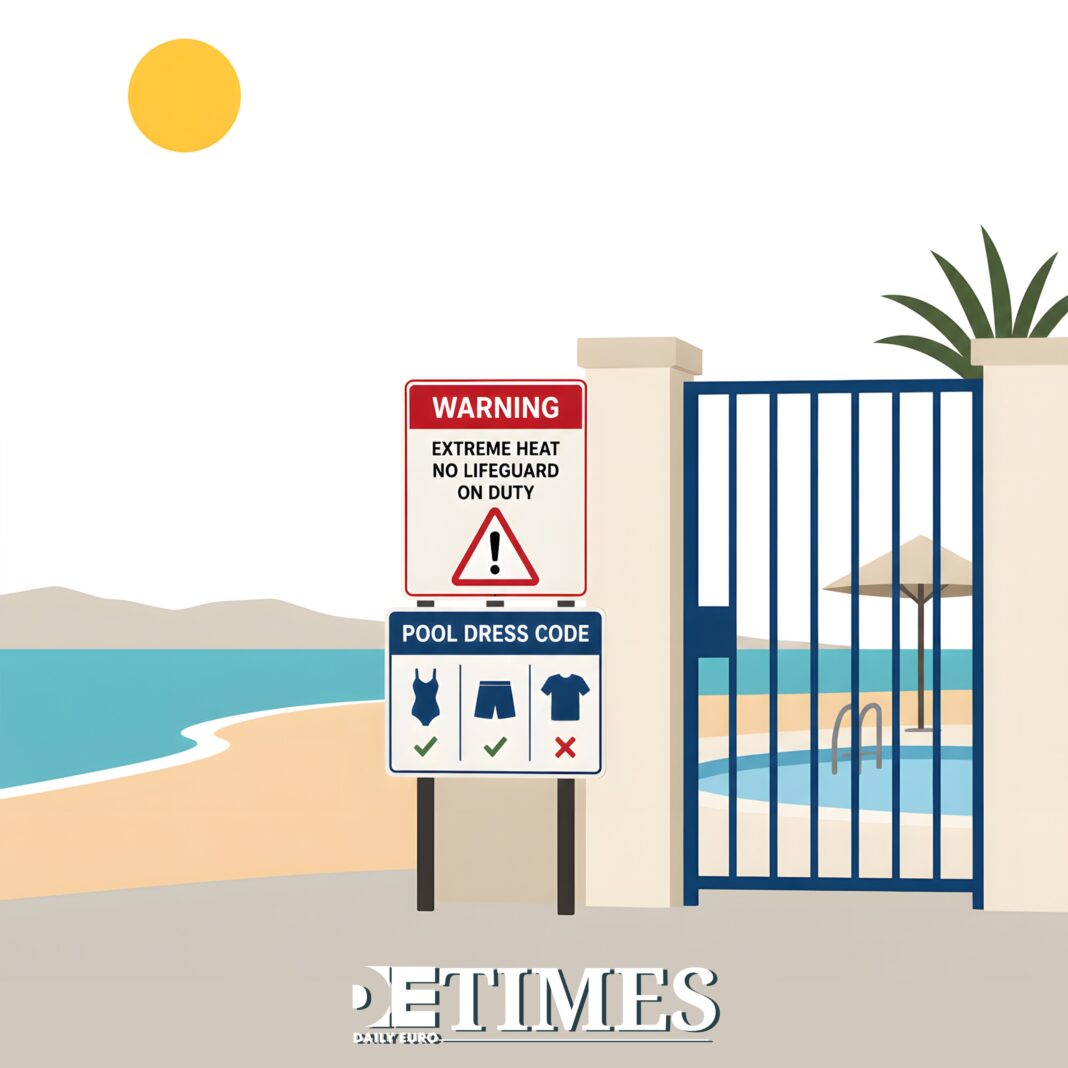
But safe water is only one layer of the summer experience. Once Europeans and tourists actually arrive at beaches and pools, they encounter a different kind of friction: not contaminated water, but growing social and legal arguments about who belongs, how bodies should appear, and what public bathing spaces are expected to tolerate. Three cases from this summer alone, in Italy, Austria and the Netherlands, illustrate how the rulebook around bathing has grown more contested at exactly the moment when heat is sending more people towards the water.
Water is Safe, the Social Codes Are Not Simple
The Italian case is the most intuitive.
The Lake Como village of Varenna, a fishing community of around 650 permanent residents that draws hundreds of thousands of tourists each year, has introduced fines of €50 to €200 for anyone found walking its streets bare-chested or in swimwear. Tour groups are now capped at 25 people and guides may no longer use loudspeakers. Mayor Mauro Manzoni said the village was proud of its popularity but insisted that “our residents’ quality of life cannot be sacrificed on the altar of mass tourism.” Swimwear is permitted on lakeside beaches, piers and boat docks. Anywhere else, it earns a fine.
The regulation sounds minor, but it illustrates a wider European impulse to turn public leisure into a carefully managed corridor of acceptable behaviour. Swimwear is normal on the beach but punishable in the street. Bodies may cool off, but only in the designated zone. In a heatwave, that tension sharpens: people want immediate relief, authorities want order, and the result is a growing moral geography of where the body may cool and how it must look whilst doing so. Varenna is not alone: Portofino, Sorrento, Gallipoli and Capri have all introduced similar restrictions in recent years, and Venice’s day-tripper fee returned for 2026 with more chargeable dates.
Modesty Rules and Equality Claims Collide
The Austrian case shows the conflict from the opposite direction.
The Salzburg State Administrative Court this week upheld fines against the managers of a hotel in St. Johann im Pongau after two Austrian Muslim sisters, Boshra and Jasmina Amasha, were refused access to the pool in burkinis during a stay in autumn 2025. The hotel’s managing director told the women they had to adapt to Austrian customs, reportedly saying that one might swim in a burkini “perhaps in Saudi Arabia, but not in Austria.” The local district authority fined each manager €100 in February 2026; the court dismissed the appeal and added €20 in procedural costs. It found that burkinis are made from the same materials as conventional swimwear and that the manager’s own statements constituted direct discrimination on religious grounds, not an indirect policy matter that might be justified under certain conditions.
Europe’s bathing rulebook does not only discipline those who wear too little. It also penalises those who wear more. The Austrian ruling pushes back against that instinct by making clear that access to leisure cannot be made conditional on conforming to one culturally dominant version of acceptable swimwear. The ruling does not set binding precedent at the federal level and can still be appealed, but it makes explicit that the growing rulebook can itself violate equality law. In a continent where far-right politics increasingly focuses on visible Muslim identity, a court drawing that line carries weight beyond the individual case.
Pools Also Reflect Europe’s Racial Fault Lines
The Dutch case adds a third dimension.
Henri Duiker arrived at the Watergeus municipal pool in Zoetermeer on the evening of 12 July 2024 to check that his 12-year-old son and a friend had safely made it to a youth disco swim event. Instead, he found his son detained at reception: staff had demanded a physical passport from the boy whilst his white friend had been waved through unchallenged.
Duiker complained on the day, was dismissed, escalated to the national anti-discrimination helpline and eventually won a ruling from the Netherlands Institute for Human Rights confirming that the operator, Optisport Zoetermeer, had used unlawful racial discrimination. The company’s chief executive subsequently apologised and wrote that the specific control measure “was abolished after that date.” Three city council parties filed formal questions demanding accountability from municipal officials.
The case triggered what the Guardian called the Dutch paradox: a society that defines itself through tolerance whilst often resisting acknowledgment of racism. Dutch Prime Minister Rob Jetten admitted at a slavery abolition commemoration that discrimination and racism were “still systematically present and deeply rooted” in the Netherlands. The pool case shows that the modern bathing rulebook is not only about clothes. It is also about scrutiny: who is assumed to belong without explanation, and who is treated as suspect. These are not secondary details. They shape whether public leisure feels genuinely public at all.
Safe Water is Not the Same as Easy Belonging
The clean-water data remains good news.
Europe has spent decades improving bathing quality, and the results are genuine. But safe water alone does not produce an easy summer commons. As heatwaves intensify, beaches and pools become more essential, not less, pushing more people towards the same spaces at the same time with different expectations of dress, identity and public behaviour. The issue is no longer chiefly whether Europe can offer clean places to cool off. It is whether those places are governed by a widening rulebook that falls unevenly on tourists, Muslims and racialised minorities.
Europe’s waters may be safe, but access to them is increasingly filtered through rules that are not socially neutral. Some target rowdy tourists. Some discipline Muslim visibility. Some operate through racial suspicion. The continent can still say, truthfully, that its bathing waters are mostly clean. What it can say less confidently is that the experience of using them is equally open, relaxed or fair for everyone.
The rulebook is growing. The question is not whether all rules are bad. It is whether Europe still knows how to let people cool off without turning every body at the water’s edge into a problem to be managed.
Keep up with Daily Euro Times for more updates
Read also:
Heat Drives Europe to the Water as Bacteria Follow
War Killed Mona Khalil and Erased Decades of Conservation
MENA-Asia Tourism Boom: Europeans Want Sophistication, Not Just Bling