

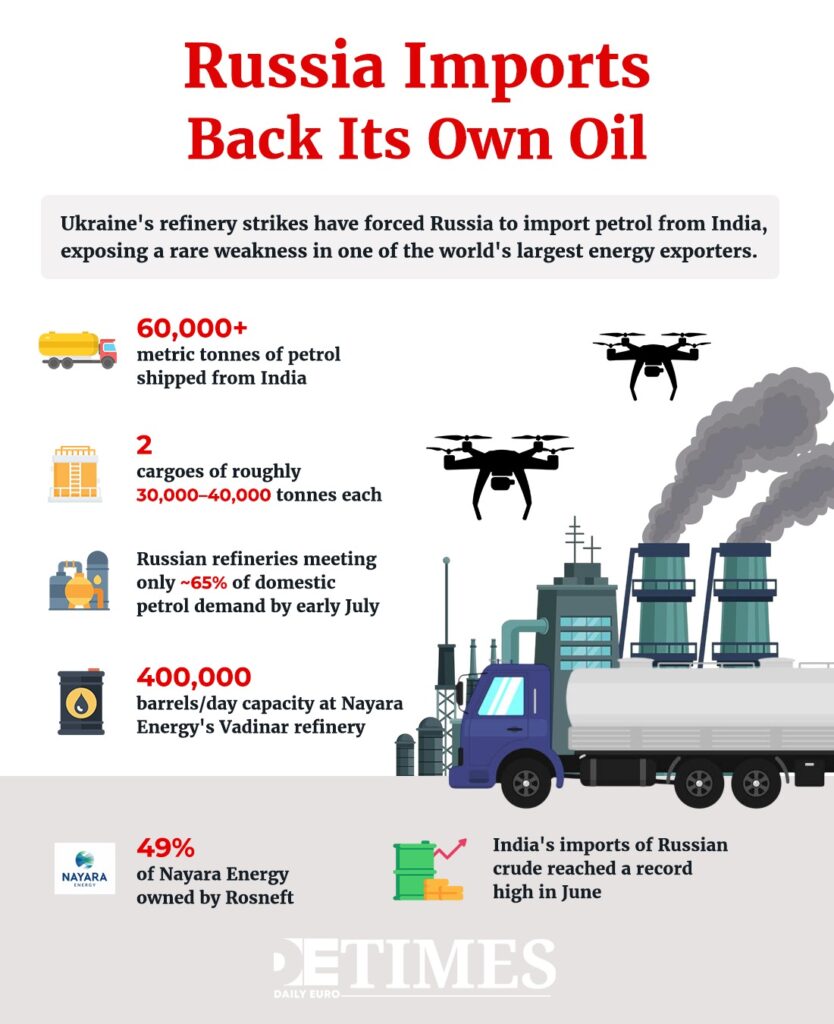
Russia has begun importing back oil from India by sea to relieve shortages caused largely by Ukrainian attacks on its refineries. Reuters reported that at least 60,000 metric tonnes had been dispatched, with two tankers carrying parcels of roughly 30,000 to 40,000 tonnes each.
A tanker invoice seen by Reuters showed that the vessel Agni, loaded with petrol from Vadinar, sailed for Fujairah on 20 June before LSEG data showed it had passed through Suez heading north. The shipments are remarkable not because Russia has run out of crude oil, but because one of the world’s largest petroleum exporters is struggling to convert enough of that crude into fuel for its own motorists.
The trade carries an additional irony. Indian refiners have spent years buying discounted Russian crude after Western sanctions redirected Moscow’s oil away from Europe. Some of that crude is now being processed in India and sold back to Russia as refined petrol. The supplier is understood to be Nayara Energy, which operates a 400,000-barrel-per-day refinery at Vadinar and has been running entirely on Russian crude since other suppliers backed out following EU sanctions imposed last July.
Rosneft owns 49% of Nayara. Indian Oil Minister Hardeep Singh Puri told reporters that Indian companies were not selling fuel directly to Russia, but acknowledged it was “possible” that Russia had purchased Indian-origin fuel from international traders.
Ukraine Has Found an Economic Pressure Point
Ukraine’s refinery campaign attacks the stage of the energy chain Russia cannot easily replace.
Russia may possess vast crude reserves, but crude oil cannot power an ordinary car until it has been refined. Repeated drone strikes, outages and emergency repairs have cut domestic petrol output whilst summer demand has remained high, with production by early July covering approximately 65% of domestic demand. India’s crude imports from Russia simultaneously hit a record high in June, according to ship-tracking data from LSEG and Kpler, driven partly by US President Trump’s decision to waive American sanctions on Russian oil already loaded onto ships, a move aimed at easing global shortages after the closure of the Strait of Hormuz.
The shortages have been felt across Russia’s eleven time zones through rationing, filling-station queues and steep price rises. Reuters reported that disruption had spread from occupied Crimea and southern Russia to regions previously shielded from it, including Moscow. This does not mean Ukraine has crippled Russia’s entire energy system. Moscow still exports crude and refined products, retains substantial reserves and can seek supplies from Belarus, Kazakhstan and Asian markets.
But the attacks have imposed exactly the kind of awkward domestic cost the Kremlin has worked to shield citizens from.
India Benefits From the Reversal
For India, the arrangement is commercially straightforward.
Its refiners buy Russian crude at favourable prices, process it and sell higher-value products wherever shortages create demand. New Delhi does not need to endorse Moscow’s war to profit from the rearrangement of global energy flows. The trade also demonstrates the limits of sanctions as a simple isolation mechanism: Russian oil did not disappear from international markets. It changed routes, passed through new refineries and returned in altered form. India has become not merely a customer for Russian crude, but an increasingly important processing and trading centre within the wartime oil economy.
Yet that does not make Moscow the winner. Russia is paying external refiners and shipping costs to obtain a product it previously manufactured in abundance at home. Nayara has itself faced financial pressure since the EU sanctions, relying on dark-fleet vessels and running its Vadinar refinery at 70-80% capacity whilst its export markets contracted. The circular trade is a symptom of a war economy distorting global energy flows in multiple directions simultaneously.
The Strategic Symbolism is Real
The quantities imported from India remain modest compared with Russia’s overall fuel consumption, and Moscow is simultaneously seeking tens of thousands of tonnes from Kazakhstan and record volumes from Belarus whilst considering export restrictions and temporarily lower fuel-quality standards.
Russia built much of its wartime confidence on the claim that sanctions had failed and that its energy power remained intact. Importing petrol refined from its own crude complicates that story in ways domestic propaganda cannot easily explain away.
Ukraine has not stopped Russia from selling oil. It has shown that an oil power can still be made vulnerable at the refinery gate. Moscow’s Indian purchases are therefore more than an emergency trade measure. They are evidence that the war is beginning to distort ordinary Russian life in ways that crude-export statistics alone do not reveal, and that the distance between Russia’s energy superpower narrative and the reality at its petrol stations is growing wider.
Keep up with Daily Euro Times for more updates
Read also:
Made with Plasma: Russia’s New Mission to Mars
Relations in the Rear View For Now: The U.S.-India Diplomatic Crisis
West Overlooks Russian Grain and Borders in Ukraine