

Emmanuel Macron answered Andy Burnham’s Brexit remarks in English from Madrid on Wednesday, telling Britain it would be welcome back. The prime minister had told his party’s conference a day earlier that leaving the EU had done “more harm than good”. He then told the BBC that Britain could “go all the way” and rejoin, a step that breaks a taboo among British prime ministers.
Burnham plans to set out his options around a UK-EU summit in Brussels in November, while the next general election is not expected until 2029. The debate is therefore about positioning for that campaign, since no application, referendum or negotiating mandate exists. Paris and Madrid have responded warmly, but nobody in Brussels has anything formal to answer.
Burnham Opens a Once-Closed Door
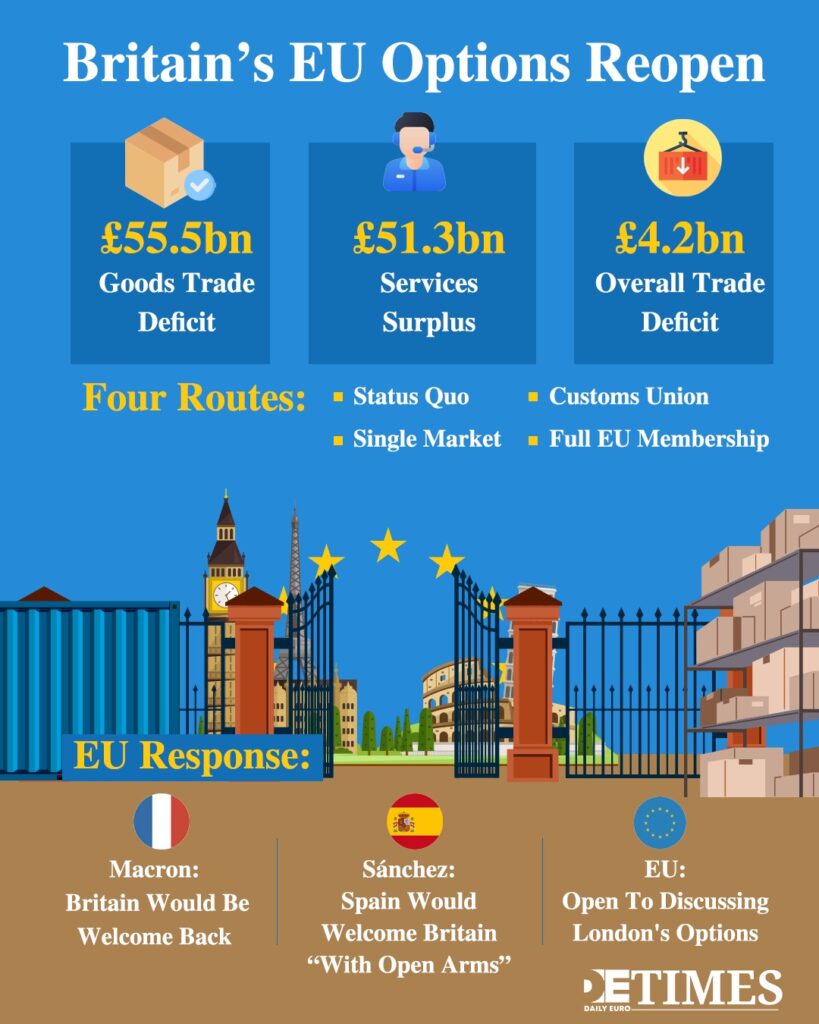
Burnham laid out a spectrum on BBC Radio 4, from staying as Britain is to Osborne’s customs union, the Liberal Democrats’ single market or full membership. He has also stressed that he will honour Labour’s 2024 manifesto during this parliament, which rules out the single market and a customs union. AFP reported that his comments suggest he plans to drop some of those red lines before the next campaign.
Public opinion gives him cover. A recent YouGov survey put support for rejoining at 56 per cent, although support tends to fall when respondents face specific membership conditions. Opponents have already called the shift a trick, with Reform UK’s Richard Tice accusing Burnham of sneaking Britain back into Brussels through the back door. Conservative deputy leader Alex Burghart accused him of looking backwards.
Paris and Madrid Offer Warm Words
Macron called a British return good news for both sides, and Pedro Sánchez said Spain would welcome Britain back with open arms. A Commission spokesperson told Bloomberg that the bloc remains open to engaging on whatever options London puts forward. The warmth came with a condition, as Macron warned: “You cannot pick and choose among the Union’s freedoms.” That warning goes to the heart of the dispute that dominated the 2016 withdrawal talks, when single-market access was tied to free movement and common rules.
A formal return would run through Article 49 of the Treaty on European Union, which requires unanimous approval from the member states before accession can be completed. Britain could not assume that its former euro opt-out, place outside Schengen or budget rebate would return automatically, because any terms would have to be negotiated again. Existing members would hold considerable leverage over those terms, and talks would probably take years. Macron and Sánchez cannot speak for the other 25 governments.
Middle Options Draw Closer Scrutiny
A customs union, which former Conservative chancellor George Osborne has recently backed, would remove many barriers to goods trade without restoring free movement or a British vote on EU law. Single-market participation would go further, resembling the Norwegian model, with broad access in exchange for adopting much EU legislation and accepting free movement. Both routes would force Labour to abandon the red lines it wrote into its 2024 manifesto.
A further idea comes from Brussels, where Ursula von der Leyen invited Canada on 16 September to become the EU’s first “associate member”. Nobody has defined what that status would involve, and Prime Minister Mark Carney has said Canada does not seek full membership. NPR reported that some EU governments were angry at not being consulted, which shows how far unanimity is from guaranteed. Britain’s size and history as a former member would make any comparable arrangement unusually complex.
Growth Complicates Both Arguments
The Office for National Statistics revised second-quarter growth up from 0.4 to 0.5 per cent on Wednesday, after 0.6 per cent in the first quarter. Real GDP per head also rose 0.5 per cent in the quarter, and household disposable income per head rose 1.0 per cent. ONS comparisons put Britain second among the G7 economies for the quarter, behind Canada.
Those figures undercut the claim that Britain must rejoin because its economy is failing outside the bloc. Yet the goods trade deficit still stood at £55.5 billion in the same quarter, only partly offset by a £51.3 billion services surplus, according to the ONS. Two good quarters cannot settle an argument about trade friction that unfolds over years, and neither side can claim the data as a verdict. Welcoming words cost Paris and Madrid nothing, and Burnham’s options cost him nothing until he names one.
Keep up with Daily Euro Times for more updates
Read also:
Burnham Uses Manchester’s Music to Build His Own Political Brand
Europe Cannot Decide How Much It Wants Canada
Warsaw’s Pump Relief Leaves Security Unbought