
An estimated 350,000 to 400,000 people gathered at Letná in Prague on Sunday 15 November to oppose a plan to scrap licence fees for Czech Television and Czech Radio. The civic group Million Moments for Democracy organised the rally, under the slogan “Never again 4:36”.
The slogan refers to the early-morning vote that sent the bill forward. The protest suggests the dispute has outgrown the question of money.
A Funding Plan Under Fire
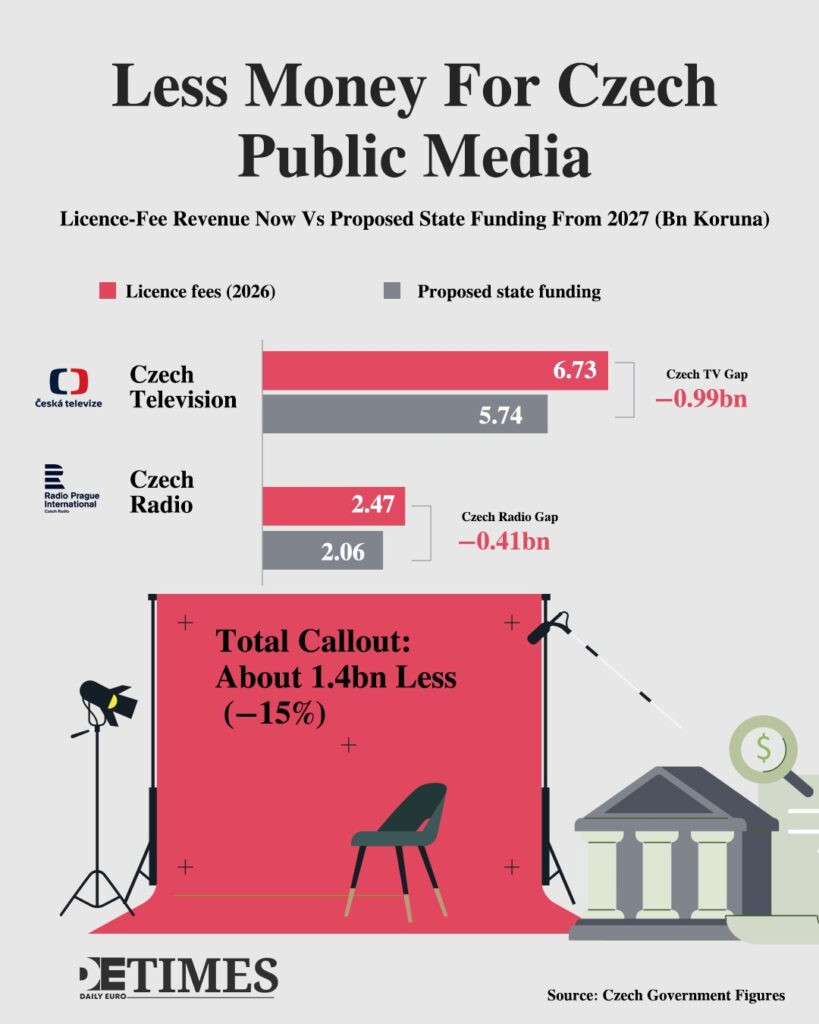
Households pay 150 koruna a month for television and 55 for radio, or 205 koruna in total, about €8.40. The government of Prime Minister Andrej Babiš wants to replace the fees with money from the state budget from 2027.
Czech Television’s fee revenue is 6.73 billion koruna this year and Czech Radio’s 2.47 billion. The plan would give them 5.74 billion and 2.06 billion, about 1.4 billion less, or roughly 15 per cent.
The government says the fee system is outdated and disadvantages some social groups, and that public media are state-funded in 17 EU member states. Babiš argues that legally guaranteed payments and an inflation-adjustment mechanism would protect broadcasters from arbitrary cuts.
The International Federation of Journalists warned that budget-dependent funding resembles models in Hungary and Slovakia, and the European Broadcasting Union has also criticised the plan.
Prague Protest Puts Babiš on the Back Foot
How the Vote Fuelled the Protests
The bill passed its first reading at 4:36 a.m. on 24 October after the ANO, SPD and Motorists coalition prioritised it and limited speeches. More than 60 opposition deputies could not speak.
Employees of both broadcasters announced a strike for 3 November, after an earlier strike disrupted programming for 24 hours in June. A petition had gathered more than 175,000 signatures by May.
Protesters at Letná demanded that the SPD, led by Tomio Okamura, leave the government, and students, theatres, writers, athletes and churches backed them. ANO’s Radek Vondráček called the organisers “an association of professional agitators”, and ANO’s Patrik Nacher said in May the government is “determined to fulfil that promise”.
The bill now goes to committee and a second reading, and existing fees stay in place until it passes.
Serbia as a Comparison
Serbia offers a comparison, though the two cases differ. Its protests began after the collapse of a station canopy in Novi Sad in November 2024, which killed 16 people, while the Czech protests concern a funding law.
The European Commission’s 2025 report found the ruling majority received 94 per cent of airtime on the main public broadcaster’s central news in 2024. The opposition received 6 per cent.
Serbia’s Student List then won a parliamentary majority on 25 October, and President Aleksandar Vučić conceded defeat.
The comparison is limited, since Serbia’s broadcasters were already accused of bias before the protests. Czech Television and Czech Radio keep their licence-fee funding for now. The outcome will depend on whether the government amends the bill or pushes it through.
Keep up with Daily Euro Times for more updates
Read also:
Europe’s AI Factories: Strategic Autonomy or Public Bubble?
Belarusian Spy Network Uncovered in Europe
Water as the New Oil: Europe and Morocco Deepen Cooperation