
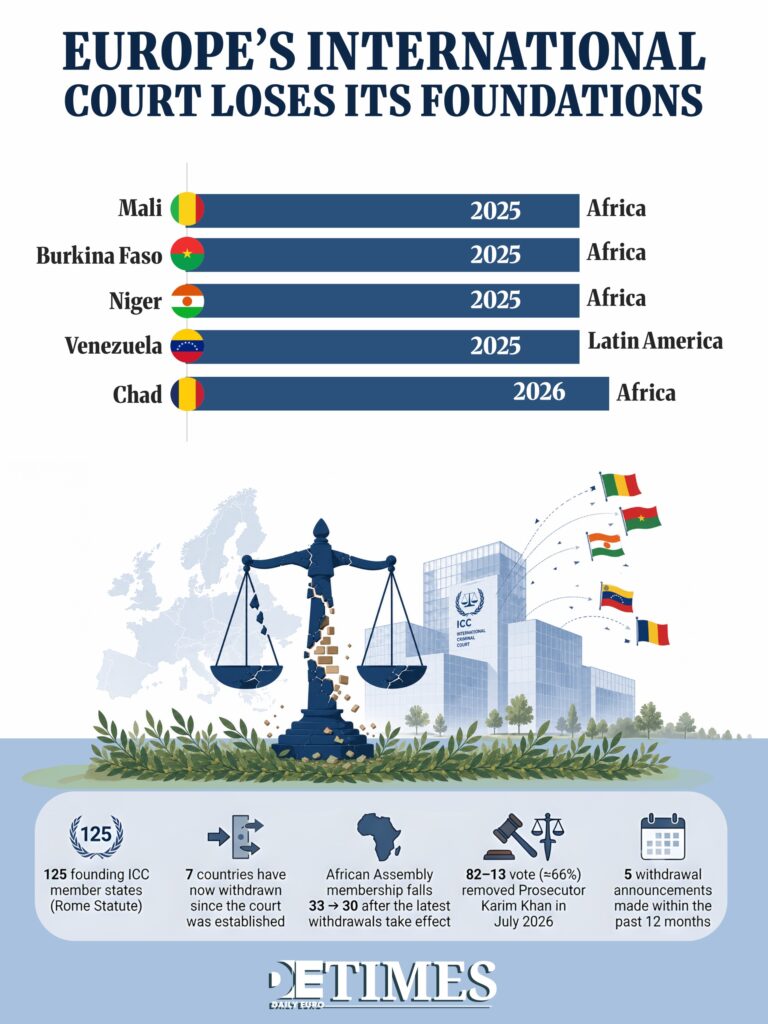
Chad’s foreign ministry notified the United Nations secretary-general on Monday that it would leave the International Criminal Court, describing the tribunal’s record as “limited and uneven.” Chad is the fifth country to start withdrawal within twelve months, after Venezuela, Mali, Burkina Faso and Niger left in turn.
European diplomats wrote the Rome Statute in 1998 and built a permanent tribunal on the legal foundations laid at Nuremberg, extending a continental tradition of codified justice worldwide. Membership always stayed voluntary, so the court’s standing rested only on countries choosing to remain, without any power to compel them.
Five departures in a year, a prosecutor’s removal by his members, and a public quarrel between Washington and Paris at the United Nations put Europe’s inheritance to a real test.
A Court Loses Its Members
The withdrawals did not start with Chad. Military rulers govern Mali, Burkina Faso and Niger and together form the Alliance of Sahel States. Those governments jointly declared their departure last September and called the court a neo-colonial instrument.
Venezuela announced its exit days later, citing “geographical bias” against the Global South, amid the tribunal’s investigation into crimes against humanity under President Nicolás Maduro’s government.
Burundi and the Philippines left earlier, and the tribunal now counts seven departures against a founding membership of 125 states.
The African bloc inside the assembly shrinks from 33 members to 30 once the newest exits take legal effect.
Washington Turns Pressure Into Policy
The exits do not stand apart from American conduct toward the court. Secretary of State Marco Rubio pledged to dismantle the tribunal “brick by brick.”
Washington has since sanctioned several judges and prosecutors over their work on Palestinian and Afghan cases, and the sanctions froze one Canadian judge out of ordinary financial life entirely.
Chad’s own foreign minister denied acting on American instruction, even as his ministry acknowledged a senior American diplomat had urged Chad to reconsider its membership days earlier.
The gap between denial and disclosure confirms how hard it now is to separate sovereign choice from external persuasion.
Prosecutor Removed Amid Disarray
American pressure now meets a tribunal already without a prosecutor to lead it. Member states voted 82 to 13 on Friday, about 66% of the assembly, to dismiss Karim Khan over findings of serious misconduct, the first such removal in the court’s working life.
Khan has said he will contest the decision before the International Labour Organisation’s tribunal, a process that could stretch on for months.
Two deputies now run the prosecutor’s office, and states parties still must design an election procedure, with no vote likely before the new year.
Paris And Washington Trade Public Words
The prosecutor’s removal came days before a separate quarrel spread well past the court itself.
American diplomats walked out of a Security Council session on Monday as France’s ambassador addressed the chamber. This followed a weekend exchange between the two governments.
France’s Geneva mission had accused Washington of standing isolated alongside North Korea, Nicaragua, Mali and Russia over its vote against renewing the UN human rights chief.
An American envoy dismissed the objection as “politicized drivel” and pledged to keep walking out until France withdrew the remarks.
What Europe Built Now Frays
France’s public feud with Washington is not its only exposure this year. Its diplomatic standing already carries damage from further south, where its retreat from the Sahel left a security vacuum, and Russian involvement never filled it.
Regulatory reach, security presence and legal authority form one fabric for Europe’s claim to set global rules, and a tear in one strand weakens the others.
Brussels called threats against the court “not acceptable,” though declaratory support cannot replace the membership Europe already lost or the enforcement power the institution still lacks.
Uncertain Search Ahead
Declared support without real leverage defines the search for a new prosecutor. The ICC’s next leader will take office under American sanctions, a shrinking membership and no fixed calendar, conditions likely to determine which candidates even apply.
Europe’s governments now must choose between defending the court as a universal project, in public and in funding, or watching it settle into a regional body with a smaller voice.
Keep up with Daily Euro Times for more updates
Read also:
When Justice and Memory Collide: Netanyahu and the ICC
Sahel Grows Increasingly Hostile Towards Foreign Powers
Arrested, Duterte Heads to the Hague