
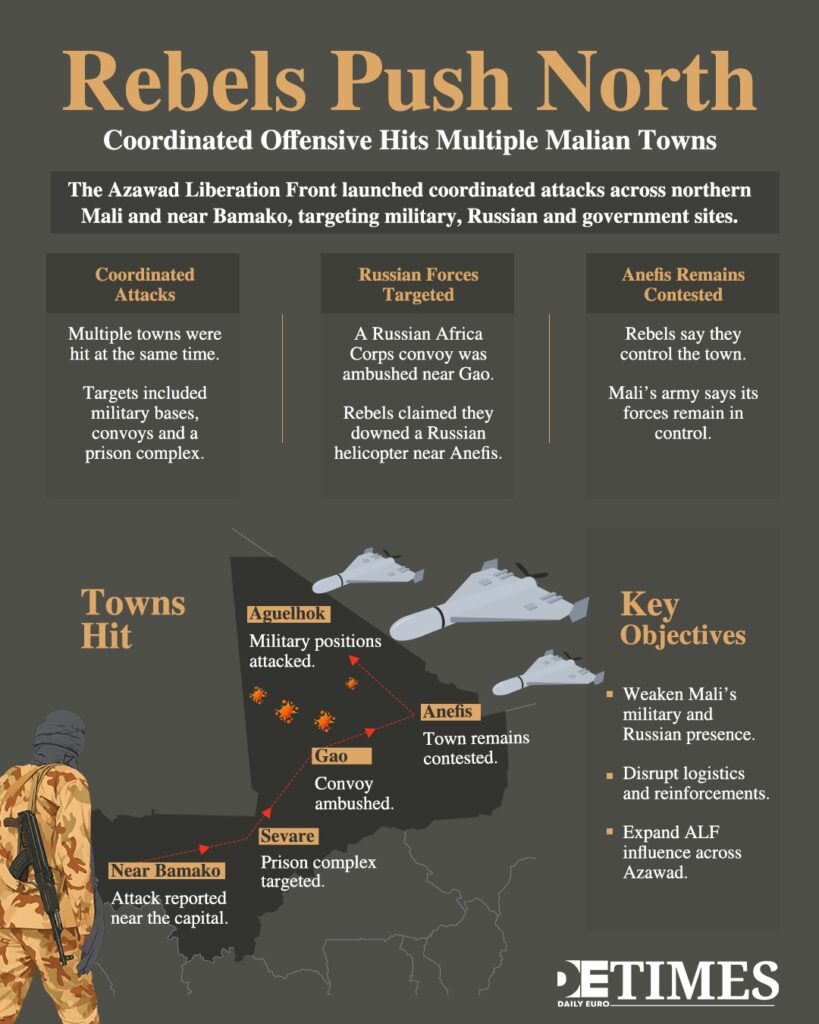
Fighters from the Azawad Liberation Front ambushed a convoy of Russia’s Africa Corps that had left the city of Gao toward Anefis to reinforce a surrounded Russian and Malian camp, and separately claimed to have downed a Russian helicopter nearby.
The ambush formed one strand of a coordinated offensive that hit multiple Malian towns simultaneously, including Gao, Anefis and Aguelhok in the north, plus Sevare and a prison complex near Bamako.
Days later, Anefis stayed disputed, with a regional official saying that rebels controlled the town while Russian personnel remained entrenched in a camp there, and Mali’s army insisting otherwise.
The assault followed April’s fall of Kidal, in which rebel forces first broke Malian and Russian control across the north.
Mali’s crisis now unfolds alongside two other ruptures. Burkina Faso has broken with France, and the Alliance of Sahel States has begun leaving the International Criminal Court. These decisions raise a question of whether three landlocked countries can defeat an entrenched insurgency without any outside coalition.
Sovereignty Severed From Paris
Burkina Faso severed diplomatic ties with France with effect from 26 June, accusing its former coloniser of neo-colonial ambitions.
The three military-led governments had already left the regional bloc ECOWAS, cutting another line to neighbours who once mediated crises of this kind. Communications Minister Gilbert Ouedraogo said conditions of mutual respect and non-interference no longer existed, though he stressed the decision spared ordinary French citizens.
Paris called the decision hostile and unfounded, reserving reciprocal measures and leaving France with almost no formal presence across the AES bloc.
Leaving The Hague Behind
Mali, Burkina Faso and Niger deposited formal notifications of withdrawal from the Rome Statute with the UN Secretary General between 18 and 24 June, a process that takes effect one year from the dates of notification.
Amnesty International’s regional director warned the departure risks denying thousands of victims any prospect of truth or reparations. AES governments describe the court as a neocolonial instrument and propose an alternative Sahel Criminal Court for Human Rights, to be based in Mali.
A Force Built Without Donors
Since December the three states have fielded a Unified Force drawing on funds from Burkina Faso’s Patriotic Support Fund, Niger’s Solidarity Fund and Mali’s Support Fund for Basic Infrastructure rather than Western donors.
The arrangement was meant to avoid the funding collapse that ended the earlier G5 Sahel coalition, and its command lets Burkinabe General Daouda Traore deploy troops across borders without approval from national staffs.
Solidarity Untested By Battle
The Unified Force stayed largely inactive during April’s assault on Kidal. Mali’s President Assimi Goita appeared publicly only on the fourth day after the attacks, alongside the Russian ambassador and four Russian generals rather than his Burkinabe or Nigerien allies.
Russia’s own position has weakened too. Africa Corps negotiated a safe-passage agreement to evacuate its personnel from Kidal under rebel escort, and Russian state-linked media reported that Moscow ordered the evacuation of non-essential staff from Mali as JNIM and the FLA opened a new offensive around Anefis.
What Bamako Must Now Decide
None of Mali’s regional partners, and none of its Russian patrons, offer any guarantee against further losses.
The trio stand before a strategic choice between deepening domestic mobilisation and quietly courting new partners in China or Turkey, options that carry a lower political price than renewed Western support.
Neither JNIM nor the ALF have the logistical strength to hold large swathes of territory indefinitely, which leaves room for the AES to regroup if its Unified Force finally becomes operational rather than ceremonial.
The expectation for the months ahead is neither collapse nor victory, but a grinding contest in which Sahel leaders discover whether sovereignty, once claimed, can be defended without the coalitions they have spent three years dismantling.
Keep up with Daily Euro Times for more updates
Read also:
Mali Crisis: Patchwork Insurgency Challenges Sahel Confederation
Black Winter: Sahel Power Calculus and Global Security Partnerships
Sahel’s New Power Broker Speaks Nuclear