

From Sunday, tech firms operating inside the European Union must label any content their systems generate or substantially alter, under Article 50 of the bloc’s artificial intelligence law.
With heavy fines threatened for firms that ignore it, the obligation covers chatbot replies, synthetic images and altered video. Brussels wants a European public able to tell real material from machine output at a glance.
The demand for reassurance stretches across classrooms, parliaments and financial markets, each testing how much confidence artificial intelligence can still claim.
Small Cracks In Everyday Confidence
Two recent incidents explain why that confidence has grown so hard to sustain.
A history lecturer in Mississippi hid the word Madagascar in white font inside a midterm prompt. Thirty-two of his thirty-five students copied the word straight into their answers, having outsourced the task to a chatbot.
And one Canadian lawmaker in New Brunswick read aloud an editing instruction meant for an AI assistant, joining his own remarks to a machine’s stage directions without appearing to notice.
Fraud played no part in either case, and audiences were left wondering how much of what they read or hear starts with a person at all.
Governments themselves increasingly lean on synthetic voices to project authority, a habit that blurs the line Brussels hopes to police.
Capital Keeps Flowing Into Data Centres
The blurred line is now visible across financial markets, where the amounts involved are larger by orders of magnitude.
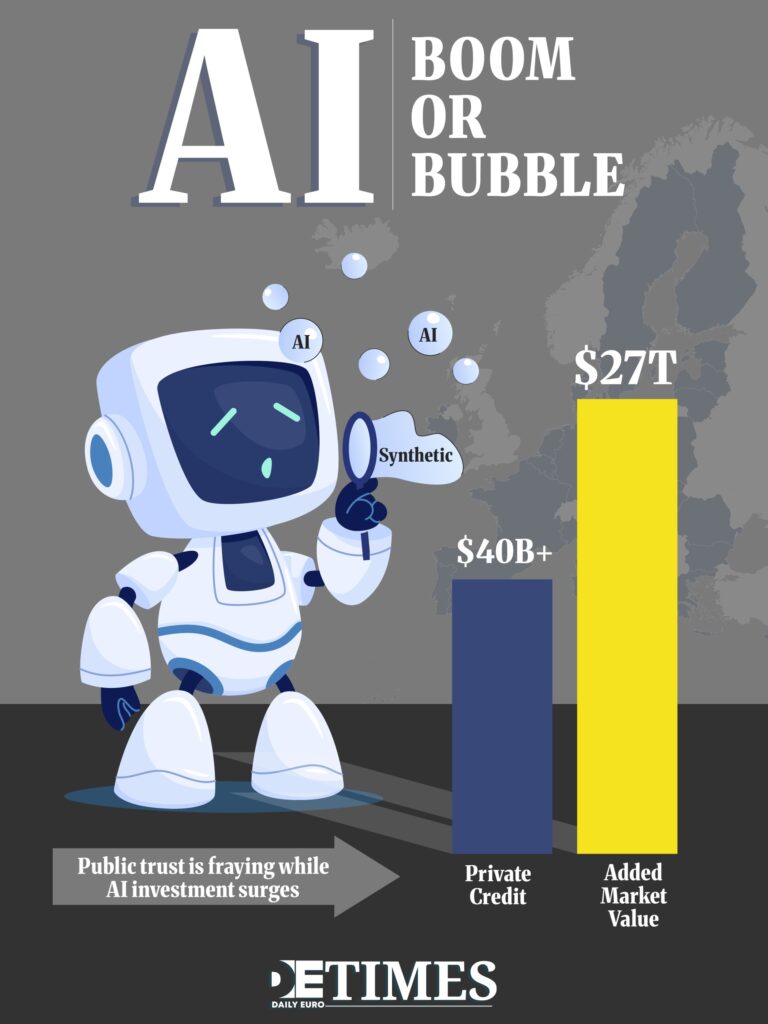
Private lenders advanced AI-related credit that grew from about three billion dollars in 2010 to more than forty billion by 2025, according to Bank for International Settlements research. Circular deals mixing equity, debt and supplier contracts have left assets pledged more than once across an interconnected web of firms.
Capital expenditure on AI infrastructure is driving a striking share of American economic growth, leaving the wider economy vulnerable to any slowdown in a single sector.
A Watchdog Weighs The Odds
Officials charged with financial stability have started to say so aloud. John Schindler, secretary-general of the Financial Stability Board, said that the surge in AI valuations resembles the exuberance seen ahead of the dotcom crash and the 2008 crisis. “We might be seeing that now,” he said, recalling how mortgage prices once climbed on similar optimism.
Goldman Sachs research puts the market value gained by AI-related firms at roughly twenty-seven trillion dollars since November 2022, an amount that dwarfs the entire dotcom rally.
Some economists find the comparison overstated, holding that AI investment stays concentrated enough in technology to keep any correction confined mostly to that one sector.
Apple’s Decision to Hold Back
One company has already positioned itself for either outcome. Apple briefly touched a five-trillion-dollar valuation on Tuesday, becoming only the second firm in history to reach that threshold after Nvidia.
Investors rewarded the company for spending far less than rivals on data centres and chips, turning instead to partnerships such as its arrangement with Google for Siri’s underlying models. Its restraint, once treated as a weakness, now reads to some as insulation against a downturn elsewhere in the sector.
What a Burst Might Bring
Apple’s insulation only counts because a downturn remains a live possibility. Researchers at Oliver Wyman describe two broad routes open to a correction. One is an equity slide that deflates valuations quickly, the other a debt-driven version that spreads losses through banks and private credit funds.
Wharton’s Itay Goldstein notes that a bubble forms only once asset prices climb well above any reasonable estimate of value, a threshold many believe AI stocks have passed.
Economists at the World Economic Forum add that any bursting bubble transfers wealth from later buyers to earlier sellers, leaving pension funds and retail investors among the most vulnerable.
Regional economies built around new data centres in Virginia and Iowa would absorb a slower, more localised version of this shock.
Grounded Expectations Going Forward
None of the scenarios above point to a certain outcome, only a range of plausible ones. European regulators have chosen disclosure over prohibition, hoping that visible labels will restore some of the confidence recent incidents have eroded.
Financial watchdogs can only monitor leverage and hope firms disclose their exposure honestly before any downturn takes hold.
Keep up with Daily Euro Times for more updates
Read also:
Does Britain Need a Ministry for Artificial Intelligence?
France, Germany Seek Software Success After Jet Failure
Norway Pulls Children Back from AI