

Marriott opened 170 hotels across Europe, the Middle East and Africa last year and signed over 230, nearly half of them existing buildings that took its flag. The regional total also includes hotels switching between chains, so it overstates the independents among them.
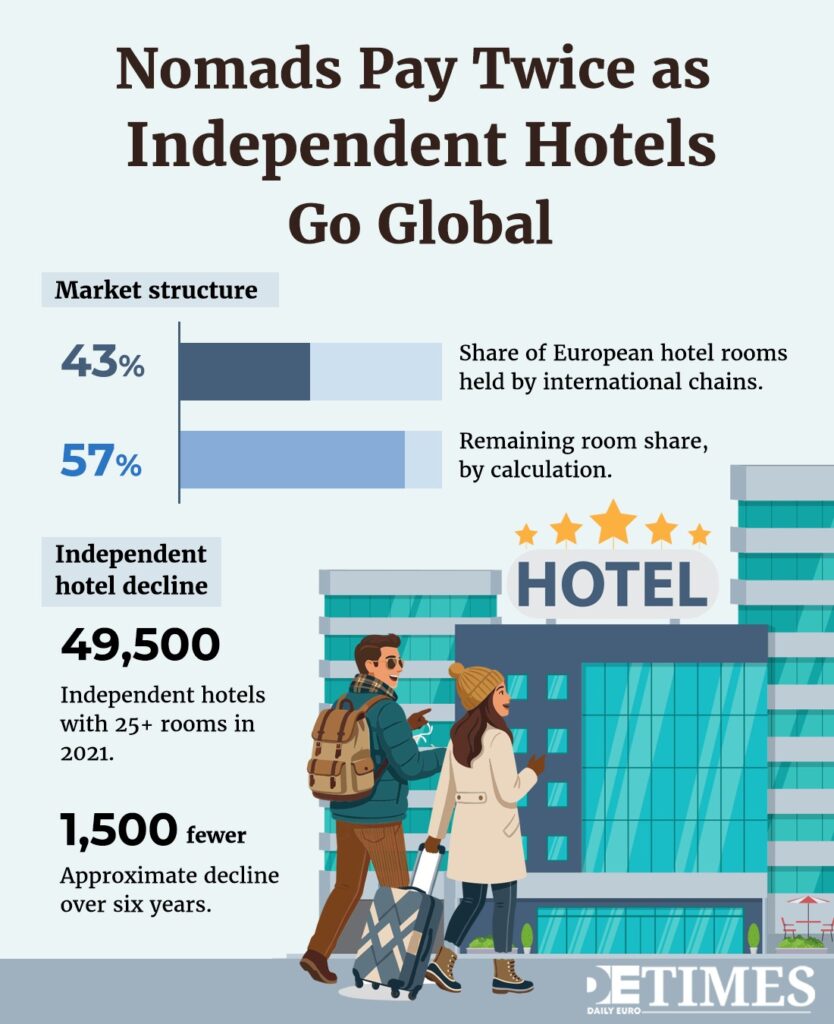
Chain hotels already hold 43% of hotel rooms in Europe. Independent hotels with 25 rooms or more numbered 49,500 in 2021, down by roughly 1,500 over six years.
Independents still outnumber chain properties by roughly 3.5 to 1, though the ratio keeps eroding. Four international groups reportedly account for almost half of Europe’s new hotel construction projects, and the pipeline holds over 1,700 projects and 260,000 rooms.
Owners who hand their flag to Marriott, Hilton or Accor behave rationally, and as a consequence, the hotel market is tilting towards affluent guests. Budget travellers and digital nomads inherit the squeeze, in streets where protesters already blame visitors for rising rents.
Why Owners Hand Over Their Keys
Distribution explains the rush. Marriott’s own data for 130 sampled Autograph Collection hotels put loyalty members at 66.9% of occupied rooms, once free nights on points are excluded. Members who earned points on a paid stay produced 63.9% of all room revenue, at an average of $298 a night.
Marriott’s own website delivered 47.3% of bookings at those hotels, a channel that carries the chain’s negotiated terms. Behind it stands a loyalty programme Marriott puts at about 271 million accounts across over 9,700 hotels.
An independent hotelier in Bavaria or Provence cannot assemble such an audience alone. Online booking platforms, the earlier remedy, replaced one dependence with another. Booking.com remains a valuable distribution partner for independents and a major source of dependency at once, which leaves owners hunting for a second source of guests.
Affluent Guests Chase the Flag
The collection brands sell a simple bargain, in which owners keep the name and borrow the machinery. Hilton’s two collection brands each passed 200 open hotels in June, with Curio alone spanning 47 countries. InterContinental Hotels Group launched a 21st brand, Noted Collection, built for conversions.
Accor’s Handwritten Collection reached 50 operating hotels in June and has since added five Verdi Hotels, including properties in Malta and Portugal. In October, Madrid’s Casa Verbena joined Hilton’s Outset Collection, a neat example of neighbourhood charm acquiring a global reservation engine.
Wealthy travellers drive the appeal. Many affluent guests prefer boutique properties tied to local territory over standardised chains, according to one luxury travel study. The chains package authenticity and perhaps sell it back at a premium. The same study notes wealthy visitors increasingly bypass big cities, which may send chain capital towards smaller destinations and the independents already operating there.
Budget Travellers and Nomads Pay Twice
In evidence, cheaper rooms are the first casualty. Palma has built a 50-million-euro fund to buy and remove outdated hotels, typically cheaper properties that attract budget tourists. Such a policy removes the beds that budget visitors fill.
Protesters in Barcelona chanted “Your holidays, my misery” last year. In Venice, residents opposed two new hotels adding about 1,500 beds in an area that had been hotel-free, a precise illustration of new rooms provoking older neighbourhoods. Barcelona has promised to bar tourist apartment rentals by 2028, which probably pushes demand towards the hotels that chains increasingly control.
Spain’s tourism sector, which supports around 13% of national output, topped a recent study of resistance to mass tourism. Spanish authorities have acted against over 65,000 Airbnb listings, which may leave hotels holding a larger share of the market.
Digital nomads meet a similar squeeze. Spain tops a 2026 index of nomad visa programmes among 50-plus competing countries, and Germany is expected to add one later this year. Portugal’s D8 visa asked for at least €3,280 a month last year, and some reports point to governments lifting income thresholds and tightening housing checks.
Chains will keep signing independents, since owners gain booking power and guests gain loyalty points. Budget travellers are expected to drift towards off-season trips, secondary towns and the shrinking stock of modest hotels.
Keep up with Daily Euro Times for more updates
Read also:
To Trial: Hotels Take Booking.Com to Court for Price Fixing
Greece Café Buzz: Locals Cannot Foot the Bill
Thailand Halves Visa-Free Stays to Reclaim Migration Control