

Yulia Svyrydenko resigned as Ukraine’s prime minister on Sunday, five days short of a full year in the post. President Volodymyr Zelenskyy called it part of a wider government reshuffle and offered Svyrydenko a new role linked to relations with a close partner.
Svyrydenko, a former economy minister, had helped negotiate the minerals agreement binding Washington’s interests to Kyiv’s defence.
The outgoing premier’s departure sits within a season of small, tentative openings across the eastern edge of Europe. Svyrydenko’s own resignation statement pointed to the same goal, voicing readiness to help secure a lasting peace for Ukraine.
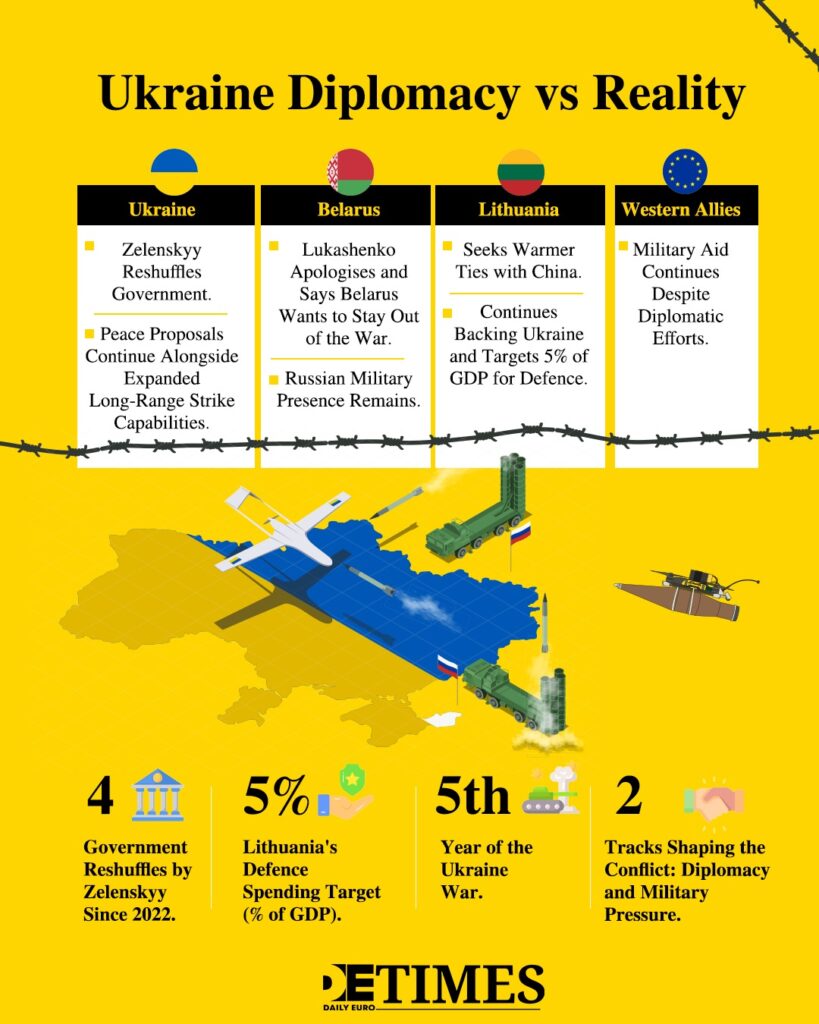
Kyiv’s leadership churn, a Belarusian apology and a Baltic reach towards Beijing hint that some actors around the war now prefer an end to further escalation. Weapons still flow into Ukraine from Europe and the United States, and this flow tells a more cautious account.
Zelenskyy Reads Peace in Kremlin’s Ranks
Zelenskyy said this week that Ukraine’s peace proposals draw support from partners abroad and from voices inside Vladimir Putin’s own circle. Zelenskyy linked the claim to a widening gasoline crisis inside Russia, calling it a fair response to Putin’s refusal to end the war.
Ukraine’s foreign minister, Andrii Sybiha, has separately said Kyiv’s proposal gives the Kremlin a way to avoid the collapse of its own regime.
The evening address included news of a newly signed decree establishing a dedicated command for long-range strikes against Russia, a detail that undercuts any sense of imminent restraint. Such statements carry an obvious incentive for Kyiv, since projecting confidence about wavering Kremlin insiders helps its own diplomatic position.
Minsk Softens Its Rhetoric Too
In Minsk, President Alexander Lukashenko apologised to Zelenskyy last month for months of hostile remarks and admitted going too far. Lukashenko said Belarus has no interest in joining the fighting, adding its own infrastructure would suffer strikes if it did join.
Lukashenko credited Vladimir Putin with the same judgement, saying Belarusian involvement would cause more harm than good for Moscow’s own war effort.
Sviatlana Tsikhanouskaya, the exiled opposition leader, read the apology as proof of Ukrainian strength, calling it a staged gesture unable to erase Minsk’s complicity.
Vilnius Opens Doors to Beijing
In Vilnius, Lithuania’s incoming government, led by Prime Minister Mindaugas Sinkevičius, intends to restore diplomatic relations with China to a level comparable with other European Union states.
The programme keeps a hard line on Russia and describes Ukrainian victory as the only route to a stable peace in Europe. It also softens old language on Belarus, dropping a blanket commitment to keep Minsk isolated and tying future pressure to its behaviour towards Russia’s war.
The programme commits Lithuania to raising defence spending to at least 5% of gross domestic product, directed squarely at air defence and drone protection. Diplomats in Vilnius describe the recalibration as security first, economic cooperation second, and note Lithuania’s posture towards Russia remains unchanged.
Weapons Still Reach Kyiv’s Front
None of these openings has slowed the flow of Western arms. European governments and the United States keep supplying Ukraine with air defence systems, artillery and long range strike capability, even as Kyiv floats ceasefire terms.
The war in Ukraine drags on towards a fifth year, and each new diplomatic gesture so far has occurred alongside ongoing fighting on the ground. Russian missiles struck Odesa and Chornomorsk even as Ukrainian drones kept hitting Russian oil refineries and storage depots, worsening the gasoline shortages Zelenskyy cited as leverage.
What Lies Ahead for Ukraine
Every one of these signs points towards mutual exhaustion, a condition pressuring both capitals without forcing either into a settlement. Ukraine’s cabinet change carries as much domestic politics as any peace calculation, since Zelenskyy has reshuffled the government four times since Russia’s invasion began.
Lukashenko’s apology, likewise, sits beside a nuclear pact with Moscow signed only months earlier and an ongoing hosting of Russian forces on Belarusian soil. Lithuania’s opening to Beijing rests on Chinese officials abandoning their own precondition, a change of name for Taiwan’s office in Vilnius. Chinese commentators still want concrete action to back the words.
Any responsible reading of these signs should credit the openings and still treat them as provisional, hinging on decisions inside Moscow, Minsk and Beijing that no Ukrainian reshuffle can control.
A more telling gauge will surface at the next prisoner exchange or grain corridor talks, venues where both sides have kept working even during the harshest fighting. The clearest test still lies ahead, resting on whether Western capitals ever ease the arms pipeline defining the war since Russia’s 2022 invasion.
Keep up with Daily Euro Times for more updates
Read also:
Start to Finish: Ukraine Peace and Nuclear Arms Race
West Overlooks Russian Grain and Borders in Ukraine
Europe’s Risky Bet on Georgia’s Frozen Conflict Model