


Last week, the United Arab Emirates announced its 24th mediation between Russia and Ukraine, with 185 captives released by each side. That brought the total freed through Emirati-led efforts to 7,471.
The UAE Ministry of Foreign Affairs described Abu Dhabi as a “trusted international mediator,” a label both Moscow and Kyiv have backed by coming back to the table again and again. That humanitarian track record is now strategic capital, and it will help decide who holds leverage in any post-war settlement.
A Record Built on Repetition
The UAE’s mediation did not start with a one-off headline. The first meeting between Russian and Ukrainian representatives took place in Abu Dhabi four years ago, when they were testing whether a large prisoner swap was possible.
Abu Dhabi sustained that contact through four years of shifting front lines, eventually hosting trilateral talks with the United States, Russia and Ukraine in January and February this year.
Observers describe the Emirati approach as specialised diplomacy, where a state builds international weight by focusing its resources in a narrow lane.
Each successful swap added credibility with both governments at the same time. The 24 completed rounds point to a working rapport with Moscow and Kyiv, with the UAE’s own ministry affirming the distinguished diplomatic bonds it has with both the Russian Federation and Ukraine.
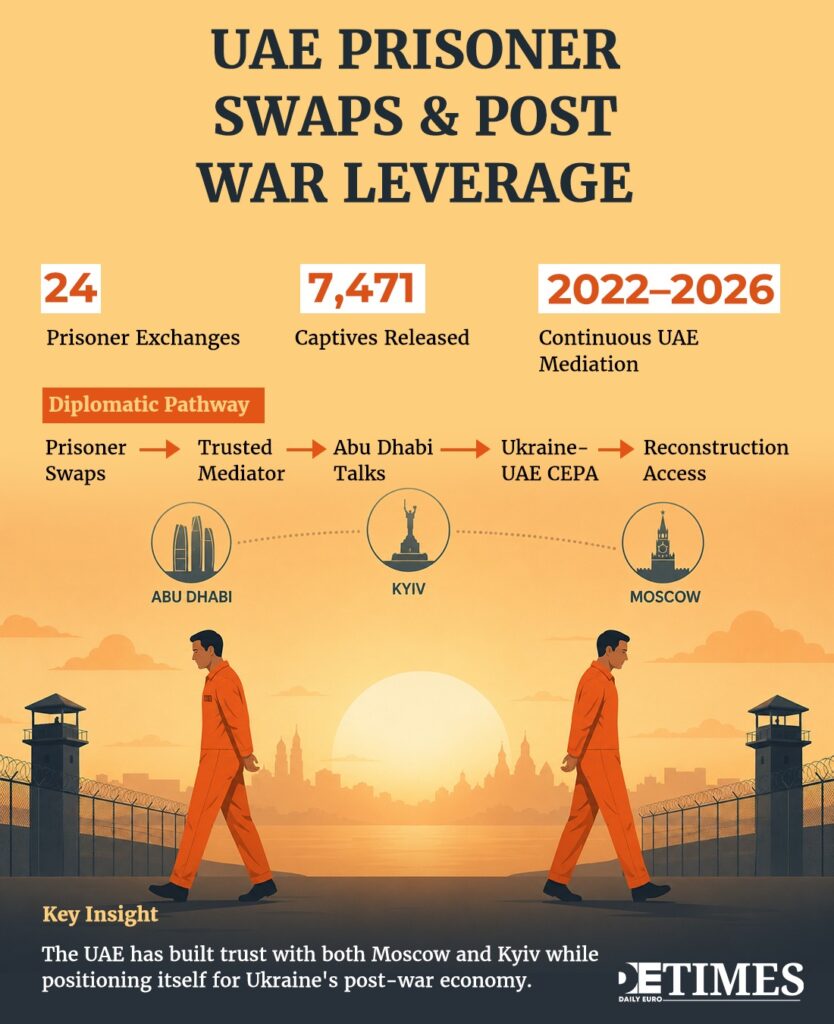
How Abu Dhabi Became the Trusted Venue
The prisoner swaps ran alongside a second diplomatic track. In January this year, Abu Dhabi hosted the first publicly acknowledged trilateral talks involving the United States, Russia and Ukraine since the war began. All three had avoided public contact for four years, which gave the meeting real weight.
A second round followed in February, with senior military and security officials from all three governments alongside political envoys. The UAE foreign affairs ministry described Abu Dhabi’s hosting as an expression of “serious, responsible diplomacy” driven by a humanitarian imperative.
Choosing Abu Dhabi was practical, both Moscow and Kyiv needed a venue neither side would see as hostile. Four years of humanitarian engagement had given Abu Dhabi exactly that reputation.
Ukraine, Partnership, and a Signed Agreement
The UAE’s position with Ukraine now covers hosting talks, moving captives, and locking in economic ties. The Emirates is the only country to have signed a Comprehensive Economic Partnership Agreement, or CEPA, with Ukraine since the conflict began. Both capitals formalised the agreement during Ukrainian President Volodymyr Zelensky’s official visit to Abu Dhabi last year.
The CEPA opens investment flows and reduces trade barriers between both countries, with the UAE-Ukraine Business Council and a joint intergovernmental commission set to expand their work.
A defence investment angle has since entered the picture. Senior Emirati officials have explored setting up an Abu Dhabi-based fund targeting defence companies worldwide. Crown Prince Sheikh Khaled bin Mohamed Al Nahyan has been among the leaders involved in the discussions, which name Ukrainian drone manufacturers as potential targets. Ukraine has signalled it is ready to open its battle-tested defence sector to international investors for the first time.
A fund like that would place Abu Dhabi capital at the heart of Ukraine’s emerging defence export industry.
Abu Dhabi’s Earned Post-War Position
The UAE’s growing mediation role reflects a method seen across its foreign policy, where diplomatic engagement comes first and enables economic positioning later. Abu Dhabi keeps its commercial ambitions in Ukraine mostly implicit.
The record shows a patient build-up of the assets that will matter in reconstruction: credibility, access, a signed trade framework, and the habit of being present.
Keep up with Daily Euro Times for more updates
Read also:
UAE First GCC Stop for Ukraine as Relations Soar with CEPA
UAE Quits OPEC to Define New Energy Order
Investment and Mediation: The UAE’s Stake in Kashmir Stability