

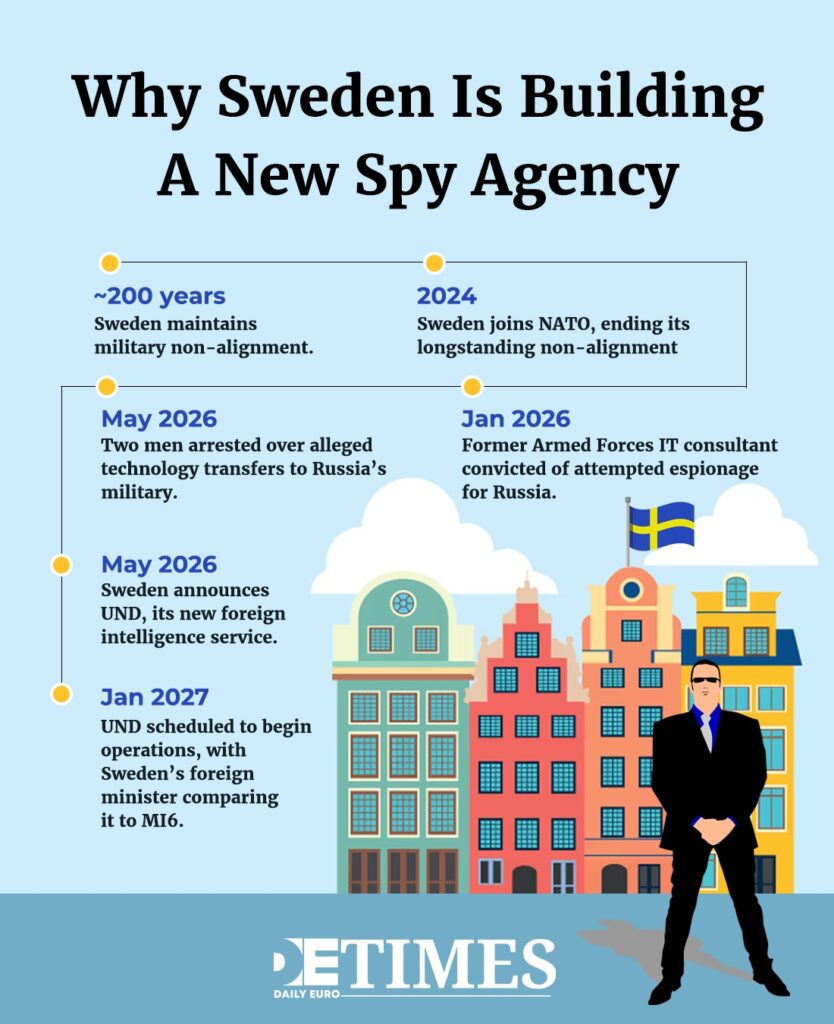
In January, Swedish police detained a 33-year-old former IT consultant to the Armed Forces on suspicion of spying for Russia. A Stockholm court later convicted him of attempted espionage, though it ordered compulsory psychiatric treatment instead of prison after finding he suffered a severe disorder.
The case followed the arrest in May of two men accused of funnelling engineering technology toward Russia’s military, and the earlier detention of a dual Swedish-Russian national wanted by American prosecutors.
Sweden joined NATO in 2024, ending nearly two centuries of military non-alignment, and has spent the period since working out what that shift demands. Among the answers is a new foreign intelligence service, the Utrikes underrättelsetjänst, or UND, announced in May and due to begin work in January 2027.
Foreign Minister Maria Malmer Stenergard described it as comparable to Britain’s Secret Intelligence Service, MI6, a comparison few Swedish officials would have made in public a decade ago.
The frequency of recent cases helps explain why Sweden built a dedicated service, and NATO membership explains why the old caution about doing so has faded.
A Run Of Arrests
Each prosecution on its own reads as an isolated case, a lone operator caught. Together they describe something closer to a trend the state has struggled to keep pace with.
Sweden’s domestic security service, Säpo, has run parallel investigations into technology transfers, sanctions evasion and stalking linked to Russian intelligence officers working under diplomatic cover in Stockholm.
Several such cases within a single year have pushed Russian activity from a periodic embarrassment into a standing item on the government’s agenda.
Bildt’s Diagnosis Of A Blind Spot
Former prime minister Carl Bildt has described the new agency as his own project, born from a specific failure. Sweden’s existing military intelligence service, MUST, tracked Russian troop movements competently before February 2022 but misjudged Moscow’s political intent, assuming an invasion of Ukraine would not follow.
Bildt has said the country wants to ensure that mistake is never repeated. The new civilian service will sit closer to the foreign ministry and the prime minister’s office, with a mandate to study Russian political decision-making, not battlefield logistics alone.
NATO Changes What Neutrality Means
Sweden’s old non-alignment rested partly on restraint, since limited foreign intelligence gathering reduced the risk of provoking a much larger neighbour. NATO membership removes much of that logic.
Collective defence commitments already assume Sweden sits inside the alliance’s standoff with Moscow. A dedicated foreign spy service extends that same logic into peacetime intelligence work, treating open monitoring of Russian elites as a normal function of alliance membership, not a provocation to avoid.
Why Now?
Timing owes something to accumulation and something to opportunity. Years of individual prosecutions built a public case that MUST alone could not carry. NATO accession removed the institutional caution that had kept Sweden’s intelligence architecture narrowly military.
Sweden’s head of military intelligence, Thomas Nilsson, has described the relationship with Russia as a lasting confrontation, not a temporary crisis, language that would have sounded alarmist in Stockholm before 2022 and now sounds close to consensus among officials.
Keep up with Daily Euro Times for more updates
Read also:
A Nuclear Divorce: Sweden and Russia
Adapting to New Realities: Sweden’s Military Strategy In Flux
Belarusian Spy Network Uncovered in Europe