

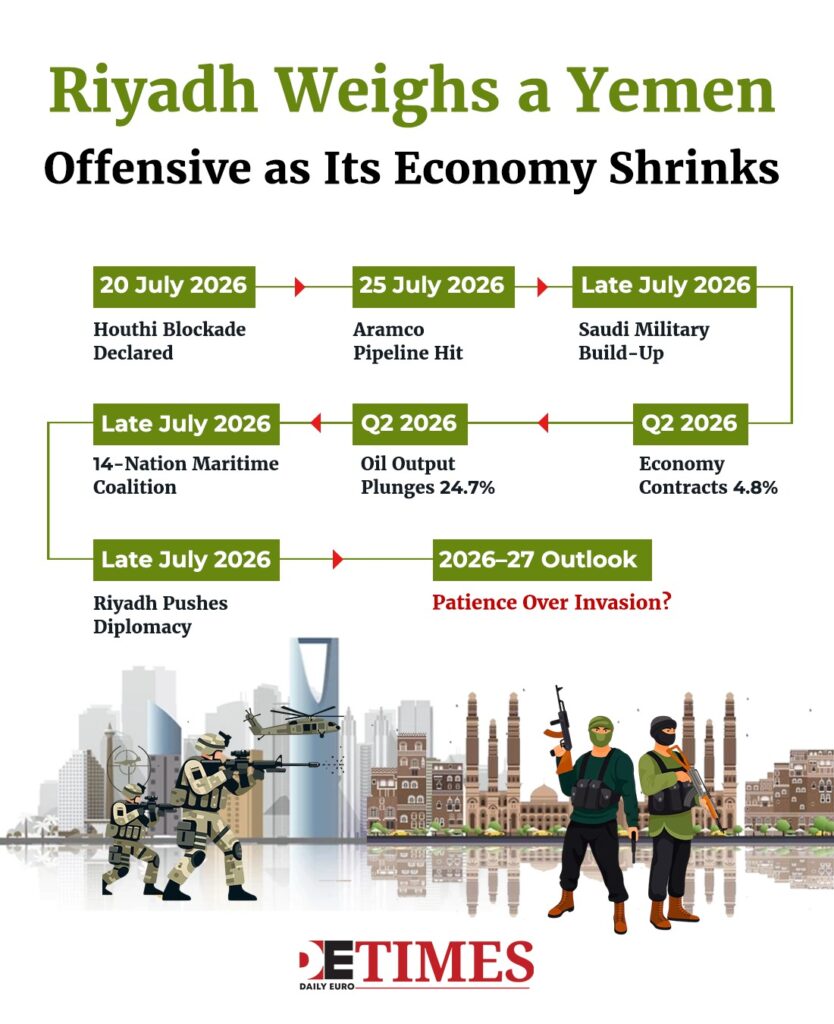
Sailors from Yemen’s internationally recognised government stood at machine-gun positions aboard a Red Sea vessel this week, a small sign that a front long dormant had woken again. Houthi fighters declared a blockade on Saudi shipping on 20 July, and Aramco’s eastern pipeline network took a hit five days later.
Riyadh answered with a build-up that Yemeni sources describe as preparation for a sea and possible land campaign in central Yemen. But the kingdom’s finances point to caution over confidence, and its diplomacy toward Washington points the same way.
Economy Under Siege
Riyadh’s military calculus rests on the data its own statisticians published last week. Gross domestic product contracted by 4.8% year on year in the second quarter, the sharpest fall since the pandemic.
Oil output alone plunged 24.7%, reversing growth recorded only three months earlier. Hormuz disruption from the wider Iran war did most of the damage, and a second front through the Bab al-Mandab strait would compound it.
Non-oil growth slowed too, to 0.6%, a sign the wider economy has begun absorbing the shock as well. The International Monetary Fund still expects annual growth of 1.7% in 2026, rising to 5.5% in 2027, but that recovery hinges on Red Sea shipping returning to normal. The kingdom has little room to fund a lengthy ground offensive of the kind that dragged on for years after 2015.
Diplomacy Overtakes War Drums
That fiscal pressure helps explain why Crown Prince Mohammed bin Salman spent the weekend working the phone, choosing dialogue over threats. He telephoned Donald Trump and, according to the Saudi Press Agency, stressed “the need to prioritise dialogue to reduce escalation.”
Trump duly announced he would hold off new strikes on Iran, citing progress toward an agreement. Iranian state media dismissed his account of a requested pause, insisting their forces remained on high alert, a reminder that any calm stays fragile.
Coalition Still Missing Muscle
Riyadh’s preferred instrument for now is maritime, a coalition of ships and pledges. Fourteen states, including Turkey, Pakistan, Egypt and Djibouti, backed a joint statement on a multinational effort to guard the Bab al-Mandab strait. The kingdom has also reached out to Germany, France, Britain and Italy about joining a Red Sea protection force.
The EU already runs its Aspides naval mission in those waters, and Riyadh’s outreach would fold Saudi ships into that wider Western presence. Whether the Houthi campaign seeks a general blockade or one directed only at Saudi vessels remains an open question.
Assembling ships and pledges costs far less than mobilising an army. It lets Saudi Arabia say it is defending its oil exports without committing ground troops its budget struggles to sustain.
Yemen’s Widening Front Lines
Restraint at the top does not mean the fighting stays contained. Houthi forces have struck Saudi positions along the Hodeidah coast, and separately built links with Somalia’s al-Shabaab traced to shared smuggling routes across the Gulf of Aden. Those links give the Houthis reach that outlasts any single Saudi campaign inside Yemen’s borders.
Some reports treat Riyadh’s withdrawal from eastern positions as preparation for an assault on al-Bayda. It could equally double as a defensive consolidation as the kingdom waits out the broader regional storm.
The United Arab Emirates has denied any part in talks about a new land campaign, a distinction worth noting given Abu Dhabi and Riyadh have long backed rival Yemeni factions.
Their coordination, or the absence of it, will do much to decide whether any Saudi offensive gathers real momentum on the ground.
What Should Be Expected Next
Expect Saudi Arabia to keep building its naval coalition and trading limited strikes with the Houthis, stopping short of the land invasion some reports have flagged. A treasury absorbing its worst quarter since the pandemic cannot easily fund a repeat of the inconclusive Hodeidah campaign from earlier in the war.
The Saudi push for dialogue with Trump over Iran points toward keeping Washington’s attention fixed on de-escalation alone. Should the Houthi blockade choke Red Sea trade further, Riyadh may still cross into ground operations out of pure necessity. For now, the kingdom’s own economic data point toward patience over a plunge into open war.
Keep up with Daily Euro Times for more updates
Read also:
Houthi Payroll Politics and Riyadh’s Bet to Secure Yemen Peace
The Gulf Rift Over Yemen: Shared Interest in Managed Partition
The Iran War Outlives Its Architects