

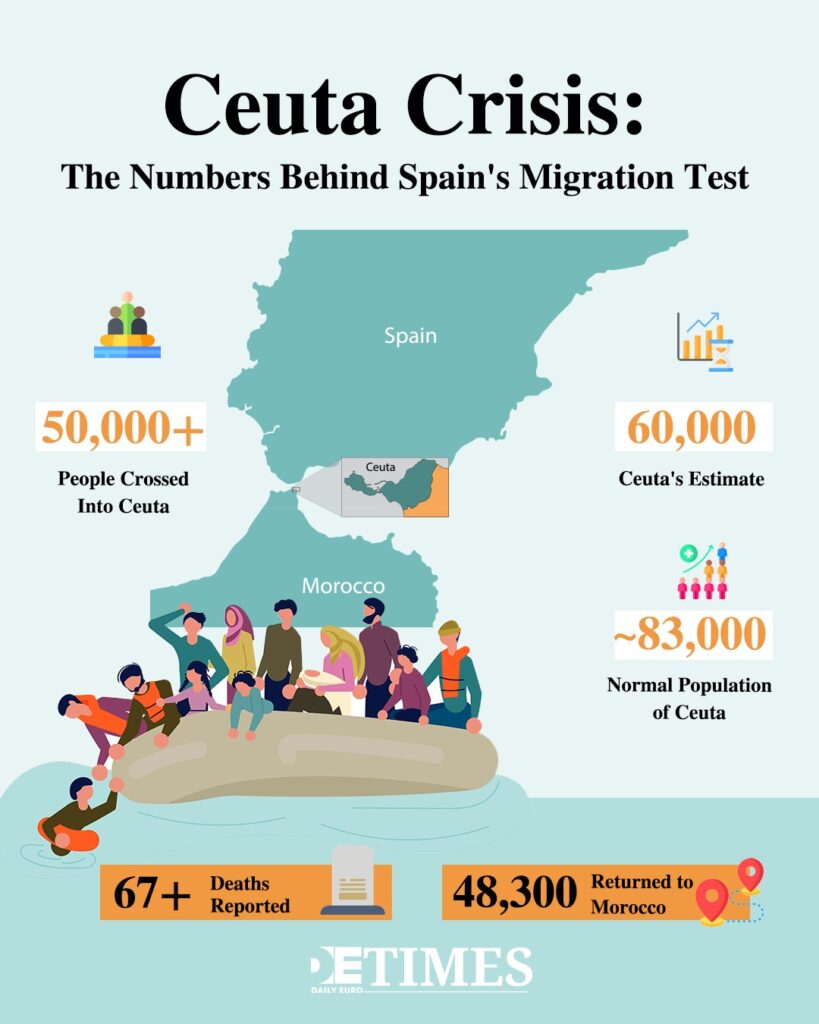
Roughly sixty thousand people crossed from Morocco into Ceuta within a single day last week, and dozens drowned attempting it. Spain’s government says the surge followed a narrow Supreme Court ruling on migrants who enter by swimming rather than climbing the fence.
Officials and outside observers agree the ruling was quickly misread, deliberately or otherwise, by networks moving people toward the enclave for profit.
Within two days Italy had shut its air and sea borders with Spain, invoking the Schengen area’s own emergency provisions. Pedro Sánchez answered on social media that solidarity was optional but respect for treaties and data was not.
The exchange, and everything that produced it, argues for a single conclusion. Clear legal architecture keeps a border calm, and vague architecture invites exploitation by whoever benefits from the resulting confusion.
A Ruling Misread
Spain’s Interior Ministry maintains the Ceuta surge has nothing to do with a separate regularisation programme approved earlier this year. This distinction never reached the people deciding whether to attempt the crossing.
Analysts note the court’s decision applied narrowly to sea arrivals, yet word spread that Spain had effectively opened the door. Traffickers amplified that message across messaging platforms, charging desperate families for a chance many never should have taken.
One Border, Two Speeds
Gibraltar joined the Schengen system’s border architecture a fortnight earlier under an entirely different logic. The treaty, negotiated over years between London, Madrid and Brussels, spelled out exactly where checks would sit and who would run them.
Checks moved to Gibraltar’s airport and port, residents kept guaranteed crossing rights, and the fence at La Línea came down without incident. Commuters walked through on the first morning using nothing but an identity card.
The comparison is not that one border matters more than the other. It is that predictability, published in advance and enforced consistently, denied traffickers and opportunists any story to sell. Ceuta received no equivalent clarity, and the vacuum filled with whichever version travelled fastest.
Numbers Sánchez Used to Answer Meloni
Sánchez countered Rome’s threat by publishing Frontex figures on irregular entries recorded across the bloc between 2021 and this year. Italy topped the list with 478,600, ahead of the Western Balkans route, Greece and then Spain itself.
The figures were accurate, drawn from the EU’s own border agency, and Brussels itself declined Italy’s push to suspend Spanish membership outright.
Selective statistics still function as ammunition rather than explanation once a crisis is under way. Sánchez was correct on the data and largely alone in offering any, which says something uncomfortable about how the rest of the bloc handled the moment.
Who Profits From the Confusion
Human trafficking networks earn money precisely when rules stay murky enough to misrepresent.
A published treaty, like Gibraltar’s, gives them nothing to sell. A narrow court ruling, stripped of context and repeated online without nuance, becomes a product traffickers package and charge for.
Political actors on several sides found the confusion useful too. Rome’s suspension drew domestic applause from voters anxious about migration, even as the European Commission confirmed no one from Ceuta had reached the mainland.
Madrid’s own critics accused the government of failing to communicate the court ruling’s limits before it metastasised into a continental dispute. Both dynamics fed off the same underlying vagueness.
What Europe Should Learn Now
Twenty-two member states, led by Italy and Denmark, have since asked for emergency talks on border rules. The more durable fix sits closer to Gibraltar’s model than to Ceuta’s.
Treaties negotiated openly, published clearly and explained before implementation deny bad actors the raw material for misinformation.
Europe’s institutions, tested twice within a fortnight, might reasonably ask why clarity proved achievable at one border and elusive at the other.
Keep up with Daily Euro Times for more updates
Read also:
Gibraltar Border Opens, but the Real Test Starts Now
Iberia: When the Lights Went Out
Trafficked Antiquities: Where Southern Europe’s Treasures Actually Go