

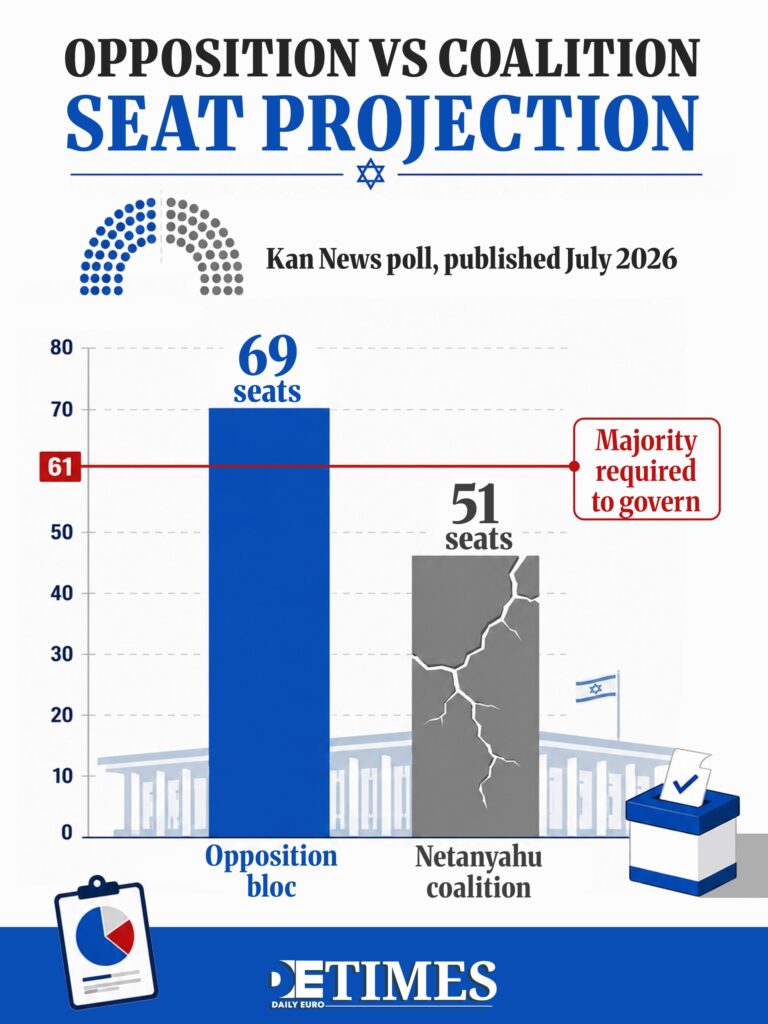
At the weekend, Israel’s public broadcaster Kan found opposition parties on course for sixty-nine seats against fifty-one for Prime Minister Benjamin Netanyahu’s coalition, a gap wide enough to unsettle Likud.
Israel goes to the polls on 27 October, the first national vote in three years. Corruption proceedings against Netanyahu remain open, an exemption crisis over ultra-Orthodox conscription has turned toxic, and the economy has absorbed years of wartime spending.
Both camps accuse the other’s polls of manufacture, even so the accumulating survey record points the same way.
Netanyahu is weaker than at any point since returning to office, and former military chief Gadi Eisenkot has become Netanyahu’s most credible rival.
Loyalist Pollster Under Scrutiny
Distrust of pollsters did not start with a single survey. Channel 14, a broadcaster with close ties to Netanyahu, set up a polling firm of its own without disclosing the ownership link, and its surveys consistently favoured the governing coalition.
The firm’s analyst, Shlomo Filber, was once among Netanyahu’s closest aides before becoming a state’s witness in the corruption trial against Netanyahu.
The irony has not stopped Filber from steadily placing Netanyahu’s bloc above the sixty-one seats needed to govern, well ahead of every rival pollster.
Eisenkot Gains on the Incumbent
Set against Filber’s outlier readings, mainstream pollsters describe a different contest.
A Channel 12 survey put Eisenkot ahead of Netanyahu as preferred prime minister by 43% to 34%, a lead unthinkable a year earlier.
Eisenkot’s appeal rests on a security record built as a former army chief, not on a defined platform. The combination draws support from voters uneasy with the governing coalition and with older opposition names alike.
A mid-July aggregate of major polling series still placed Likud a few seats ahead of Yashar nationally, even as Eisenkot led personally as preferred prime minister.
The gap between party-line and leadership polling points to how fractured the opposition vote remains among Yashar, Naftali Bennett’s party and older centrist lists.
Eisenkot and Bennett have still not agreed on how to combine forces.
Trust in Institutions Also Falls
The polling fight sits inside a wider loss of confidence in Israel’s public institutions. A survey by the Israel Democracy Institute recorded 61% of Israelis saying Netanyahu should not seek re-election, with 63% fearing for the country’s system of government.
More Israelis named internal division than external threats as the graver danger to the state, an unusual reversal for a country long defined by security anxiety.
External pressure has compounded the mood. Washington has voiced open criticism of Netanyahu’s diplomacy since the Iran ceasefire, adding a foreign complication to an already fragile governing majority.
Netanyahu’s allies read the domestic survey results as proof of an organised campaign against Netanyahu, a claim without documented backing.
Coalition Calculations Remain Unresolved
Even a Netanyahu decline does not guarantee a change of government. Most mainstream polling places the opposition bloc around fifty-eight to sixty seats and the coalition near fifty, short of the majority either side needs.
Arab-led parties hold enough seats to tip a majority either way, though both leading blocs publicly reject counting on them to form a government.
The arrangement leaves Eisenkot and Bennett with a shared problem, unifying enough of the anti-Netanyahu vote to cross sixty-one without a formal partnership with Arab-led parties.
What the Coming Months Should Settle
Three months separate Israel from a vote no single pollster can safely predict. Filber’s polling will keep flattering the coalition, and mainstream surveys will keep tracking Netanyahu’s fatigue with the electorate.
Voters stand to gain by weighing each survey against the pollster behind it and treating any single reading with caution.
The decisive test falls on 27 October, as the ballot itself replaces every disputed poll. Until then, disputed instruments will keep measuring Eisenkot’s rise and Netanyahu’s resilience, leaving the composition of the next government almost as uncertain as the polling meant to forecast it.
Keep up with Daily Euro Times for more updates
Read also:
Netanyahu Aide Bypasses Military Censors via German Tabloid
When Justice and Memory Collide: Netanyahu and the ICC
Israeli Cabinet Uses Red Tape to Claim West Bank