

Daniel Kinahan returned to Ireland on Sunday for the first time in roughly a decade, but not voluntarily. An Irish Air Corps jet flew to Dubai on Saturday, departed the UAE on Sunday morning and landed at Casement Aerodrome on the outskirts of Dublin shortly after 18:30.
Kinahan, 49, was taken directly to the Special Criminal Court for an unusual Sunday evening sitting, charged with directing a criminal organisation and remanded in custody at Portlaoise Prison, a high-security facility 90 miles southwest of the capital. His next court date is set for 5 October. He denies wrongdoing. A joint statement from the justice ministers of Ireland and the UAE described him as “one of the most wanted individuals in cases related to transnational organised crime,” accused of “leading an organised criminal group, murder and illicit trafficking of narcotics.”
The US Treasury, which designated the Kinahan Organised Crime Group a significant transnational criminal organisation in 2022, valued the organisation at more than $1 billion and had offered a $5 million reward for information leading to convictions, a sum that was cancelled following his April arrest in Dubai.
Garda Commissioner Justin Kelly said the arrest “shows our determination, along with our international policing partners including Dubai Police, to target transnational organised crime.” The extradition followed a final ruling by the Dubai Court of Cassation and was carried out under a bilateral treaty between Ireland and the UAE that formally came into force in May 2025. A major security operation, involving armed police, military personnel and a recently acquired bombproof escort van, was deployed to transport Kinahan from the airport to the court.
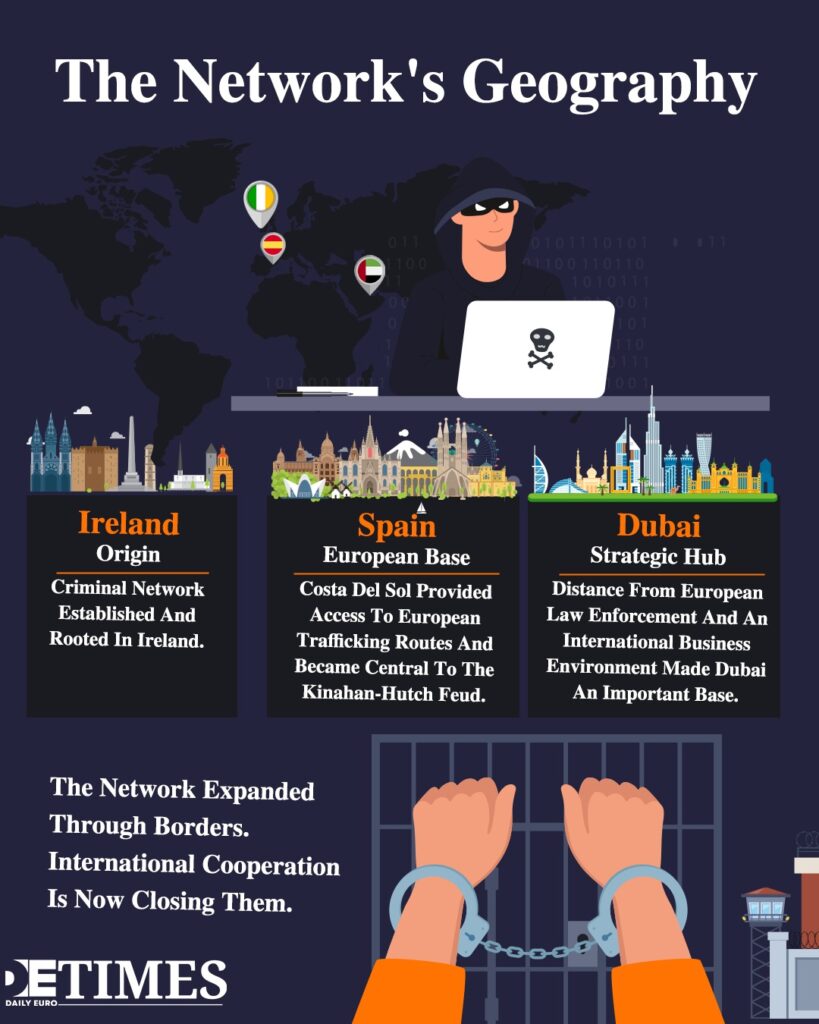
Spain Became the European Base
The Kinahan Organised Crime Group was never simply an Irish gang operating abroad.
US authorities describe it as a transnational organisation established in Ireland, Britain, Spain and the UAE, involved in international drug and firearms trafficking and money laundering. Spain, particularly the Costa del Sol, offered obvious advantages: its ports, tourism economy and international population made the region useful for moving people, money and narcotics whilst remaining relatively close to Ireland and Britain. The organisation became deeply associated with Marbella and southern Spain, where its feud with the Hutch gang also spilled into violence. According to the US Treasury’s 2022 designation, the conflict produced 18 murders from February 2016 alone, including two innocent bystanders.
Spain therefore represented both opportunity and danger. It gave the organisation access to European trafficking routes whilst placing its members increasingly within reach of European policing. A series of arrests in Spain in recent years, alongside the extradition of senior figure Sean McGovern from the UAE in 2024 — who pleaded guilty and was sentenced to 24 years in June 2026 — showed the organisation’s reach was not immune from sustained law enforcement pressure across jurisdictions.
Dubai Offered Something Different
Dubai became the more important refuge.
The US Treasury said the Kinahan organisation frequently used the city as a facilitation hub, whilst Daniel Kinahan also developed a public profile there through boxing promotion and management. For years, the UAE offered distance from Irish law enforcement and a comfortable base from which an international network could allegedly continue operating.
That advantage gradually disappeared as international sanctions increased pressure on the group, UAE authorities froze Kinahan-linked assets and cooperation between Dublin and Abu Dhabi strengthened through the new extradition treaty.
Kinahan’s transfer to Ireland is one of the clearest signals yet that the UAE no longer wants the reputational cost of being seen as a safe destination for internationally wanted organised-crime figures. Organised crime depends on jurisdictions as much as on criminal networks. The Kinahan group used Ireland as its origin, Spain as a European operating space and Dubai as a distant strategic hub.
That geography worked while international cooperation remained uneven. It works considerably less well when those jurisdictions begin exchanging evidence, freezing assets and honouring extradition requests. The network became global partly by exploiting borders. Those same borders are becoming harder to hide behind.
Keep up with Daily Euro Times for more updates
Read also:
Under the Radar: The Expanse of the Muslim Brotherhood in Ireland
On Cloud Nine: Female Entrepreneurship in Dubai
How Rob Jetten Reclaimed the Dutch Centre