

Lebanese President Joseph Aoun travelled to Ankara last month, the first such visit by a Lebanese head of state in seventeen years, and left with a pledge from President Recep Tayyip Erdoğan that Türkiye wants a place in whatever force follows the United Nations Interim Force in Lebanon.
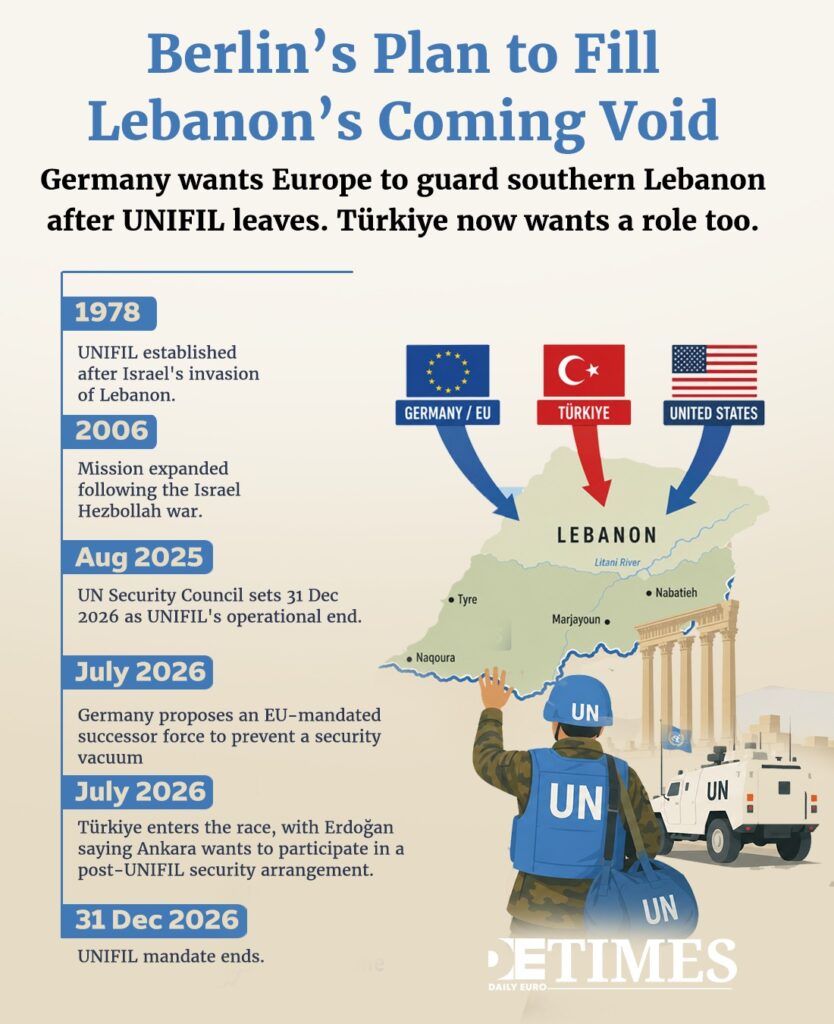
The peacekeeping mission, deployed since 1978 and reinforced after the 2006 war with Hezbollah, must withdraw by the end of 2026 under a Security Council resolution passed last year at the urging of America and Israel.
Germany had already staked its own claim weeks earlier, when Foreign Minister Johann Wadephul proposed a European Union-mandated mission to prevent what he called a security vacuum along Lebanon’s southern border.
Berlin’s proposal and Ankara’s now sit awkwardly close together, and neither Germany nor Türkiye has explained how their competing offers might coexist.
What began as a technical question about who patrols the Blue Line has turned into a contest over which outside power gets to shape Lebanon’s next chapter, with France, Italy and the United States all holding stakes of their own.
Berlin’s Bid to Fill Lebanon’s Coming Void
Wadephul’s proposal followed a familiar German pattern of stepping into gaps left by weakening multilateral structures. He described Lebanon’s government, led by Aoun since January, as one of the more hopeful cases in a difficult region, and argued that a European mandate could let Israeli troops withdraw from the south without opening space for Hezbollah’s return.
Officials in Brussels have signalled that any such mission would look less like UNIFIL’s armed patrols and more like a training and support operation built around the Lebanese army, a distinction that matters given how little appetite European capitals have shown for placing their own soldiers in the path of renewed fighting.
Türkiye’s Ankara Diplomacy Complicates Europe’s Lebanon Plan
Erdoğan’s answer to Aoun arrived with none of that caution. Türkiye has spent the past year deepening ties with Beirut, and its president used the Ankara summit to offer support for the Lebanese army’s reconstruction and to press Aoun on Lebanon’s neutrality in the wider regional war.
A senior diplomatic source told Middle East Eye that Ankara wanted assurance Beirut would not drift into an Israeli-aligned camp, a sign that Türkiye views its Lebanon bid as part of a broader contest with Israel over regional standing rather than a narrow peacekeeping question.
A German Proposal Meets Ankara’s Own Ambitions
Türkiye’s entry into the competition changes the shape of Germany’s plan more than Berlin may have anticipated. Analysis from Defence24 observed that Ankara’s declaration positions Türkiye as a direct rival to Israel, France and Iran, each already invested in Lebanon’s outcome, and that France has separately made clear it intends to lead any new coalition itself.
The European mission built mainly around German and French leadership would need to answer whether it welcomes Turkish troops at all, given Israel already blocked Ankara from joining the stabilisation force it helped assemble for Gaza.
Washington’s Shadow Over Every Option
None of these bids can proceed without accounting for the country that ended UNIFIL in the first place. The United States pushed the Security Council to wind the mission down, arguing it failed to curb Hezbollah’s rearmament, and Washington now leads a separate trilateral effort with the Lebanese army aimed at disarming the group directly.
This effort gives the United States effective leverage over any successor force, since a European or Turkish mission operating alongside an American-led disarmament track would need Washington’s blessing to avoid working at cross purposes.
Lebanese officials involved in the planning have said they hope Washington will simply decline to veto a new arrangement, a modest ambition that captures how little room Beirut has to set its own terms.
Keep up with Daily Euro Times for more updates
Read also:
Italy’s Mediterranean Strategy: Why Troops Stay in Lebanon
Economic Diplomacy: Establishing Safety Zones in Ukraine and Lebanon
Lebanon Ceasefire: New Deal Ploughs the Same Furrow