
Germany’s energy transition has produced an increasingly strange contradiction. Renewables now supply well over half of the country’s electricity, solar capacity continues to rise rapidly and the government is spending billions to reduce power costs, yet one of Europe’s largest independent solar developers has entered insolvency proceedings, while Berlin is simultaneously cutting fuel taxes because petrol and diesel have again turned politically painful.
The problem is not that renewable energy has failed to expand; it is that adding cheap generation does not automatically make the entire energy system cheap, stable or financially easy to operate.
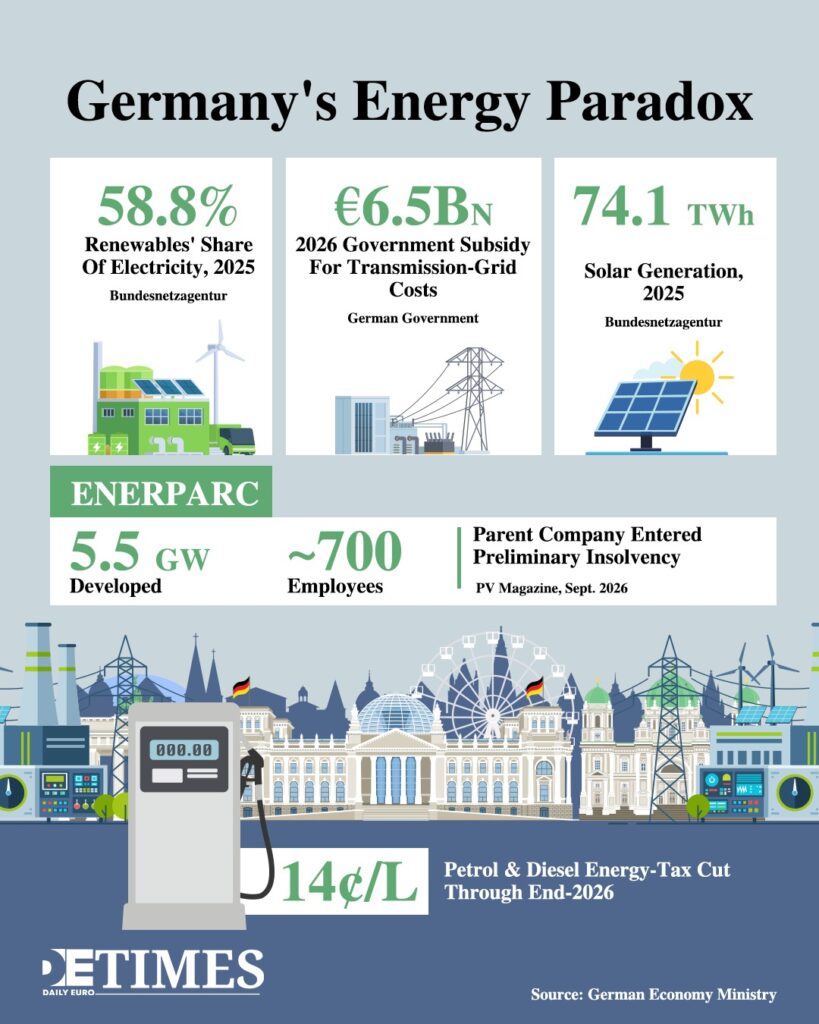
Germany generated 58.8 per cent of its electricity from renewable sources in 2025, according to national grid data, and solar alone produced 74.1 terawatt hours, up sharply from 63.2 TWh the previous year.
Installed renewable capacity rose by almost 21 gigawatts during 2025, reaching just under 210 GW, with solar accounting for 16.4 GW of that expansion and taking total photovoltaic capacity to around 117 GW. Those numbers hardly describe a stalled transition, yet Enerparc, one of the companies responsible for building that capacity, entered preliminary insolvency proceedings this month.
Solar Keeps Growing
The Hamburg-based group has developed roughly 500 photovoltaic projects with a combined capacity of around 5.5 GW, including 3.8 GW already connected to the grid, and employs just under 700 people.
Only months earlier, Enerparc had secured a financing package worth up to a billion euros to expand its solar and battery-storage portfolio. That makes the insolvency especially striking.
The Enerparc case should not be treated as proof that solar itself is uneconomic. The insolvency filing currently affects the parent company rather than every subsidiary or project company, and its electricity-trading arm has said operations remain stable while the preliminary administrator has focused on keeping the business running.
No definitive public explanation for the insolvency has yet been established, which carries weight because renewable developers face risks that have little to do with the cost of sunlight.
Growth Does Not Guarantee Profit
Projects require large amounts of capital upfront, and financing costs carry weight of their own. Grid connections can be delayed, power prices can fall during periods of intense solar production and reduce revenues exactly when output is highest, and battery storage, land acquisition and permitting all add further complexity.
A company can therefore operate in a booming market while still struggling financially.
This is one of the transition’s less intuitive lessons: cheap electricity generation does not mean cheap project development. Germany’s electricity system also has to move power from where it is generated to where it is consumed, and wind production is concentrated heavily in the north while major industrial demand lies farther south and west.
Large solar installations are often built in rural areas with relatively little local demand, which requires grid expansion, reinforcement and expensive congestion management.
The Grid Has Its Own Bill
The national regulator explicitly acknowledges that regions with high renewable generation face additional network costs because grids must be upgraded and digitalised. In 2026, roughly 70 per cent of a 1.56 cent-per-kWh surcharge for special network use is linked to redistributing those renewable-integration costs.
The government is already subsidising transmission charges with 6.5 billion euros this year, reducing household network fees by roughly two cents per kilowatt hour across major network areas.
That support makes bills lower than they otherwise would be, but it shows that Germany’s energy transition increasingly depends on the public budget as well as private investment. Wholesale renewable power can be extremely cheap when wind and solar output is strong, yet retail bills also include networks, taxes, levies and the cost of keeping backup generation available when output falls.
Since the start of 2026, the government has subsidised grid fees, permanently lowered electricity taxation for more than 600,000 businesses, removed the gas-storage levy and added support for energy-intensive industry, with total relief reaching around 10 billion euros annually.
Electricity Is Only Half the Story
The political difficulty grows clearer once transport and heating are added. Germany may generate increasing amounts of renewable electricity, but cars, freight, aviation and large parts of industry still depend heavily on fossil fuels.
The renewed Middle East conflict has pushed global oil prices sharply higher, and Germany has responded by cutting the energy tax on petrol and diesel by 14 cents per litre through the end of 2026.
Once VAT is included, motorists are expected to receive relief of roughly 17 cents per litre, and the package will cost federal and regional governments around 2.5 billion euros. Berlin is also exploring a temporary fuel-price cap from 2027, modelled partly on systems used in Belgium and Luxembourg.
This is the German energy paradox in its clearest form: the country can install millions of solar panels and still remain vulnerable to an oil shock occurring thousands of kilometres away, since electricity decarbonisation does not instantly decarbonise mobility, chemicals, freight or heating.
Germany’s Problem is Integration
New household electricity contracts did turn cheaper early this year, falling to around 34.87 cents per kWh in January, but those prices remain high enough to carry real political and industrial weight.
Germany is therefore building more renewable capacity while simultaneously subsidising the system required to make that capacity useful. The easiest criticism of Germany’s energy policy is that the country spent heavily on renewables and still ended up with expensive energy, and that description is partly true but incomplete.
Germany has succeeded at building enormous amounts of renewable generation; the difficult part now is integrating that power into an industrial economy while reducing dependence on oil and gas.
Enerparc’s insolvency shows that companies delivering the transition can still suffer financial stress even while their sector expands, and the fuel-tax cut shows something equally important: renewable electricity cannot protect motorists or logistics firms from an oil shock if transport stays dependent on petroleum. Germany’s transition is therefore turning into less a question of proving wind and solar work, since they already do, and more one of building grids, storage and business models capable of turning abundant renewable electricity into genuinely affordable energy. Until that happens, Germany may keep producing more green power while still spending billions protecting consumers from the cost of energy.
Keep up with Daily Euro Times for more updates
Read also:
Warsaw’s Pump Relief Leaves Security Unbought
Food Security: Europe’s Next Strategic Crisis
AfD Rise as Germany’s Twin Elections Squeeze Merz’s Coalition