

Elif Eralp, Die Linke’s candidate for Berlin’s top job, studied Zohran Mamdani’s mayoral campaign in New York before her own race began. Party officials travelled to Manhattan last year to learn canvassing methods from American democratic socialists, then adapted his message on rent freezes and free transport for a German audience. Die Linke finished first in Berlin with a quarter of the vote.
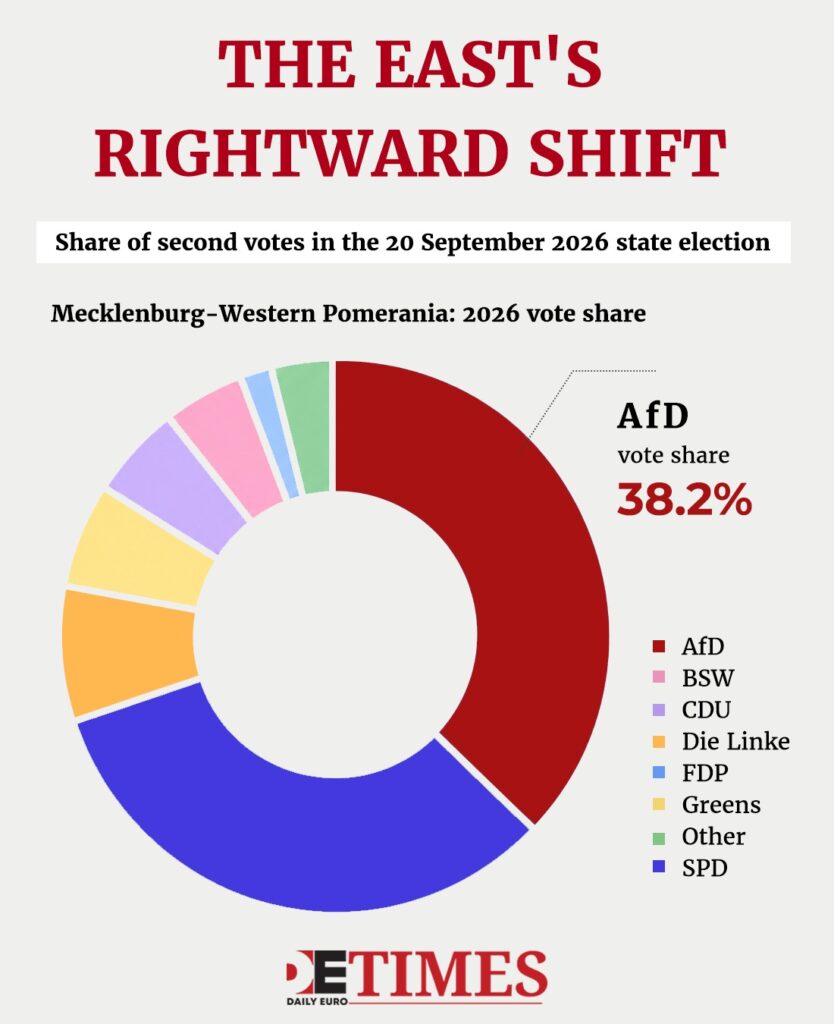
The result compounded the setback Alternative for Germany (AfD) handed Chancellor Friedrich Merz’s Christian Democratic Union in Mecklenburg-Western Pomerania (MV), where the party took the largest share of the vote. The CDU collapsed in each region, widening a decline that started in Saxony-Anhalt a fortnight earlier.
Berlin, a cosmopolitan city-state of nearly four million residents, gave Die Linke 47 seats against 34 for the CDU. MV, a sparsely populated coastal state in the former East, gave the AfD 38.2% of the vote, a tally that exceeded its 2021 result twofold. The CDU fell to below 5%, its weakest showing there on record.
The Vote Against the Centre
Merz called the MV result what it was. “It is a disaster,” he told reporters at his party’s Berlin headquarters. He said the contest had narrowed into a straight fight between the Social Democrats and the AfD, leaving his own candidates marginalized.
His diagnosis understates how far the erosion goes. The CDU governs within Merz’s federal coalition, though voters in Berlin and MV withheld the loyalty such incumbency usually earns.
The unfinished reform programme and rising irritation with Merz’s coalition have combined to push voters toward parties promising a clean break, in whichever direction it points.
Merz’s Weakening Grip
Merz’s approval ratings sank, reaching levels his predecessor had surpassed earlier this year, and business leaders have pressed him for tax and welfare cuts he has struggled to deliver. Speculation about a leadership change inside the CDU grew louder after Saxony-Anhalt, where the AfD won 43.8% of the vote, a tally that exceeded the party’s previous best twofold.
Sunday’s result puts to rest any notion of Saxony-Anhalt standing alone. Three regional votes inside a fortnight have each returned a verdict against the CDU, giving opponents within his ranks new reason to say his time as leader is running short.
Berlin’s American Import
Die Linke’s Berlin campaign drew explicit inspiration from Mamdani’s New York run, down to shared language on affordability and organising. Eralp stands to become the city’s first Muslim mayor and the first Left Party mayor since reunification, a milestone rooted in anger over rents, sharpened by years of grassroots organising.
Infratest dimap surveys found Berliners trust her party on housing and social justice by wide margins, leaving the CDU trailing.
The comparison with American politics carries a caution alongside the inspiration. Mamdani won by dominating one primary inside a majority system; Eralp must assemble support from a fragmented parliament where many Berliners still hesitate to hand her party the mayoralty outright. Enthusiasm at the ballot box has left consensus on who should govern unresolved.
A Fractured Country’s Near Future
Coalition talks in each state will consume months, and the Bundestag contains the chancellor whose party has lost three consecutive regional contests within weeks of each other.
Calls for Merz’s replacement will grow louder before they fade, though any obvious successor currently commands scant support within the party for forcing his hand.
Keep up with Daily Euro Times for more updates
Read also:
Merz Weighs Reshuffle Amid Record Low Ratings
Breaking Point: The AfD American Divorce
Stuttgart Voters Punish Merz as Energy Prices Surge

