
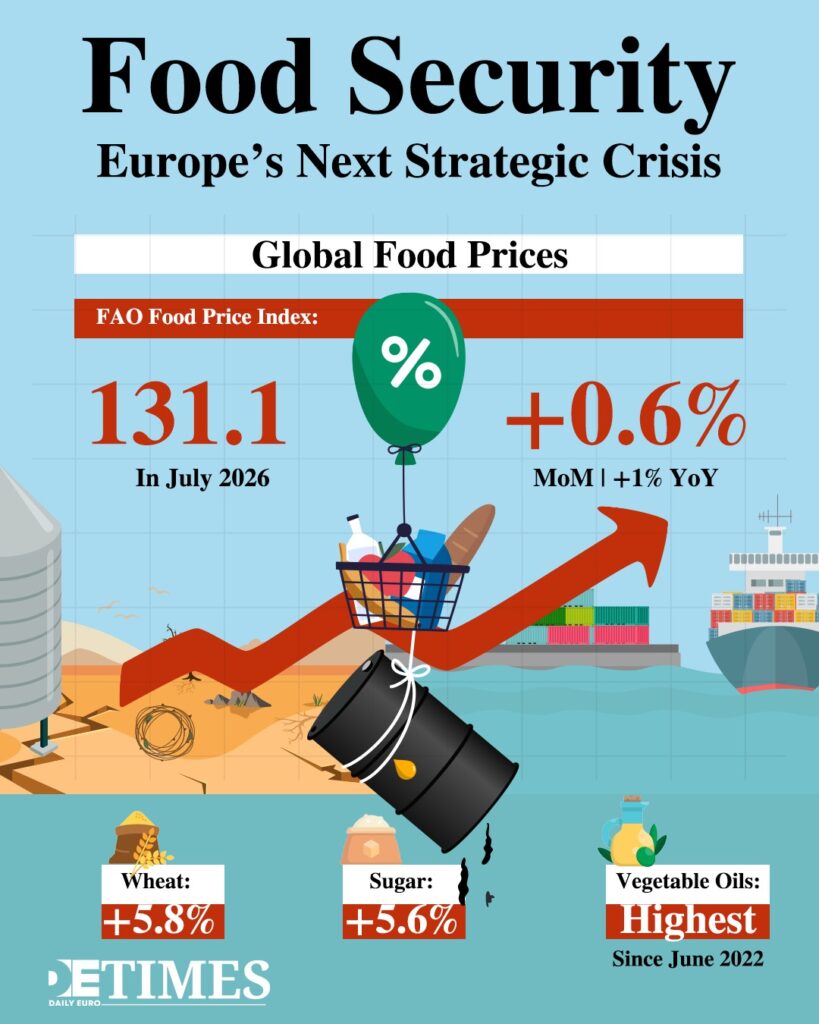
Global food prices have reached their highest level in more than three years. The UN Food and Agriculture Organization’s Food Price Index climbed to 131.1 points in July 2026, up 0.6% from June and 1% above its year-earlier level. Wheat prices surged 5.8% on Black Sea export disruption and heatwave damage to crops; the vegetable oil index reached its highest point since June 2022; and the sugar index rose 5.6% on weather concerns in Europe and Asia.
FAO chief economist Máximo Torero told Reuters the combination of wars in Iran and Ukraine with El Niño conditions creates “a perfect storm of higher costs and lower crop yields,” warning that prices will accelerate further by year-end and into 2027. The index remains below the extraordinary peak reached after Russia’s invasion of Ukraine in 2022, but the direction of travel is clear.
For Europe, the worrying dimension is not simply another round of supermarket inflation. Several pressures are arriving simultaneously: heat is cutting yields inside the EU, the Black Sea remains vulnerable to military disruption, and the Iran war has increased the cost and uncertainty surrounding fertiliser supplies through the Strait of Hormuz. Food security is beginning to resemble the kind of strategic question Europe already asks about energy and defence, and the institutional reflex to treat agriculture as a domestic subsidy question rather than a geopolitical one is becoming harder to sustain.
Europe’s Own Harvests Are Under Pressure
France offers one of the clearest warnings.
Farmers and analysts fear the country’s maize crop may be the smallest in roughly 50 years, with the French growers’ association AGPM projecting around 9.5 million tonnes, compared with 13.8 million last year, and some forecasters placing it below 8 million tonnes. That would be a level not seen since 1976. Maize conditions plummeted to their lowest rating in at least 15 years as France endured its third heatwave since late May, with the share of crop rated good to excellent falling from 84% to 47% between early June and early July. Grain trade association COCERAL took the unusual step of issuing an out-of-cycle forecast, cutting its estimate for total EU and UK grain production in 2026 to 286.6 million tonnes, a reduction of 23.4 million tonnes from 2025. EU maize production alone was cut 8% to 52.7 million tonnes, the lowest since 2007.
France is the EU’s largest grain producer, which makes a poor harvest there structurally significant for the whole bloc. A single country’s shortfall does not create a European famine, particularly whilst global maize supplies remain comparatively abundant, but it tightens the buffer that allows Europe to absorb shocks elsewhere. Maize export quotes were already running approximately 16% above year-ago levels and soybean quotes more than 20% higher as markets priced in tighter European supply. Climate pressure therefore does not simply mean that Europeans occasionally pay more for bread.
It can weaken domestic production precisely when international alternatives become less reliable.
War Now Reaches the Farm Through Fertiliser
Ukraine demonstrated after 2022 how quickly food can become geopolitical.
Its grain exports feed markets far beyond Europe, particularly in Africa and the Middle East. Continued damage to Black Sea export infrastructure has again contributed to higher international cereal prices. Latvia’s foreign minister Baiba Braze warned during a recent visit to Kyiv that restrictions on Ukrainian agricultural exports threaten food security well beyond Europe, whilst President Volodymyr Zelenskyy discussed food security alongside defence cooperation with Saudi Crown Prince Mohammed bin Salman this week. That pairing is revealing: grain, drones and strategic security increasingly belong to the same diplomatic conversation.
The Iran conflict has added another vulnerability. Disruption to the Strait of Hormuz has affected supplies of fertiliser and the natural gas needed to manufacture it, and the World Bank’s fertiliser price index rose sharply earlier in 2026. The European Commission says fertiliser prices and availability have already been affected, and its Fertiliser Action Plan, adopted this year, is intended to address both short-term cost pressures and longer-term supply resilience. Europe’s farmers therefore face the possibility of paying substantially more to grow crops whose yields are simultaneously being reduced by heat and drought. A field in France or Italy can be exposed to a conflict thousands of kilometres away through fertiliser, fuel and shipping costs, which is precisely how the energy crisis arrived a few years earlier.
Consumers Feel the Shock Unequally
Europe remains wealthy enough to avoid the worst consequences of global food stress.
Higher commodity prices usually mean pressure on household budgets rather than outright scarcity. Elsewhere, the same movements can become socially destabilising. Iran provides an extreme example: food inflation has accelerated under the combined weight of war, sanctions and economic weakness, with Al Jazeera reporting point-to-point inflation of more than 260% for oils and fats and more than 115% for fruit and nuts. That is not a problem Europe experiences at home, but international food crises rarely remain purely humanitarian. They can contribute to political instability, migration pressures and competition over trade routes. Europe’s own security therefore depends partly on whether vulnerable neighbouring regions can still afford basic food.
There is also a domestic political dimension. Food prices are unusually visible: consumers may tolerate abstract changes in wholesale energy or bond markets for some time, but they notice immediately when bread, oil and vegetables cost more at the till. Persistent food inflation can rapidly become a measure of whether governments appear competent, giving the issue a political urgency well beyond its weight in national accounts. That visibility is part of why energy policy was eventually treated as a strategic question rather than a consumer one. Agriculture may be approaching the same reclassification.
Europe Needs a Food-Security Strategy
The EU does not need to retreat into agricultural self-sufficiency.
Europe benefits enormously from international trade, and trying to produce every crop domestically would be expensive and inefficient. But resilience requires more than assuming global markets will always compensate for local failures. Europe needs diversified fertiliser supplies, stronger domestic production capacity for key inputs, better water management, climate-adapted crop varieties and infrastructure capable of protecting harvests against extreme heat. The lesson of the energy crisis was that dependence looks cheap until the supply route fails. Agriculture may now be approaching a similar inflection point.
No single heatwave, blocked port or expensive bag of fertiliser will break Europe’s food system. The risk comes from accumulation: weaker harvests at home, war affecting exports abroad, higher input costs and climate shocks arriving at the same time. Food security has often been treated as something Europe helps poorer countries manage.
The current pressures suggest it increasingly needs to think about its own, and the FAO’s warning that prices will keep rising into 2027 means the window for preparation is already narrowing.
Keep up with Daily Euro Times for more updates
Read also:
Iran and Ukraine’s Wars Are Converging
Europe’s Farm Lobby is Keeping Pesticides in the Fields
New Zealand Goes Green: Blockchain in Agriculture