
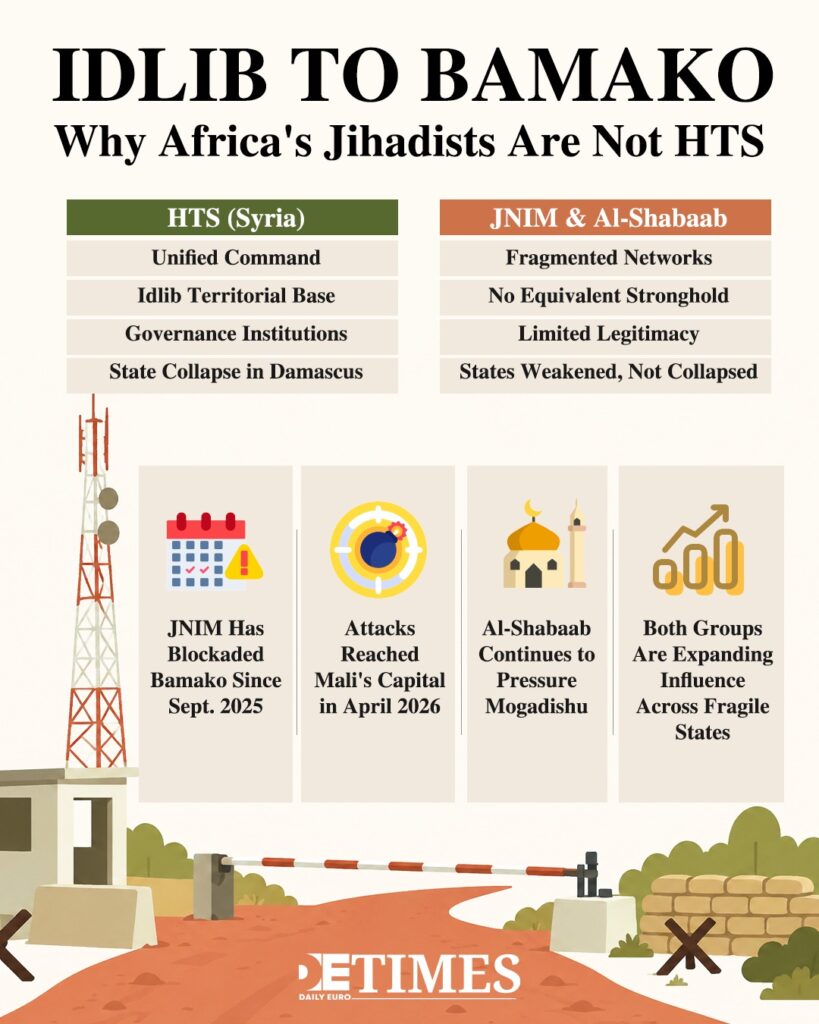
JNIM has blockaded Bamako since September 2025, cutting fuel and food supply routes into Mali’s capital, and on 26 April struck multiple areas of the city directly. Ranked second in ACLED’s 2026 assessment of the world’s deadliest terrorist organisations, behind only ISIS, the group has also taken strategic towns across northern Mali alongside Tuareg separatist fighters.
In Somalia, al-Shabaab continues to pressure federal authorities. The spread is real, it is severe, and in Mali’s case it has already reached the capital’s perimeter. The question is whether any of this leads where analysts are being asked to say it leads: to a Damascus-style state seizure.
The comparison with HTS is tempting because the headlines look dramatic. Armed Islamist movements are gaining territory, state forces are under strain, and foreign counterterrorism strategies are faltering. But analysts tracking both theatres want to stress a distinction the headlines often collapse: territorial pressure and blockade are not the same as the political and institutional conditions that allowed HTS to walk into Damascus in December 2024.
Growth Does Not Equal Cohesion
The first limit is organisational. Sahel jihadism is broad but fragmented.
JNIM, Islamic State affiliates, and local armed actors overlap, compete, and strike tactical bargains without forming a disciplined national project. ISS researchers have argued that the region is more exposed to fragmentation than to a single centralised jihadist takeover. Hudson Institute’s analysis adds that JNIM has not shown intent to seize Bamako outright, even as it squeezes it, because its strategic model is insurgency and attrition rather than state replacement. A blockade and a coup are different operations requiring different capacities.
HTS benefited from a coherent territorial base in Idlib, a semi-governing structure built over years, and a political narrative that could be sold as order after exhaustion. JNIM lacks all three in comparable form. Its strength is in hollowing out state reach across a belt thousands of kilometres wide, not in offering an alternative government that urban populations and civil society would accept.
States Are Weak, But Not Empty
The second difference is state failure of the wrong kind for jihadist seizure.
Many Sahel and Horn governments are weak, violent, or distrusted, but they have not collapsed into the hollowed-out condition that left Damascus available. The withdrawal of French and US counterterrorism forces has created dangerous vacuums, yet those vacuums are regionally uneven rather than nationally terminal. Somalia is the closest case to a more acute scenario: the Africa Center warned that al-Shabaab could threaten Mogadishu if political cooperation between federal and state authorities broke down, and that risk has not receded.
Yet even there the risk operates through fragmentation and siege pressure rather than a broad legitimacy transfer to jihadist rule. Al-Shabaab’s recent reversion to negotiating local power-sharing agreements with pro-government militias, rather than attempting to overrun them, tells its own story about strategic limits.
The Threat Is Still Severe
None of this is reassuring.
A movement does not need to capture a capital to reshape a region. JNIM’s blockade of Bamako is already a humanitarian and economic crisis. Al-Shabaab governs territory, taxes populations, and runs parallel courts across significant parts of southern Somalia. The Sahel’s insurgencies are deepening displacement and eroding state reach across a vast arc from Senegal to Sudan.
Africa’s jihadist groups are better at grinding states down than replacing them cleanly. That may be less spectacular than Damascus. It can still be devastating. The Syria comparison is useful only if it sharpens analysis rather than exaggerates theatre. What these groups are building, for now, looks less like a march on one capital and more like a sprawling, patient politics of attrition against many weakened states with fewer and fewer outside allies willing to help hold the line.
Keep up with Daily Euro Times for more updates
Read also:
Black Winter: Sahel Power Calculus and Global Security Partnerships
Mali Crisis: Patchwork Insurgency Challenges Sahel Confederation
Looking for a Better Life: African Migrants Under Houthi Trafficking