

Officials gathered last week at the Energy Department’s Washington headquarters for a signing few had expected to see completed after two decades of delay, with a screen beaming in Saudi Arabia’s energy minister from Riyadh as the two governments finalised a civilian nuclear cooperation agreement.
A day later, Donald Trump added a condition nobody in the room had mentioned: Saudi Arabia must normalise relations with Israel through the Abraham Accords before Congress approves the agreement. Riyadh has not responded publicly.
Donald Trump also insisted the deal contains no uranium enrichment provision, even as several outlets reported the agreement’s text leaves that door open.
The confusion over a single week captures something larger than diplomatic improvisation. Washington is trying to become Riyadh’s nuclear patron before Riyadh finds a cheaper, faster patron of its own, one that has quietly stood ready for decades: Pakistan.
Old Pledge Made Formal
Pakistan and Saudi Arabia have shared defence institutions since Pakistani soldiers first deployed to guard Saudi borders in the late 1960s, a relationship Riyadh’s oil wealth helped finance for generations of Pakistani military development.
Last September, days after an Israeli strike on Hamas negotiators in Doha, Crown Prince Mohammed bin Salman and Prime Minister Shehbaz Sharif turned that relationship into a written Strategic Mutual Defence Agreement, declaring any aggression against one state an aggression against both.
Pakistan’s defence minister soon told local television that Islamabad’s nuclear capability “will be made available” to Saudi Arabia under the pact, language a Saudi analyst later described as a literal nuclear umbrella over the kingdom.
Some Western scholars caution the pact’s public text names no weapons systems and formalises decades of existing cooperation rather than creating something new.
Either way, Riyadh now holds a security guarantee that costs Washington nothing and constrains it not at all.
Tehran as the Constant Pressure
None of this happens in isolation from Iran. Mohammed bin Salman has said openly that if Tehran builds a weapon, Riyadh will match it, and Saudi officials have spent years warning Washington they expect Pakistani support should nuclear talks with Iran collapse.
The current civil nuclear deal arrives while American operations against Iranian enrichment sites continue, giving Riyadh’s suitors, American and Pakistani alike, a live audience for their offers.
A generous civil nuclear partnership, complete with reactor construction, fuel supply and long-term technical dependence on American firms, gives Washington leverage over a Saudi nuclear future that a bilateral Pakistani handshake would never grant it.
Every American engineer embedded in a Saudi reactor programme is one fewer channel through which Islamabad’s warheads could quietly become Riyadh’s problem to manage.
Counteroffer, Not A Solved Problem
Washington’s approach reads less like nonproliferation policy and more like competitive matchmaking. The enrichment ambiguity Trump introduced this week, paired with the abrupt Israel condition, suggests an administration improvising terms in public rather than negotiating a settled agreement, which weakens the deal’s power to outcompete Islamabad’s offer.
Riyadh, for its part, has spent years also signing nuclear cooperation memoranda with South Korea, China, France and Argentina, treating every suitor as one option among several rather than a single answer.
Pakistan’s arrangement carries no normalisation demands, no congressional review and no Israeli veto, which makes it considerably easier for Riyadh to keep in reserve regardless of what happens in Washington.
A Saudi kingdom hedging between an American reactor programme and a Pakistani nuclear promise is not a kingdom persuaded that either offer alone resolves its anxiety about Tehran.
Congress Now Holds the Question
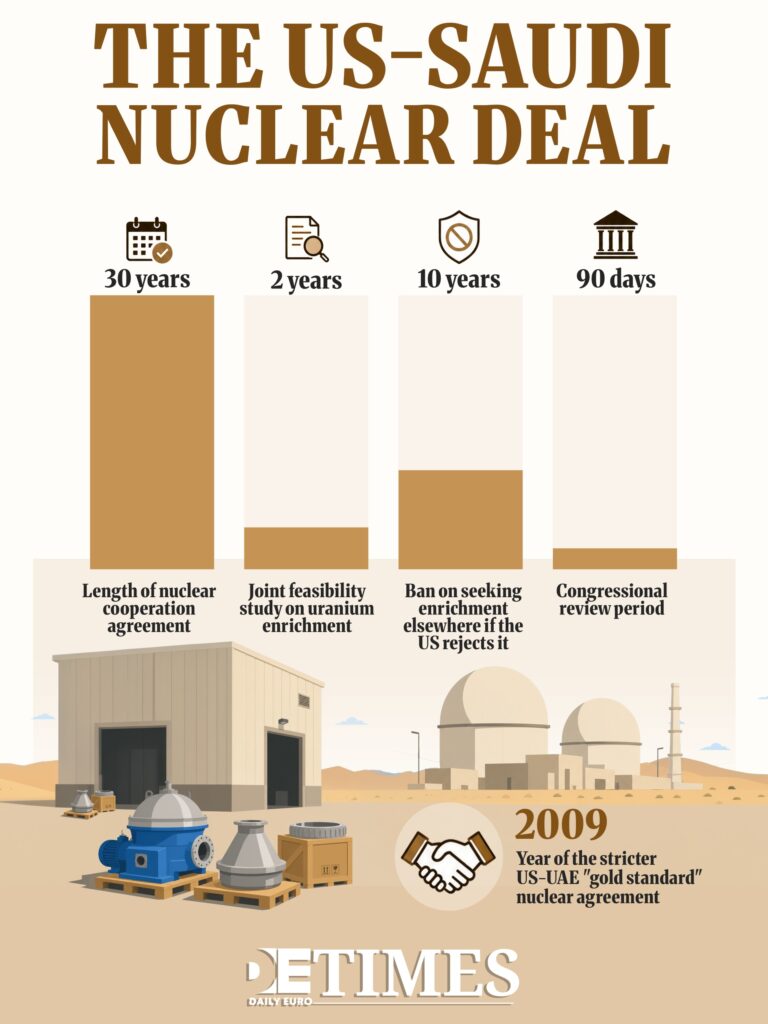
Congress has ninety days to review the American agreement, and lawmakers including Representative Brad Sherman have already asked for the same enrichment restrictions Washington applied to the United Arab Emirates.
Whatever emerges from that review will say more about the deal’s true purpose than anything posted on social media this week. A version stripped of enrichment rights and paired with genuine safeguards would look like an attempt to keep Saudi Arabia inside an American-regulated system rather than an unregulated Pakistani one.
A version that survives with vague safeguards intact, however, would suggest Washington cares less about closing the Pakistani channel than about being seen to compete for it.
Riyadh, unbound by either outcome, will likely keep both options open, treating American reactors and Pakistani warheads as complementary insurance policies rather than rival ones, until Iran’s own nuclear trajectory forces a sharper choice on everyone involved.
Keep up with Daily Euro Times for more updates
Read also:
Slovakia Overtakes France in Nuclear Power Share
Europe’s Nuclear Turn Carries a French Accent
Sahel’s New Power Broker Speaks Nuclear