

A lone day witnessed the most extensive coordinated assault in Mali soil for 14 years.
Before sunrise on 25 April, two detonations struck near Kati, Mali’s primary military base and General Assimi Goïta’s private compound, 15 kilometres north of Bamako. Gunfire erupted at the Modibo Keïta International Airport and, within the hour, in Kidal, Gao, Sévaré, and Mopti.
Defence Minister General Sadio Camara died in an attack on his own residence. Fighters of the Azawad Liberation Front (FLA), Spokesman Mohamed Elmaouloud Ramadane said, had captured most of Kidal; an FLA field commander added that “Timbuktu will be easy to fall” after Gao.
Islam and Muslims Support Group (JNIM) later released a statement confirming joint coordination with the FLA, and called on Russia to “stay out of the conflict for stable future relations.” Africa Corps troops retreated to former United Nations compounds in Gao, the Russian contingent Mali spent years recruiting toiled to hold the north.
What Pushed Rivals into Each Other’s Arms
The FLA–JNIM alliance occupied the hollow vacuum left by the Sahel States Alliance (AES). Mali, Burkina Faso, and Niger established the AES in 2023 through the Liptako-Gourma Charter, later formalising their departure from ECOWAS in 2025.
The AES launched a 5,000-strong unified force in Bamako in December 2025 with considerable ceremony. Operationally, the trio of states grew increasingly brittle in their isolation, leaning on a Russian partner whose Africa Corps toiled to hold major cities.
FLA spokesman Ramadane had explicitly warned “the authorities of Burkina Faso and Niger to stay out of the ongoing events in Mali”, the declaration exposed the fragility of AES solidarity. A government buckling against an armed blockade on its own capital lacks the surplus strength to aid neighbours, a plight Bamako’s neighbours understood precisely.
How Gaddafi Recruited a Rock Star
JNIM founding leader Iyad Ag Ghali’s biography explains why the group carries such resonance across the Malian north.
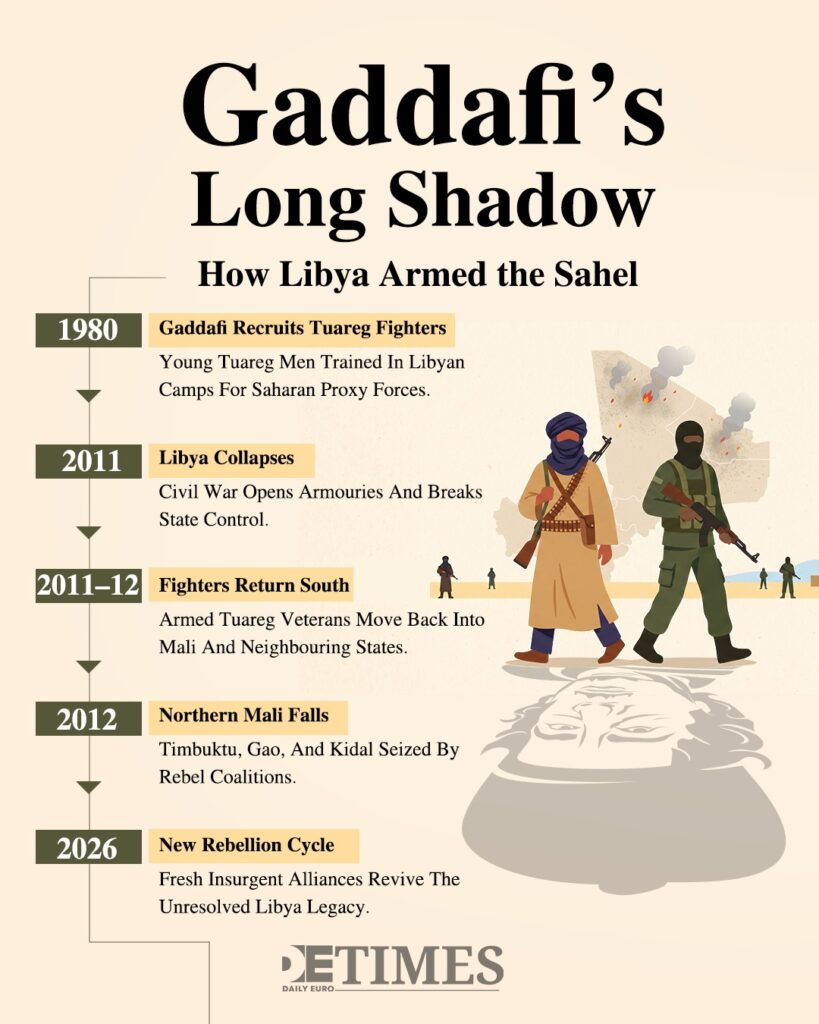
In 1980, Muammar al-Gaddafi promulgated a decree inviting young Tuareg men to undergo military training in Libya, envisioning a Saharan regiment to project power across the region. Ag Ghali answered the call, proved himself as a rebel commander, and negotiated the Tamanrasset Accords with the Malian government.
After Libya Fell, the Sahel Armed Itself
The 25 April offensive finds its genesis in the terminal collapse of the Libyan state.
Libya’s fall in 2011 dispatched thousands of Tuareg fighters with Libyan military training flooding back into Mali. Many joined Ag Ghali’s new Ansar Dine formation, bringing weapons from Gaddafi’s arsenals.
By 2012, a coalition of Tuareg rebels and armed groups had seized Timbuktu, Gao, and Kidal, proclaiming the state of Azawad.
France intervened, the Algiers Accords of 2015 offered a framework for northern autonomy, leading to the eventual erasure of the sidelined accords by the military-led government in 2024.
The Syria Comparison that Almost Fits
The 25 April offensive arguably sought to replicate HTS-led rapid seizure of Syrian cities in 2024.
Researchers Jason Warner and Wassim Nasr had examined the way HTS’s speed and coordination moulded JNIM’s operational thinking; BBC militant media specialist Mina al-Lami observed JNIM’s parochial turn toward Sahelian grievances.
The economic blockade JNIM imposed on Bamako from September 2025, severing petrol convoys from the coast, echoed the encirclement tactics HTS deployed before the Syrian state buckled.
The distinct Sahelian state of affairs limits the comparison. “Mali isn’t Syria and JNIM isn’t HTS, politically, militarily and diplomatically speaking,” armed group researcher Philip Bra said. JNIM lacks a regional patron to anchor a post-junta order, operating instead as a source of regional alarm across five states.
Three Scenarios, One Fractured Region
The AES advertised a collective security response that struggled to withstand the multi-front pressure now crushing Mali.
Three trajectories now lie open. A Somalia-style fragmentation would see Bamako retain a rump state as armed groups administer vast territories.
Another outcome, similar to Sudan, would drag the fighting across borders, dissolving what remains of AES cohesion.
Negotiation, the third trajectory, has a historical basis: JNIM’s operational commander Ibrahim Ag Koufa stated in December 2024 that the group remained open to negotiations with the government and what he referred to as ‘conflict resolution.’ The FLA’s own existence has periodically circled back to peace talks.
Keep up with Daily Euro Times for more updates
Read also:
Black Winter: Sahel Power Calculus and Global Security Partnerships
Diplomatic Immunity No Longer: What Mali’s Arrest Means for Europe
Sahel’s New Power Broker Speaks Nuclear