

Classics is often presented as a civilisational inheritance that runs cleanly from Athens and Rome into modern Europe. Egypt usually appears in that story as backdrop, museum, or conquered land.
The new find at Oxyrhynchus makes that version harder to sustain. It shows Greek literature circulating inside Roman Egypt in ways that were practical, intimate, and far less tidy than the polished idea of “Western heritage” suggests.
A Spanish-Egyptian archaeological team working at Oxyrhynchus uncovered a papyrus fragment from Homer’s Iliad placed inside a Roman-era mummy. The University of Barcelona said the latest campaign ran from November to December 2025 and produced finds of “exceptional historical and archaeological significance.”
Researchers confirmed the fragment preserves lines from Book II — specifically the Catalogue of Ships — and described it as the first known Greek literary text found deliberately incorporated into an embalming context.
Literature Did Not Stay Pure
That detail matters because ancient literature is often imagined as a separate world of scrolls, schools, and elite readers.
This fragment suggests a messier reality. A text now treated as the summit of canonical poetry was reused in funerary practice, folded into the material life of death and preservation. The Iliad was not only read. It was handled, repurposed, and absorbed into a provincial world where Greek and Egyptian habits overlapped.
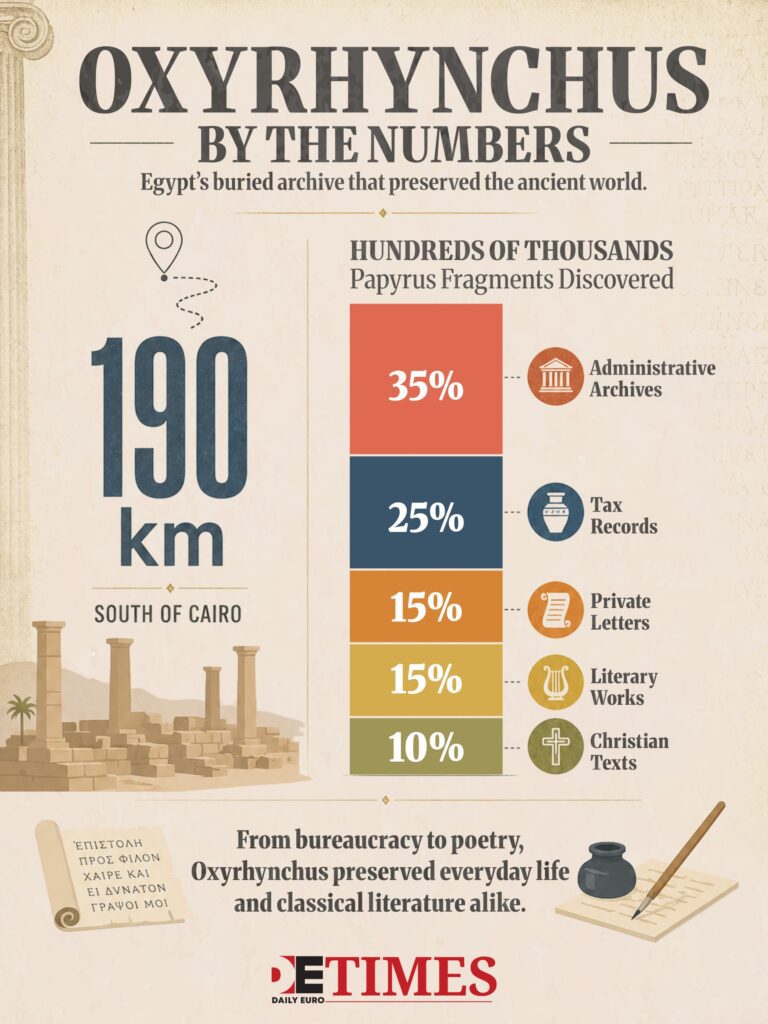
Oxyrhynchus is the perfect place for that lesson. The city, known today as Al-Bahnasa and located around 190 kilometres south of Cairo, has yielded hundreds of thousands of papyrus fragments over more than a century of excavation. Administrative records, private letters, tax receipts, Christian writings, and literary works have all surfaced there. Homer appearing in a mummy continues that pattern of cultural mixing rather than breaking it.
Egypt Carried the Archive
There is also a modern irony in the headlines around this story.
The discovery is being framed as a Spanish archaeological success, and the mission from Barcelona does deserve credit. Yet the deeper point is that Egypt keeps carrying the archive of a world later claimed by Europe as its own. Without Egyptian soil, climate, and burial practice, much of what is now called classical civilisation would simply have vanished.
That is why this find should not be reduced to a charming oddity about Homer and mummies. It complicates the old habit of placing Greek culture on one side and Egypt on the other. Roman Egypt was a zone of overlap, translation, and reuse. The canonical text survived not in a purified library but in a funerary setting far from any classroom.
The modern classics industry still benefits from pretending that antiquity came to Europe in a straight line. Oxyrhynchus keeps showing otherwise. A fragment of Homer inside a mummy is not only a beautiful discovery. It shows that the ancient world travelled through mixture, not purity, and that the archive Europe venerates was often preserved elsewhere.
Keep up with Daily Euro Times for more updates
Read also:
Lebanon Sends Byblos to Paris as a Warning
Trafficked Antiquities: Where Southern Europe’s Treasures Actually Go
Pope Leo XIV Returns Augustine to Algeria