

Péter Magyar swept Hungary’s April election with 53.6% of the vote, taking 138 parliamentary seats for his Tisza party and ending more than a decade of previous rule. Speaking to jubilant supporters on the banks of the Danube, Magyar declared with evident intensity: “Tonight, truth prevailed over lies.”
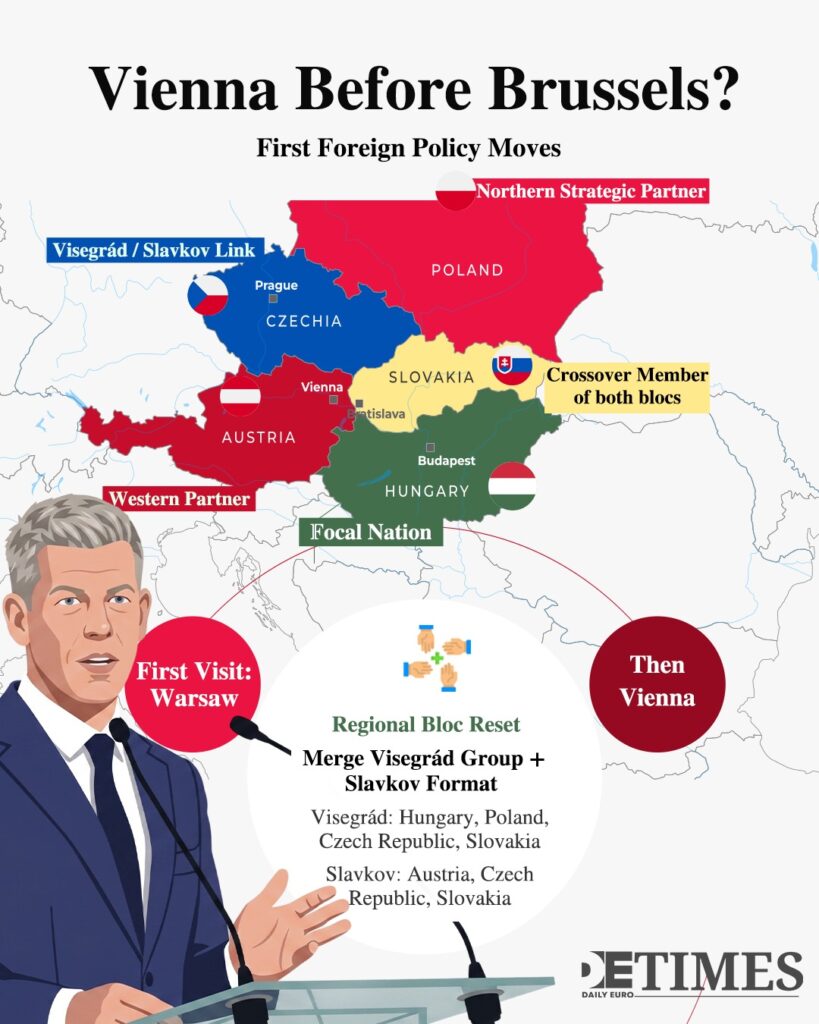
Within days, Magyar had proposed merging the Visegrád Group with the Slavkov format, and announced his first trips as prime minister would be to Warsaw and Vienna. The Habsburg undertones were immediate. “We used to share a country, and Austria is a key economic partner of Hungary,” Magyar said.
“I would like to strengthen the relationship between Hungary and Austria for historical but also for cultural and economic reasons.” Stefano Bottoni, professor of Eastern European studies at the University of Florence, offered a cooler assessment: “He’s basically the first Hungarian prime minister who has a perfect understanding of how the Brussels and European Union machine works.” The coalition push still carries an imperial veneer.
Economic Rationale Without the Mythology
The economic case for tighter Central European coordination stands on its own. Austria is Hungary’s second-largest investor after Germany, with more than €11.7 billion committed, and some 134,000 Hungarians work in Austria.
An unnamed Austrian diplomat told Politico that the Benelux model offered a practical template. Reinhard Heinisch, a political scientist at the University of Salzburg, noted that joint infrastructure bids from Central European governments would strengthen their hand in securing EU cohesion funds.
The lobbying logic is strong enough without the history lesson. Budapest should weigh what the imperial framing actually adds before adopting it in public.
The Empire’s Troubled Legacy
The Austro-Hungarian Empire offers little reassurance from history. Between 1867 and 1918, the dual monarchy failed to accommodate its Slavic, Romanian and Italian communities, deepening internal fractures and regional inequality.
By 1918 the imperial economy had collapsed into hardship, and the multi-ethnic army lost cohesion as the empire broke apart that autumn with startling speed. Its successor states, forged in opposition to Vienna’s centralization, including the Czech Republic, Slovakia and Poland, are now the partners Magyar hopes to recruit.
Inviting them to gather under a symbolic revival of that empire loads a modern alliance with heavy historical baggage.
Europe’s Old Guard Sheds Post-War Restraint
Magyar’s nostalgic framing comes just as postwar restraints are falling away elsewhere. The powers discarding them are responding to cold strategic calculations, not sentiment.
Germany is set to spend €650 billion on defence over the next five years, more than double the previous five-year total, in what Chancellor Friedrich Merz calls a “turning point”, a clear break from post-1945 restraint.
Japan’s Prime Minister Sanae Takaichi has loosened decades-old curbs on arms exports, opening sales to more than a dozen countries. Switzerland launched a security policy realignment in December, prompting Chatham House analyst Grégoire Roos to conclude bluntly that “there’s no way back.”
Diversified Partners Serve Hungary Better
Hungary’s Tisza manifesto commits the incoming government to energy independence from Russia by 2035, restoring judicial autonomy, and joining the European Public Prosecutor’s Office. These are modern commitments.
A disciplined Central European caucus inside EU institutions, modelled on Benelux, would advance Budapest’s aims. The imperial metaphor does nothing to strengthen Hungary’s position in the EU Council, and risks alienating partners with long memories.
An interdependent, multipolar world rewards governments that diversify partnerships across geographies and sectors. A Budapest that acts as a reliable EU member, working with Vienna on energy security, with Warsaw on defence procurement and with Prague on digital infrastructure, will earn political credit that no amount of flag-waving for a defunct empire can provide.
Keep up with Daily Euro Times for more updates
Read also:
A Vote for the EU and Péter Magyar
Oil and Troubled Waters: Moscow’s Luck Holds
Heroes Square to Hollow Institutions: The Orbán Reckoning