

About 36,000 Japanese citizens gathered outside the National Diet building in Tokyo on 19 April, chanting “No War” and carrying placards demanding the government uphold Article 9, the constitutional clause that has renounced war since 1947.
Prime Minister Sanae Takaichi, a week later, formally announced the lifting of Japan’s decades-old ban on lethal weapons exports. Takaichi wrote on social media that “no single country can now protect its own peace and security alone.”
That six-day gap, dense with historical memory, points to something foreign policy debate often overlooks: governments rearm against public resistance, and the political cost of that split matters more than any weapons list.
The Iran war accelerated militarisation. The conflict struck a world already rearming after the Ukraine war, and gave governments in Asia and Europe a clear public justification for defence budgets that voters had long questioned.
Switzerland Chooses Between Two Identities
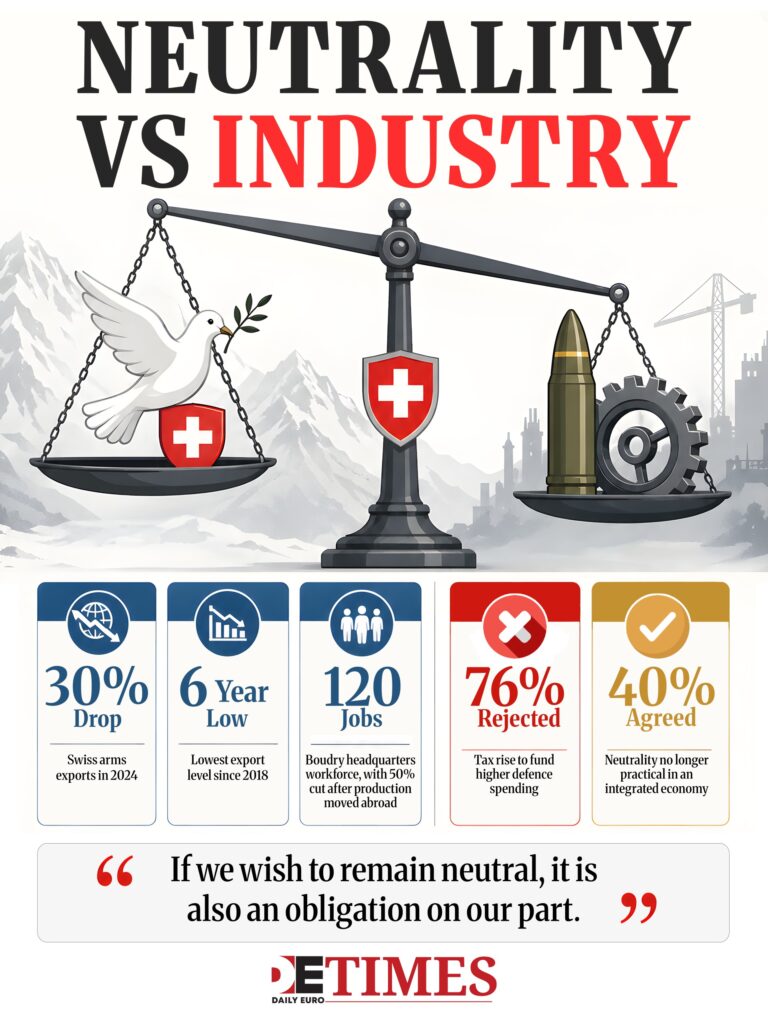
Switzerland’s dilemma shows the contradiction in economic terms. Swiss arms exports fell 30% to a six-year low in 2024, after the Federal War Material Act barred Swiss-made weapons from reaching conflict zones and locked the country’s defence industry out of Europe’s rearmament boom.
Entrepreneur Peter Huber moved most production for his firm Systems Assembling to Portugal, cutting half of the 120 jobs at its headquarters in Boudry. “Defence customers only placed new orders with us if we could guarantee that our products were not manufactured in Switzerland,” Huber said.
The Swiss Parliament responded last December by allowing the government to approve weapons sales to countries at war, as long as ministers deemed the transfers compatible with neutrality, and by lifting the long-standing ban on re-exports.
Defence Minister Martin Pfister put the external pressure plainly: “Europe expects Switzerland to be capable of defending itself without relying on support from others. If we wish to remain neutral, it is also an obligation on our part.” Marcel Berni, who teaches military strategy at ETH Zurich, went further: “Switzerland has convinced itself that it’s neutral. But neither Russia nor NATO see it that way.”
The shift soon collided with Switzerland’s long-standing role as diplomatic intermediary between Washington and Tehran, a function Bern has filled since the two powers severed diplomatic relations in 1980.
On 20 March, the Swiss government declared that “exports of war material to the USA cannot currently be authorised,” and closed its airspace to US military flights linked to the war. The move clarified Switzerland’s priorities: preserving its role as a broker mattered more than the revenue lost by sitting out the arms market.
A 76% majority of Swiss citizens rejected a tax increase to fund higher defence spending during the parliamentary debate. At the same time, a record 40% concluded that economic integration had already made traditional neutrality unworkable in practice, leaving the government trapped between incompatible expectations.
Japan’s Post-War Constitution Under Pressure
Japan’s path carries different weight, shaped by a history its government increasingly treats as a constraint. The Takaichi cabinet approved a record 9 trillion yen defence budget (around $58 billion) for the current fiscal year, the fourth straight annual increase in a five-year plan to double defence spending to 2% of gross domestic product.
The government then removed remaining restrictions on overseas arms sales, and Australia signed a $7 billion contract to buy Japanese warships in April, Tokyo’s largest military export since it eased the ban in 2014.
Japan’s Self-Defence Forces are acquiring long-range Type-12 missiles with a 1,000-kilometre range and autonomous drone platforms under the SHIELD programme, a clear move away from the strictly defensive posture Article 9 was meant to ensure.
Brad Glosserman, a senior adviser at Pacific Forum, argued that Japan has always been pragmatically anti-militarist, and that the current shift is a proportionate response to a changed regional environment.
Japan’s Chief Cabinet Secretary Minoru Kihara described the move as shifting toward “a more robust defense posture for our own reasons.” Both views carry weight as Chinese carrier operations occur near Japanese waters and a US administration presses Tokyo to pay more for its own security.
The 19 April antiwar protesters understood the rationale and rejected it. A Tokyo woman attending her first rally with her seven-year-old son told journalists she feared constitutional revision could pull Japan into war.
Another protester named Takahashi recalled that Japan had inflicted immense suffering across Asia during wartime, and that the pacifist constitution was a deliberate answer to that history.
Mizuho Fukushima, leader of the Social Democratic Party and a member of the House of Councillors, backed the demonstration with a post reading “NO WAR! Don’t change the Constitution!”
Their testimony offers a different calculus: rearmament should be judged not by hardware, but by the new risks it creates.
Economic Pressure Overtaking Peace Principles
The war in the Middle East provided the most dramatic backdrop for arguments officials in Bern and Tokyo had already embraced for market and strategic reasons.
Bern had faced criticism from Berlin and Brussels after Swiss export rules blocked the re-export of Swiss-made weapons to Ukraine. Tokyo had faced a US administration demanding Japan shoulder more of its defence costs.
The closure of the Strait of Hormuz sent oil prices up and disrupted supply chains across Asia within weeks, showing voters in Tokyo and Zurich that in an integrated global economy, non-participation carries a direct cost.
Governments seized on the war to make their case: the world is too interconnected for traditional abstention, and abstention now has an economic price.
Keep up with Daily Euro Times for more updates
Read also:
Palantir: UK Fraud Files and the Swiss Press
Swiss About to Crack: New Financial Realities
Japan’s Cherry Blossom Under Tourism Threat