

Last Friday’s decision by the Trump administration to prolong a waiver permitting Russia to sell oil from tankers at sea, purchases running legally until 16 May, landed in Kyiv as the second blow of a bruising week.
Once Treasury Secretary Scott Bessent issued public assurance that the waiver would expire, only to have his department reinstate it, the development added $10 billion to Russian military spending via 12 million tonnes of crude.
JD Vance told a Turning Point USA crowd in Athens, Georgia, with evident pride: “It’s one of the things I’m proudest that we’ve done in this administration is we’ve told Europe that if you want to buy weapons, you can, but the United States is not buying weapons and sending them to Ukraine anymore.” The Kiel Institute recorded a 99% collapse in US military support for Ukraine between 2024 and 2025.
Zelensky hit back, noting only parties active in peace negotiations possess the requisite understanding of the value of Ukrainian territory.
The Iran War Constricts Ukrainian Options
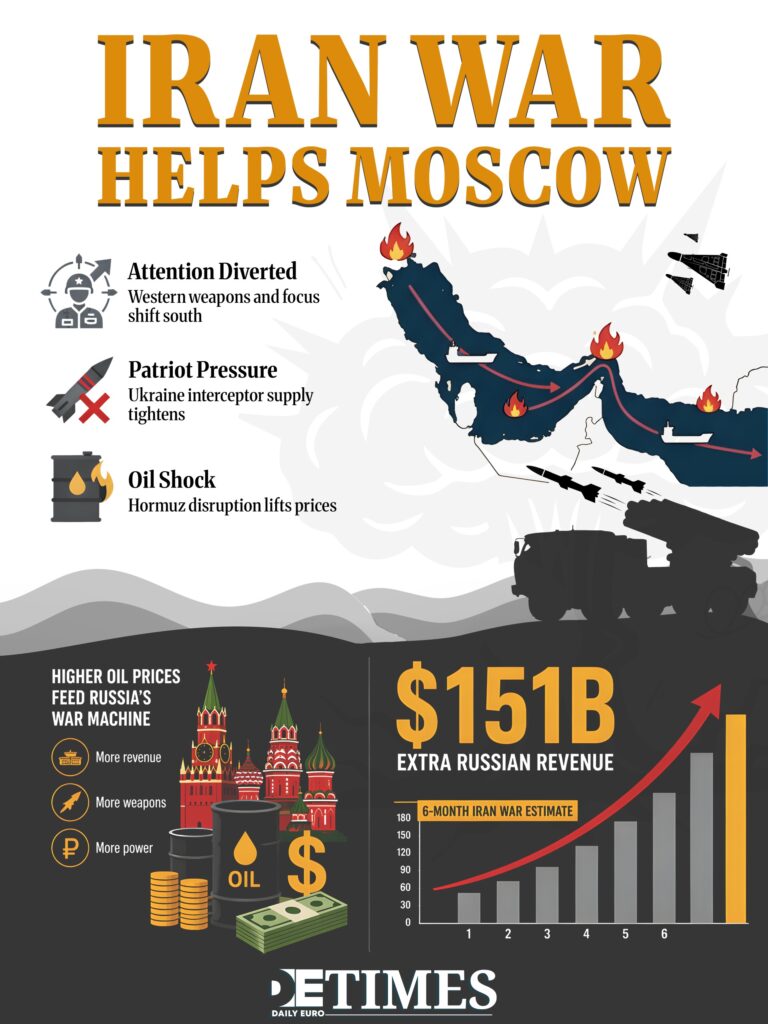
A second tier of pressure built up since late February, as the US-Israeli campaign against Iran diverted Western attention and weapons southwards. Zelensky warned that a prolonged conflict in Iran would shrink Ukraine’s Patriot air-defence missile allocation, stating the package would diminish daily.
Iran’s closure of the Strait of Hormuz pushed oil prices upwards, boosting Russia’s export revenues during a period of already elevated military expenditure in Moscow. The Kyiv School of Economics estimated a six-month Iran war could generate a $151 billion windfall for Russia, covering close to the entire projected annual war budget.
Zelensky told Axios evidence existed of Russia sharing satellite imagery with Tehran to prolong the Middle East conflict, stating, “I think Russia is supporting Iran directly, 100%.”
In his March address to the British Parliament, Zelensky described Russia and Iran as “brothers in hatred,” contending that Moscow benefits from the Iran war on both the military and economic fronts.
The trap for Ukraine is structural. The conflict the US warranted to unlock Russian oil revenues is the same one drawing Patriot interceptors away from Eastern Europe.
Kyiv’s long-standing strategy of undermining Moscow economically collapses on contact with rising oil prices, and four years of investment in air-defence capabilities dwindle before an adversary re-armed with Iranian revenues.
Europe and Washington Part Ways on Strategy
European leaders refused US pressure for NATO to assume a direct role in the Iran campaign, exposing an existing rift over military expenditure. At a G7 foreign ministers’ meeting, EU High Representative Kaja Kallas pressed US Secretary of State Marco Rubio on intensifying pressure on Russia, receiving a sharp rebuff.
The transatlantic spending rift widened at last year’s NATO summit in The Hague, where Washington secured a pledge from most member states to raise defence spending to 5% of GDP. Spain was the sole member state to declare the target unrealistic.
EU Defence Commissioner Andrius Kubilius proposed a standing European force of 100,000 troops, acknowledging that EU armies are built for integration into American-led military structures. Germany has done the most to fill the void, announcing a €4 billion package covering Patriot missiles, IRIS-T launchers, and joint drone production with Kyiv, a designation Washington once held by default.
A Hungarian Election Reopens a €90 Billion Door
Péter Magyar’s landslide victory in Hungary on 12 April delivered the most concrete piece of news Kyiv had received in months. Magyar’s Tisza party secured a two-thirds supermajority, ending Viktor Orbán’s sixteen-year hold on power.
Orbán had blocked a €90 billion EU loan to Ukraine in March, accusing Zelensky of deliberately withholding Russian oil supplies to Hungary via a Soviet-era pipeline. Magyar campaigned explicitly on freeing the loan, and the EU’s Cypriot presidency placed the package back on the agenda within days of the vote.
Nonetheless, the gains carry caveats. Magyar’s government must reconcile Hungary’s reliance on Russian energy with EU obligations, and Slovakia’s Robert Fico pledged to take Orbán’s obstructive place at the EU table. Orbán stays in power until Magyar formally enters office in early May, placing the capital in a holding pattern for a few weeks longer.
Ukraine Turns Necessity Into New Partnerships
The Moscow-Tehran association that has burdened Ukraine from two directions has given Kyiv an opening: four years of combat experience against Iranian drone families translates directly into expertise sought by Gulf capitals battling the same threat.
In late March, Zelensky visited Saudi Arabia, Qatar, and the UAE and signed ten-year security and defence agreements. “Simple sales do not interest us,” Zelensky told reporters, describing the pacts as durable strategic ecosystems spanning joint production and energy cooperation.
A defense.info analysis evidenced Kyiv offering Gulf states durable strategic ecosystems of software, tactics, training teams, and co-production lines. The UAE brokered a 175-prisoner-per-side exchange, a mediatory role running alongside the new defence arrangements.
Ukraine now generates the security defence expertise it once relied upon from the West. The €90 billion from Brussels and the Gulf pacts specifically secure Patriot interceptor supplies across two simultaneous fronts regardless of whoever provides the funding.
A post-Orbán Hungary, a Gulf ready to invest in Ukrainian expertise, and a Germany willing to step into Washington’s vacated place are assembling into a broader coalition, growing faster than Kyiv’s detractors anticipated.
Keep up with Daily Euro Times for more updates
Read also:
Start to Finish: Ukraine Peace and Nuclear Arms Race
Ukraine Talks in Abu Dhabi: Land for Peace
The US-Russia Peace for Ukraine Leaves Europe in the Cold