

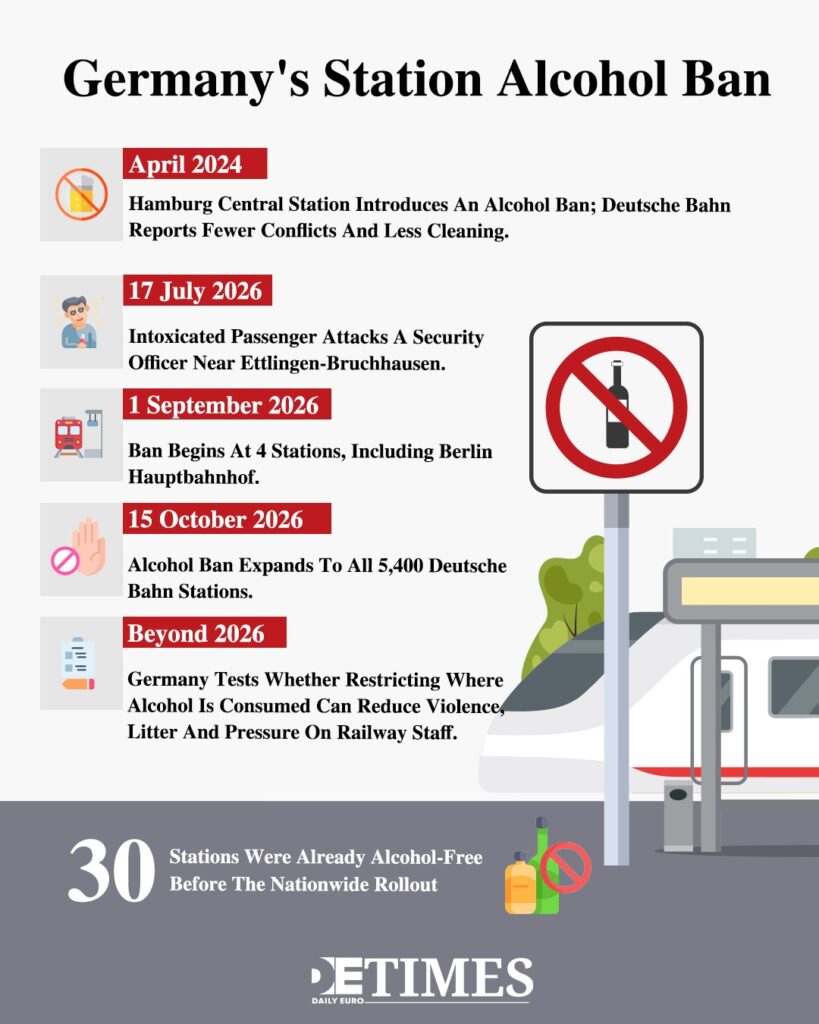
Deutsche Bahn is preparing to remove one of the most familiar sights from Germany’s railway stations: passengers drinking beer on platforms or in station halls. The company announced this week that alcohol consumption will be prohibited at all 5,400 stations it manages, phased in from 1 September at Berlin Hauptbahnhof, Berlin Gesundbrunnen, Kiel and Braunschweig, and fully implemented by 15 October 2026.
The trigger was an attack on 17 July near Ettlingen-Bruchhausen in Baden-Württemberg, in which a 26-year-old security officer was punched and kicked by a 36-year-old intoxicated passenger during a ticket inspection and fell through an open train door. “We have seen all too often that where too much alcohol is consumed, violence also increases,” said chief executive Evelyn Palla. “The experience at stations where the rule already applies is clear: no alcohol means less violence and less litter.”
The policy is not complete prohibition. Travellers may carry unopened alcohol through stations, whilst licensed bars and restaurants inside them may still serve it. Drinking also remains permitted aboard trains, including in dining cars on many long-distance services. Those distinctions reveal what the measure actually is: not a moral campaign against alcohol itself, but an attempt to control where its consequences are felt.
Calling it a sin tax would be imprecise, since no new levy is being imposed. Yet the ban belongs to the same family of policies as tobacco restrictions, sugar taxes and gambling advertising controls, all of which begin from the idea that an apparently personal habit can impose costs on strangers, workers and public services.
Violence Changes the Debate
Deutsche Bahn’s case rests primarily on safety and evidence rather than cultural disapproval.
Hamburg Central Station introduced an alcohol-consumption ban in April 2024, after which the company reported fewer conflicts, an improved sense of security and lower cleaning requirements. Around 30 stations are already designated alcohol-free, including locations in Cologne, Munich and Hamburg. Such findings do not prove that alcohol caused every incident at those stations, but they provide a practical argument for extending the experiment nationally. Germany’s stations function simultaneously as transport hubs, shopping centres, waiting rooms and gathering places. Staff cannot leave when intoxicated passengers become aggressive, and other travellers often have no alternative route. The right to drink therefore competes with the right of workers and passengers to use essential infrastructure without intimidation.
That competition helps explain why the policy may prove popular even in a country where public drinking is culturally normal. Germany is not generally associated with strict alcohol regulation: beer remains inexpensive, widely available and deeply embedded in social life. A nationwide station ban consequently represents a meaningful shift in where the boundary between tolerance and public order is drawn. Deutsche Bahn is implementing the measure under its existing Hausrecht, the legal right of a property owner to set conduct rules on its premises, without any legislative change.
Local station regulations will be amended in coordination with municipalities and public authorities over the coming weeks.
A Ban With Many Boundaries
The exemptions may become the policy’s main weakness.
A passenger may buy a beer in a station shop, carry it sealed through the concourse and drink it after boarding the train. Another may consume alcohol in a station restaurant only metres from a platform where the same act is prohibited. Pro Bahn chairman Joachim Barth described the nationwide decision as an “abrupt and reactive measure” and argued that extending the ban to every station, including thousands of small, unattended stops, could not realistically be monitored. The Gewerkschaft der Polizei’s deputy federal chairman, Alexander Poitz, said the ban was justified in principle but would be difficult to enforce consistently without additional personnel, and that excluding trains created an obvious gap in the policy.
Those criticisms have some force, but they do not undermine the operational logic behind the rule. Restaurants are supervised environments with staff, tables and clearer responsibility for customers. Platforms and station halls are open transit spaces where intoxication, litter and confrontation are harder to manage. The ban may also function best not as a system designed to catch every drinker, but as a legal instrument allowing staff to intervene when alcohol consumption accompanies disorder. A rule enforced primarily against disruptive behaviour rather than applied arbitrarily across all drinkers could improve safety without turning ordinary passengers into targets.
Europe is Restricting Place, Not Product
The German decision reflects a broader evolution in European public-health and public-order policy.
Governments increasingly avoid outlawing socially accepted products outright. Instead, they limit the spaces in which those products may be consumed, advertised or sold. Smoking followed this path. It remained legal whilst progressively disappearing from aircraft, offices, restaurants, platforms and many outdoor areas. Alcohol could gradually face a comparable, though less comprehensive, process. Railway stations are a particularly straightforward place to make that case: passengers cannot choose whether to pass through them, and transport workers already face growing pressure from aggression and disorder. Restricting alcohol there is easier to defend than limiting it in parks, streets or festivals.
Still, public authorities should resist presenting every social problem as something that can be resolved through regulating individual habits. Violence at stations may also reflect inadequate staffing, homelessness, drug addiction, poor mental-health provision and weak policing. Alcohol can intensify those problems without being their sole cause, and a ban enforced only in stations does nothing about any of those underlying pressures. The policy is best understood as a limited restriction on conduct in shared infrastructure, not as a broader strategy for managing the conditions that produce disorder in the first place.
A Reasonable Rule, Not a Cure
Germany’s ban is likely to make some stations cleaner and calmer, especially where public drinking has become associated with persistent disorder.
It also sends an important signal to railway employees: their safety takes priority over the convenience of passengers who want to drink whilst waiting for a train. Deutsche Bahn will need to demonstrate through published outcomes that assaults, conflicts and cleaning costs actually fall, and that enforcement does not simply displace troublesome drinking to station entrances, nearby streets or the trains themselves.
The compromise the policy strikes may be precisely what makes it politically workable. It does not demand abstinence. It asks passengers to accept that some habits become less private when practised in spaces that everyone is required to share. Germany is not taxing sin at its railway stations. It is drawing a boundary around its public cost, and that is a different and rather more limited claim, but also a more defensible one.
Keep up with Daily Euro Times for more updates
Read also:
Germany’s Rich Want Out and the Brand is Taking the Hit
Addiction by Design Enters the Courtroom
Hell No to Hellenic Handling of Train Crash Inquiry