

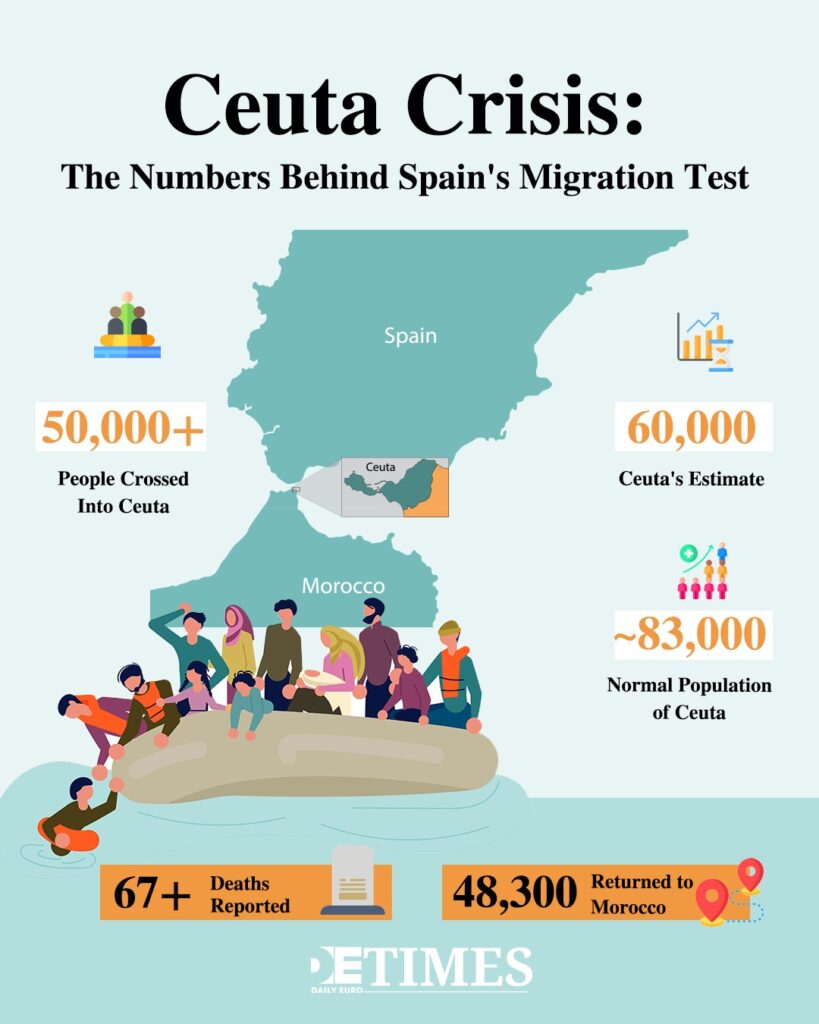
The arrival of tens of thousands of people from Morocco into Ceuta over 30-31 July has placed Pedro Sánchez’s migration policy under its greatest pressure yet. Spain’s interior ministry said close to 50,000 migrants rushed into the enclave since Thursday morning; Ceuta’s president Juan Jesús Vivas put the figure at 60,000, equivalent to more than 70% of the city’s normal population of 83,000. At least 57 people died, many by drowning or being crushed at the border fence and breakwater.
By Friday evening, 48,300 had returned to Morocco, according to the interior ministry, but thousands remained in a city whose services and infrastructure were entirely overwhelmed. Sánchez flew to Ceuta and said what had triggered the surge was that “trafficking mafias took a self-serving interpretation of a Supreme Court ruling” and that interpretation “spread like wildfire in recent hours.”
Spain’s government has tried to distinguish itself from Europe’s harder turn on migration, presenting immigration as economically necessary and regularisation as a practical way to move undocumented workers into the formal economy. That model is now under direct challenge. Italy temporarily restored border controls on travel from Spain; France ordered extra checks along its border with Spain; and the US State Department criticised Spain’s immigration policies, saying the incident was a direct result of “deliberate efforts to enable and facilitate mass illegal migration into Europe.”
The Amnesty Did Not Cover New Arrivals
Critics quickly blamed Spain’s recent migration regularisation, under which more than 600,000 applicants had received temporary work permits by July. The suggestion that new arrivals in Ceuta could automatically benefit from the programme is, however, factually wrong. Eligibility was restricted to people already living in Spain before January 2026 and able to demonstrate several months of residence.
The programme did not offer any immediate legal route to those crossing from Morocco in July, and irregular arrivals to the rest of Spain actually fell 32% in the first half of 2026 compared with the same period in 2025, from 17,990 to 12,138, according to interior ministry data. The Ceuta surge cannot be described as migrants responding rationally to a new amnesty.
The mechanism was different and more specific. A recent Spanish Supreme Court ruling determined that migrants arriving by sea could not be immediately returned to Morocco in certain circumstances. Smuggling networks and social-media rumours appear to have interpreted that judgment as a temporary suspension of border enforcement, prompting a sudden and massive movement. The perception that the border had become penetrable spread faster than any accurate legal explanation could follow. Land arrivals in Ceuta in the first half of 2026 had already risen 164% compared with the prior year, from 978 to 2,582, suggesting the conditions for a surge had been building before Thursday’s events.
Morocco is Both Partner and Pressure Point
Morocco is a functioning state with expanding infrastructure, universities and economic projects.
Its stability distinguishes it from several countries across North Africa and the Sahel, and the scale of Thursday’s movement does not suggest a population fleeing war or famine. Many of those who crossed were young men seeking employment, mobility and access to the EU. Major economic differences between Morocco and Spain remain, particularly for young people facing unemployment. Spain depends heavily on Moroccan cooperation to control the border, and when that coordination weakens, whether through confusion, temporary inaction or deliberate pressure, Ceuta can be overwhelmed very quickly. There is no solid evidence that Morocco deliberately engineered Thursday’s surge, though the pattern resembles the 2021 crisis in which Moroccan authorities appeared to loosen controls temporarily.
What the crisis does show is that the legal and territorial divide between the two countries can be exploited rapidly when enforcement signals become ambiguous. The legal framework for returns is now contested, Morocco’s cooperation cannot be assumed and smuggling networks respond quickly to any perceived gap. Those structural vulnerabilities existed before Sánchez’s regularisation programme and will persist after it.
Sánchez Must Defend Both Humanity and Control
Sánchez now faces pressure from two directions simultaneously. Restrictionist parties argue that regularisation rewards irregular entry and makes Spain a magnet for mass crossings. Human-rights advocates warn that a security response cannot erase asylum rights or justify dangerous pushbacks. The government must answer both without simply choosing one side. Spain can maintain legal routes and regularise people who are already established in the country whilst making clear that sudden irregular entry does not guarantee transfer to mainland Europe or future residence. Sánchez has indicated his government is considering legal changes to strengthen repatriation procedures, an acknowledgement that the current framework leaves too much ambiguity that smugglers can exploit.
The episode does not prove that Spain’s relatively welcoming approach has failed. It proves that welcome without clear enforcement can be misrepresented as an open door, and that misrepresentation can move tens of thousands of people in a single day. Sánchez’s challenge is not to imitate Europe’s harshest governments.
It is to show that compassion and control are not opposites, because unless Spain can defend both, Ceuta will keep turning every legal ambiguity into a political and humanitarian emergency.
Keep up with Daily Euro Times for more updates
Read also:
A Poison Chalice: Migration Politics in the Netherlands
Trump Targets Spain and Picks His Hardest NATO Fight
Morocco Edges in on Spanish-Controlled Sahara Airspace