

The Kurdistan Workers’ Party’s recent decision to disband suggests a fundamental change in Middle Eastern security for minorities as the Kurds contemplate new dynamics in Türkiye, Syria, and Iraq.
The decision emerges alongside similar transitions across neighboring Iraq and Syria as foreign powers withdraw from regional conflicts.
Armed Fighters Trading Mountains for Politics
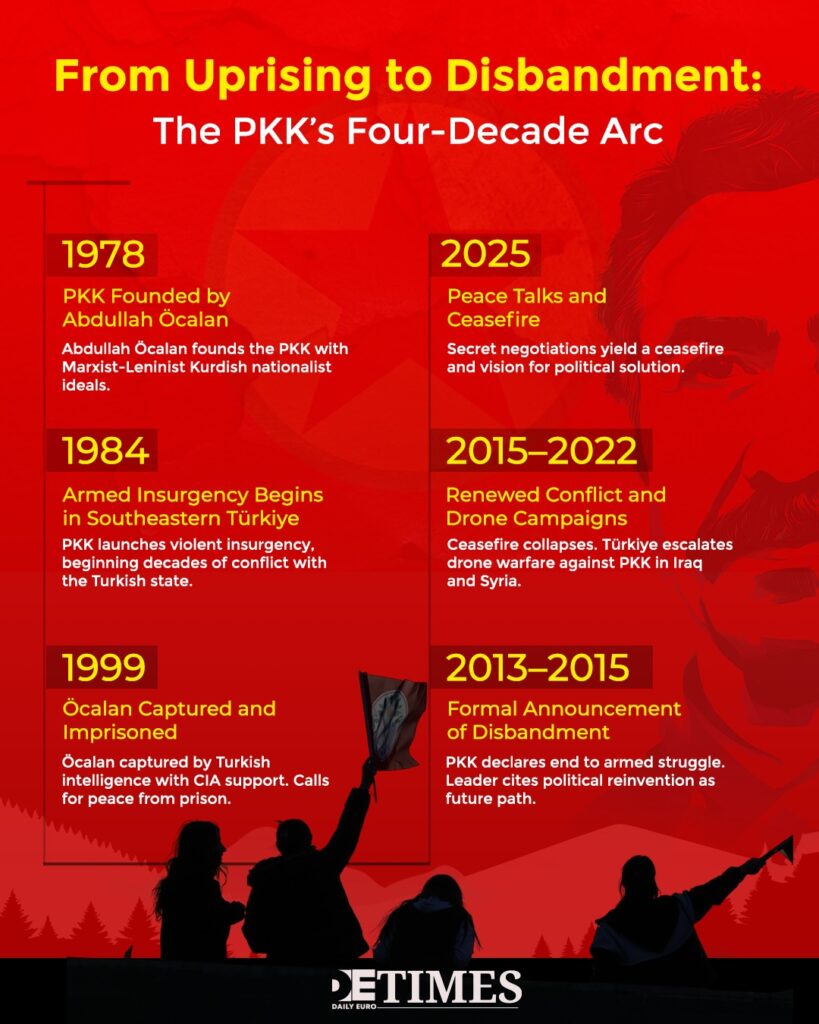
After forty years of conflict that claimed over 40,000 lives, the PKK’s announcement to dissolve itself represents a stunning reversal.
The imprisoned PKK leader Abdullah Öcalan declared that the group’s ideological foundations no longer existed.
This change didn’t happen suddenly.
New regional conditions have pushed many militant groups toward similar conclusions. As foreign involvement wanes, armed groups must adapt or become irrelevant.
"The PKK has completed its historical mission," the group stated.
Their struggle had “successfully challenged policies that sought to suppress Kurdish rights,” but future progress would come through democratic means.
Foreign Powers Step Back, Local Players Adjust
The timing of the PKK’s announcement points to the ripple effects of changing international priorities.
American and European powers have gradually reduced their direct involvement in regional conflicts.
The American partnership with the Syrian Democratic Forces – linked to the PKK – had long irritated Turkish-American relations.
Türkiye had been assured that the collaboration would remain temporary and tactical.
As Western influence decreases, regional powers have filled the vacuum.
The PKK’s announcement comes against a backdrop of notable changes in the region, including developments in Iraq and, more recently, Syria.
Unexpected Allies Find Common Ground Together
The path to the PKK’s dissolution reveals pragmatism from surprising sources.
The PKK leader responded to an offer from Devlet Bahçeli, leader of the right-wing Nationalist Movement Party – traditionally opposed to Kurdish aspirations.
Bahçeli had suggested in October that Öcalan could receive parole if he disarmed and disbanded the PKK.
Öcalan delivered, creating what Kurdish parliamentarian Sırrı Sürreya Önder called an "alignment never seen before."
For Turkish President Recep Tayyip Erdoğan, the calculations serve practical purposes.
Türkiye’s two-term restriction currently disqualifies him from running in the 2028 presidential election without constitutional changes or early elections.
Former Fighters Face Uncertain Future Plans
The real test lies ahead: what happens to fighters who spent decades in the mountains?
This question remains largely unanswered. Details of the peace initiative have not been made public.
Kurdish communities hold high expectations tempered with caution.
"Taking some humane, concrete and confidence-building steps without postponing them until after the holiday is the right way for Türkiye to move forward," urged Tuncer Bakırhan, co-chair of the pro-Kurdish Peoples' Equality and Democracy Party.
Many hope for the release of political prisoners, especially former Kurdish leader Selahattin Demirtaş.
Such action would be “a strong gesture likely to speed up implementation of this historic decision,” suggested Adnan Çelik, an expert at the Paris School for Advanced Studies in Social Sciences.
Similar Stories Unfold Across Middle East
The PKK’s disbandment fits a pattern visible elsewhere in the Middle East.
In Iraq, former militias have integrated into state structures. In Syria, rebel groups formed the government.
These changes all occurred as external powers reduced their presence. Without foreign backing, militant groups must either strike deals with dominant local powers or risk elimination.
For the PKK, this reality became stark recently. The group has been "hit hard by the Turkish military" with "leaders and fighters hunted down in drone warfare," the BBC reports.
Turkish technological advantages made armed struggle increasingly untenable.
Hope Mingles With Distrust Among People
For ordinary citizens caught in decades of conflict, reactions combine hope with scepticism.
“No one has achieved anything,” Ibrahim Nazlican, 63, told the BBC in Diyarbakir, a Kurdish-majority city in southeastern Türkiye.
Others express outright mistrust. “The government have been tricking us for thousands of years,” said Necmettin Bilmez, a 65-year-old driver.
“When I get an ID card in my pocket saying I am Kurdish, I will believe everything will be solved.”
For families who lost loved ones, reconciliation brings mixed feelings.
Menice, who lost five relatives fighting for the PKK, told the BBC she wants her surviving son back.
“I hope Berxwendan and his friends will come home. As a mother, I want peace.”
News Ripples Through Neighbouring Countries
The effects of the PKK’s disbandment stretch beyond Türkiye’s borders.
The group and its affiliates have operated across Iraq and Syria, complicating regional relationships.
Iraq welcomed the PKK’s announcement as “a significant opportunity to promote peace efforts and end longstanding conflicts.” The PKK presence in northern Iraq has caused tension with Türkiye for years.
Internationally, United Nations Secretary General António Guterres described the decision as “an important step towards peace” if implemented. Brussels urged “all parties to seize the moment,” while Syria called it a “pivotal moment” for regional stability.
Peace Requires More Than Words
The PKK’s disbandment creates possibilities for improved relations between Türkiye and its Kurdish minority.
Yet lasting peace requires more than just an end to armed conflict.
It would take "a major democratic transition by Türkiye" to meet demands from Kurdish political parties, said Winthrop Rodgers from Chatham House.
While Turkish leaders have shown “some goodwill,” whether that extends to “major changes needed to ensure full Kurdish participation in politics and society is far less clear.”
For now, central governments hold the cards. As external powers pull back from Middle Eastern conflicts, they must decide how to bring former militants into civilian life.
Keep up with Daily Euro Times for more updates!
Read also:
PKK Defies Odds as Peacemaker After Forty Brutal Years
Türkiye and U.S. Sideline France in Northern Syria
Türkiye Warns Kurdish Fighters in Syria

