
European Commission President Ursula von der Leyen toured Podgorica recently and endorsed Montenegro’s slogan of becoming the “28th member by ’28”. Montenegro’s government has opened all 33 negotiating chapters of the European Union, and Brussels calls the present phase the final stretch.
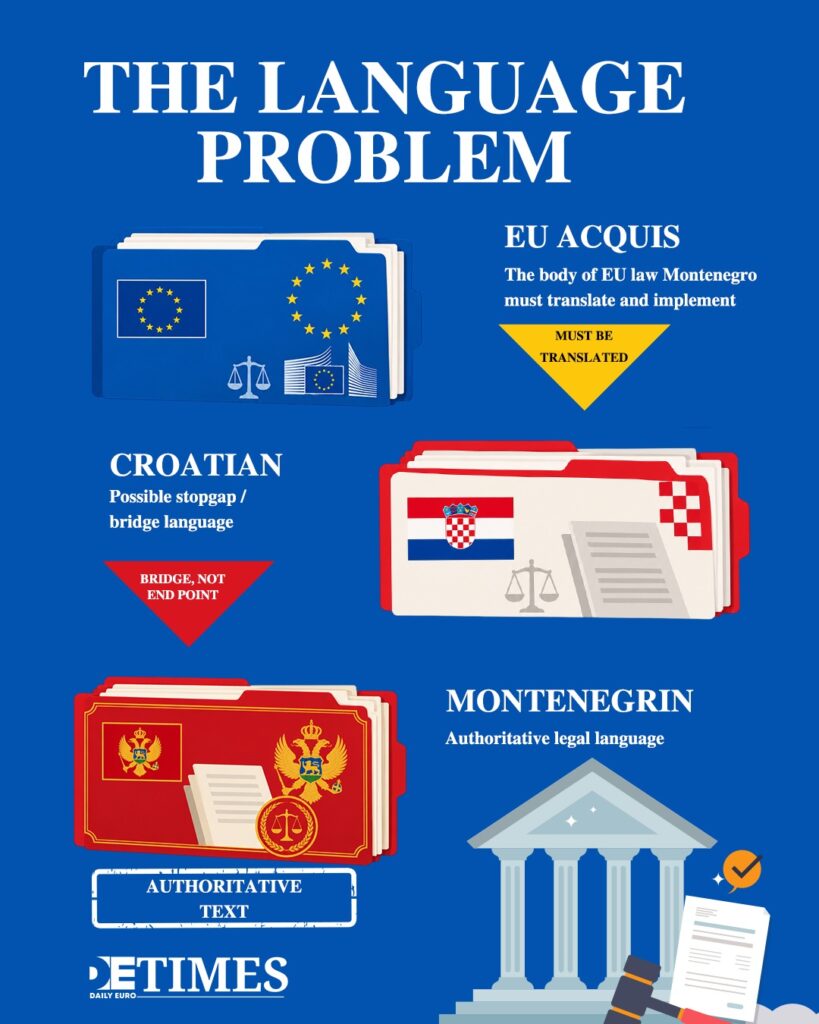
Translation has become the snag, since every candidate must render the whole body of EU law into its official language, and Commission officials explore letting Podgorica borrow Croatian for any gaps.
The stopgap looks tidy on a spreadsheet and would burden Montenegro with legal headaches and wounded pride. Croatian as a bridge language would buckle under political baggage.
A Deadline Meets a Dictionary
The scale of the workload explains Brussels’ nerves. Since Croatia joined thirteen years ago, EU legislation has almost doubled, leaving Montenegro tens of thousands of legal acts to render in its own language.
Podgorica insists its translators will finish on time after investing heavily in administrative capacity.
Croatian tempts officials because it is the only official EU language a Montenegrin speaker readily understands. Convenience of that kind explains the proposal without justifying it.
Negotiators have kept a brisk tempo elsewhere, having closed 18 chapters provisionally by July. Von der Leyen urged Montenegro’s parties to back integration despite domestic friction, so a language row would sour the mood. Podgorica targets 2028 membership, and any delay in translating the acquis ripples straight into the treaty calendar.
Zagreb Holds the Red Pen
Convenience cannot hide the politics. Croatia has questioned the quality of some translated legal texts and has a bilateral dispute with Montenegro that could slow the whole accession process. Letting Croatian patch the gaps would turn Zagreb into the proofreader of Montenegrin law.
Statutes drafted against Croatian text would invite quarrels over meaning in Podgorica’s courts and, eventually, before European judges in Luxembourg. Litigants would pay for every ambiguity with years of delay.
Pride adds a second burden. Podgorica campaigned for years to win international recognition of Montenegrin, which gained constitutional status almost two decades ago. Telling Montenegrins to lean on Croatian after such effort invites a bruising domestic row.
Madrid Adds Its Own Condition
Spain muddies the waters further. Madrid wants Catalan, Basque and Galician recognised as official EU languages ahead of Montenegrin or alongside it, and Spain’s European affairs counterpart assured Maida Gorčević that the wish will not derail accession.
Gorčević herself says Serbian, Bosnian and Albanian should receive official EU status with each state’s membership. Her stance treats every language of Montenegro alike, and fairness favours it.
Official status turns on politics. Brussels never classifies languages by linguistic distance, as Czech and Slovak attest. More than 200 linguists and writers signed the Declaration on the Common Language nine years ago, so nobody disputes the kinship among the four standards. Kinship calls for mutual respect, and respect gives Montenegrin its own seat at the table.
Closing the Gap
Brussels can meet the deadline without borrowing Zagreb’s language. Extra staff and shared terminology databases would help Montenegrin translators cross the finish line with texts in their own tongue.
Where gaps survive in 2028, a time-limited derogation could keep Montenegrin authoritative and reduce Croatian to a reference dictionary with a fixed expiry date. A panel of linguists from Podgorica, Zagreb, Sarajevo and Belgrade could review disputed passages and publish its findings. Croatia would gain a voice without gaining the pen.
Quarterly progress reports would give Podgorica public deadlines and Zagreb a proper venue for complaints. Spain’s ambitions may take years to settle, and Montenegro has no reason to wait for them.
Montenegro has earned its place at the front of the queue through years of grinding negotiation, and Brussels would do well to honour the language its citizens speak.
Keep up with Daily Euro Times for more updates
Read also:
No Buying Your Way In: Malta’s ‘Golden Passport’ Ruling
Words Have Meaning: EU Language Politics Blocks Defence Budget
Curse or Blessing? The Complex Impact of Gulf Investment in the Balkans

