

At the NATO summit in Ankara on 8 July, Donald Trump turned a long-running quarrel with Spain into something sharper. “Spain is a terrible partner in NATO. They don’t participate. They don’t pay. I don’t want anything to do with Spain,” he said, seated next to Secretary-General Mark Rutte. “Cut off all trade with Spain, please, including visits.”
He then turned directly to Treasury Secretary Scott Bessent and ordered him to act immediately, to which Bessent replied: “Yes, sir.” Spain’s IBEX 35 equity index fell more than 2.8% within hours; the yield on Spain’s benchmark 10-year bond rose almost 10 basis points to 3.5682%. The Spanish prime minister’s office said Madrid was treating the comments as “business as usual.”
The backdrop is specific. Spain was the only member of NATO’s 32 states to refuse to commit to the new 5% GDP defence spending target agreed at The Hague last year. Madrid denied US forces access to the jointly operated Rota Naval Base and Morón Air Base for offensive operations against Iran under Operation Epic Fury, citing the lack of UN legal backing.
Spain’s defence spending stood at 2.1% of GDP in 2025, up from 1.4% in 2021 according to the Stockholm International Peace Research Institute, but Rutte himself noted “there are still issues we have to solve.” Trump had made the same trade threat in March without follow-through. The question is whether this time is different.
The First Hit Is Uncertainty
Trump’s outburst may not produce a formal trade embargo, but its first effects have already arrived.
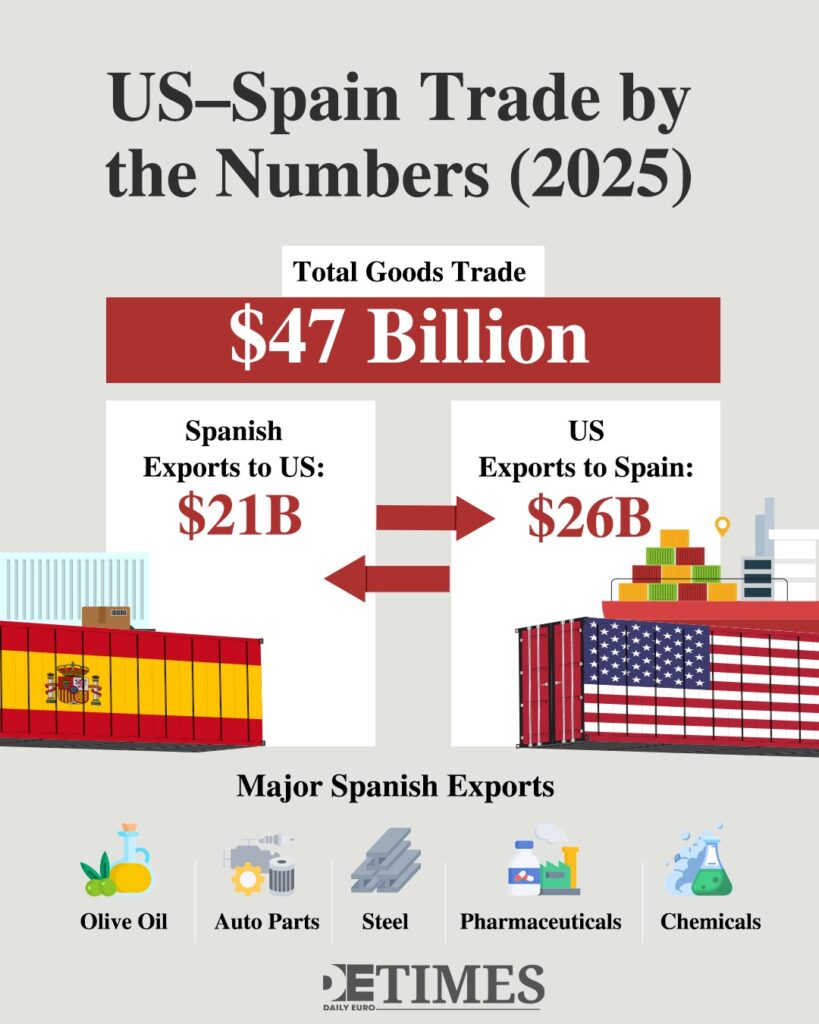
The US and Spain traded roughly $47 billion in goods in 2025, with $26 billion in US exports to Spain and $21 billion in the other direction. Spain is the world’s largest olive oil exporter, and its trade exposure also includes auto parts, steel, pharmaceuticals and chemicals. A US importer deciding whether to renew a contract for Spanish goods now has one more question to ask. A Spanish company planning US expansion now has one more reason to wait. Logistics firms managing long lead-time contracts have to factor in whether political threats will harden into customs friction, selective embargoes or punitive tariffs.
This is the real short-term danger. Trade relationships do not break only when governments sign formal sanctions; they weaken when uncertainty becomes expensive. Business decisions are made on expected risk, not only on today’s law. Once a market is seen as politically exposed, even a subsequent backtrack leaves residue. Confidence is often the first casualty of diplomatic escalation, and confidence is what keeps ordinary trade flowing without panic.
Spain and the U.S. Are Too Entangled for a Clean Break
The threat also lands awkwardly because Spain and the United States are deeply tied in ways that are hard to sever cleanly.
Trade is only one strand of the relationship. Investment, tourism, military basing and corporate linkages all run alongside it, which makes a dramatic “cutoff” far easier to announce than to implement. EU rules requiring trade negotiations to be conducted as a single bloc add another layer of legal complexity, as Reuters noted in its summit coverage. Trump is not merely picking a fight with Madrid. He is picking a fight with Brussels as well, and with a trading relationship that both sides have spent decades building.
Complexity does not equal safety, though. It simply means disruption would arrive selectively rather than all at once. Perishable food exporters and mid-sized firms would be especially vulnerable because they have less room to absorb volatility than large multinationals do. A pharmaceutical group has lawyers, hedging tools and diversified markets. A smaller producer of wine, oil or processed foods has fewer buffers. Even if the legal machinery never reaches a total halt, the threat itself can alter bargaining power: US buyers push harder on terms, Spanish sellers discount more heavily to keep access, and banks treat Spanish exposure more cautiously. In microeconomic terms, political noise becomes a tax on trust.
Citizens May Not Care Yet, but Firms Already Do
Ordinary Spaniards will treat the episode as another Trump outburst unless it starts changing prices, jobs or travel.
Abstract trade conflict is too distant for most households. Concrete business loss is not, and the bond market’s reaction on Wednesday showed that financial markets are already pricing in something more than theatre. The longer-term effects depend on whether the threat becomes a pattern. If it does, Spain could accelerate a wider shift already visible across Europe: treating the United States less as a stable economic partner and more as a political variable requiring active management.
The Palantir issue belongs to the same deteriorating atmosphere. Spain’s reported reluctance to deepen strategic data ties with the US company may not have triggered Trump’s move directly, but it reflects a broader climate of mistrust around dependence that his Ankara remarks will now deepen. Trump’s Spain threat may backtrack, narrow or dissolve into theatre. But even theatre is economically costly when it enters real contracts and real planning cycles. The first thing it cuts is not all trade. It is predictability, and predictability is what exporters, importers and investors cannot easily price without.
Keep up with Daily Euro Times for more updates
Read also:
Defence: NATO’s New Strategy in Eastern Europe
A Tug of War: One Island and Two Visions
Spain: Adiós Relaxation, Hello Red Tape