

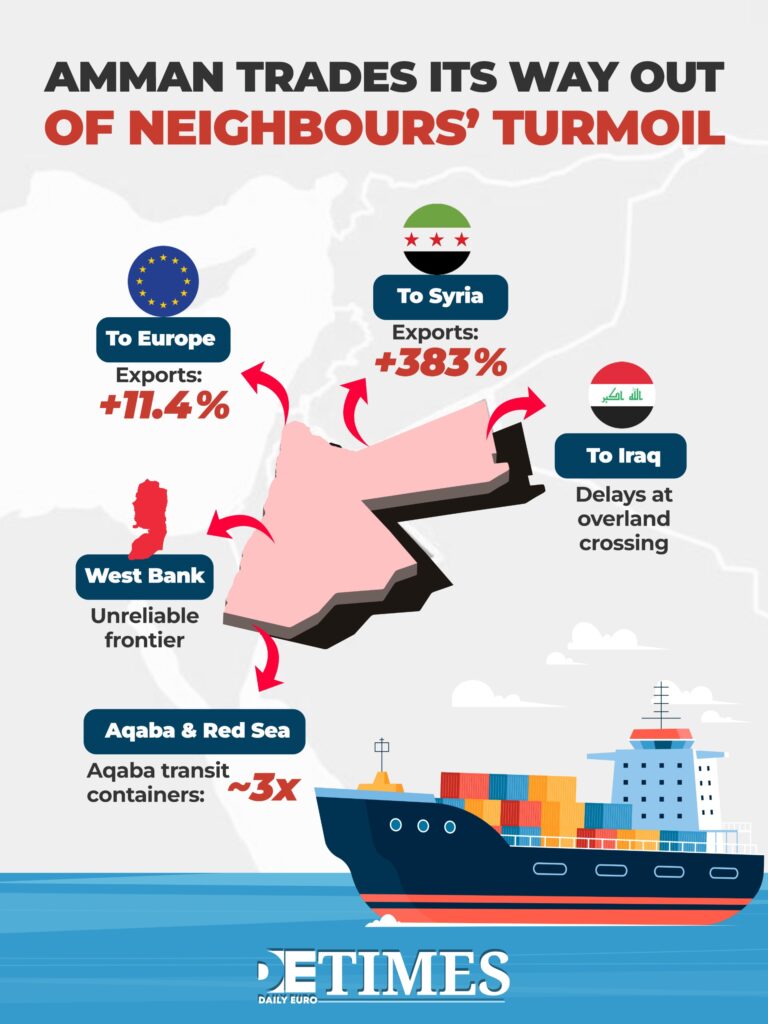
Jordanian-made exports to the European Union rose 11.4% in the first eight months of the year, reaching 411 million dinars as investors gather at the Dead Sea this week. Brussels elevated its partnership with Amman two years ago and attached a €3 billion financing package for 2025 to 2027. The Iran war then pushed the investment conference back from April to November.
Jordan has built a trade role out of a difficult geographic position. Europe would do well to treat that role as a stabiliser worth supporting with long-term investment.
Garments, Fertilisers and Emirati Dates
The increase reflects a broad base of producers. Belgian and Dutch purchases climbed about 46% each, and German orders grew 16.3%, according to the head of the Jordan Chamber of Industry. Industry specialists also estimate $926 million of untapped demand across EU markets, led by garments, chemicals and jewellery.
Exporters credit a simplified rules-of-origin arrangement with easier access, particularly for food products. The Arab Potash Company, for its part, signed a deal with Belgium’s Euroports to handle and store 60,000 tonnes at Antwerp, giving Jordanian fertiliser a European warehouse.
Emirati investment explains much of the agricultural growth. The partnership between Abu Dhabi and Amman helped carry Jordanian dates, Medjool above all, to more than 50 countries. It is driven by the Khalifa International Award for Date Palm and Agricultural Innovation, working with Jordan’s Agriculture Ministry. Gulf capital backing orchards, packing and marketing for years has produced a recognisable brand, and returns have grown over time.
Forty-One Projects Seek Signatures
The upcoming event convenes under the patronage of King Abdullah II, with European Commission President Ursula von der Leyen expected. Jordan will table 41 investment opportunities worth about $15 billion.
Sixteen specialised sessions reportedly cover energy, water security, mining, mobility and railways. The flagship items include the Aqaba-Amman desalination and conveyance scheme, which has secured $5.8 billion and could employ up to 8,000 people, and the Aqaba Digital Hub.
A Wednesday session on Jordanian-European industrial partnerships opened the programme, and the European Chamber of Commerce in Jordan urged buyers to convert trade into manufacturing alliances. The 41 opportunities form a proposal list until investors sign contracts.
Frontiers With Their Own Risks
Evidently, investors sign only where cargo moves reliably, and each Jordanian frontier currently carries a distinct hazard. But Damascus offers the most promising opening.
Syria reopened the Jaber-Nassib crossing last month after a closure triggered by Jordanian strikes on suspected militant sites. The two governments then agreed last week on 11 cooperation documents, including a rail memorandum and a round-the-clock crossing with separate truck lanes.
The World Bank estimates Syria’s rebuilding bill at $216 billion, and Gulf investors courted Damascus early. Exports from Jordan to Syria climbed 383% in the first nine months of last year, so the commercial case is already visible.
Westward, Israeli policy in the West Bank keeps Jordan’s western frontier unreliable for commerce, and Amman has repeatedly warned of escalation. Southward, the Houthis declared a maritime embargo on Saudi shipping in July, which endangers the Red Sea route Riyadh has used to bypass the Strait of Hormuz.
Riyadh nevertheless welcomed Amman’s plan for commercial flights to Sanaa, and the rail memorandum envisages a corridor from Saudi Arabia through Jordan and Syria to Türkiye.
Aqaba, Jordan’s only seaport, sits at the northern end of the Red Sea, and its transit container traffic roughly tripled in the first half. Shipping firms still report delays at overland crossings with Syria and Iraq.
Iranian missiles have crossed Jordanian airspace repeatedly this year, and the European Union’s ambassador in Amman credits the country with “a unique sense of self-preservation and capacity to absorb shocks.”
Keep up with Daily Euro Times for more updates
Read also:
Jordan Valley: The Middle East’s New Fault Line
Defensive Postures Leave Houthi Red Sea Stranglehold Unchecked
Western Exit From Iraq Leaves Tehran’s Cells Untouched