

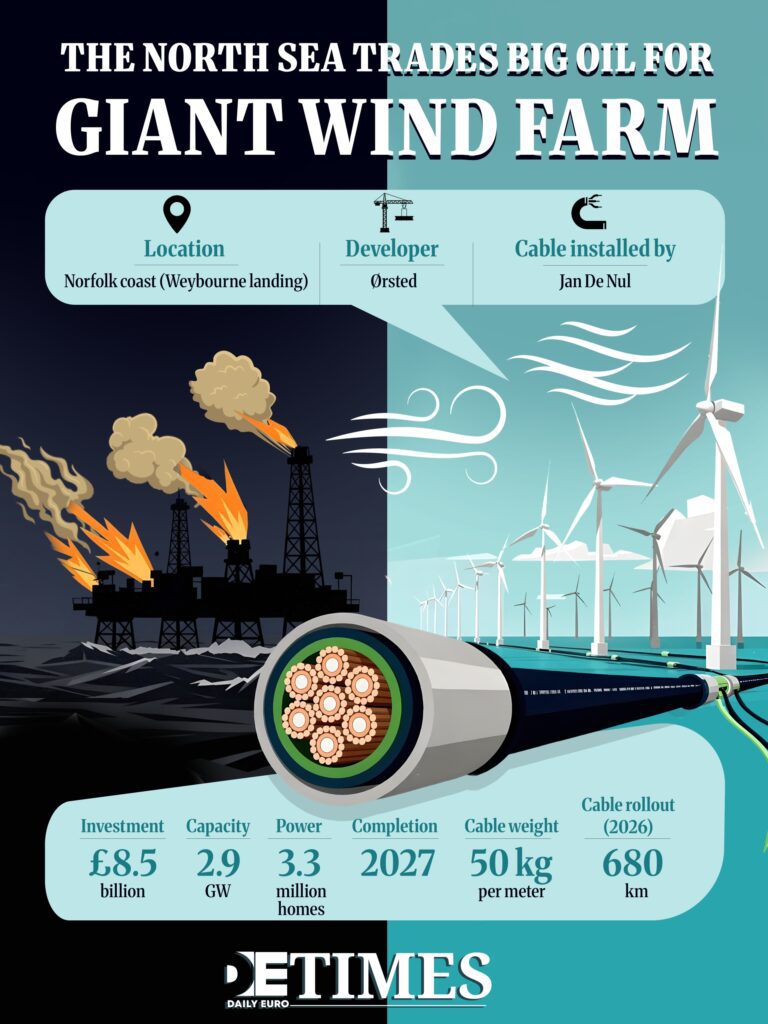
Belgian marine contractor Jan De Nul has successfully landed the first export cable for Hornsea 3 on the shores of Weybourne, Norfolk, marking a critical milestone for the world’s largest offshore wind farm.
The operation establishes the project’s first physical connection to the UK’s national grid via a bundled assembly of high-voltage direct current lines and fiber-optic data relays. The scale of the engineering is immense, with every meter of the cable weighing 50 kilograms.
The £8.5 billion project, developed by Danish company Ørsted, carries a planned capacity of 2.9 gigawatts. By 2027, the infrastructure will generate enough electricity to power more than 3.3 million UK homes.
The same week, from his Truth Social account, President Donald Trump was in full throat. “Europe is in desperate need of energy, yet the United Kingdom refuses to tap its North Sea oil — one of the greatest fields in the world. Tragic!!!” he wrote, adding an instruction to end wind turbines.
The Financials of Anger
Donald Trump’s hostility to wind power is a manifestation of financial loyalty. Fossil energy interests gave at least $75 million to Trump’s campaign and affiliated PACs, making them a top corporate backer.
The industry has since received $18 billion in tax incentives from Trump’s signature legislative package as clean energy incentives were stripped out.
Back in 2024, Trump told oil and gas executives at Mar-a-Lago to raise $1 billion for his campaign, promising in return to act on their policy wish list.
During his second term, Trump’s administration paid $1 billion in taxpayer capital to French energy giant TotalEnergies to abandon two planned offshore wind farms off the US Atlantic coast, redirecting the funds into oil and gas, an extraordinary transfer of public wealth to kill a private investment.
The assertions Trump deploys against wind power, that turbines are ugly, expensive, unreliable, or dangerous to eagles, are described even by the next administration’s own allies as talking points that overlook the 50% decrease in offshore wind outlays since 2013.
The Gulf Has Spoken Louder
The situation in the Strait of Hormuz delivered an emphatic rebuttal to prevailing energy doctrines. Following American and Israeli campaigns, the Islamic Revolutionary Guard Corps declared the strait closed and began attacking merchant vessels, bringing shipping traffic to a near standstill.
The consequences for Europe were immediate and severe. The conflict coincided with historically low European gas storage levels, estimated at merely 30% capacity after a harsh 2025–2026 winter.
The fallout led the European Central Bank to postpone planned interest rate cuts and raise inflation forecasts. The International Energy Agency’s executive director Fatih Birol called it the “worst energy shock the world has ever seen”: worse than the oil crises of the 1970s and the Ukraine war combined.
A Continent Reorders Itself
Europe’s practical response has proceeded faster than the speeches. Scarcely a month before the Hormuz closure, the UK’s Energy Secretary Ed Miliband signed the Hamburg Declaration with European allies in January, an extraordinary pact to jointly deliver 100 gigawatts of offshore wind projects in the North Sea.
The group includes Belgium, Denmark, France, Germany, Ireland, Luxembourg, the Netherlands, and Norway.
The declaration consisted of firm government commitments to building 15 gigawatts of offshore wind annually from 2031 to 2040, with the industry pledging expenditure decreases of 30% by 2040 and 91,000 additional jobs, unlocking an estimated €1 trillion in economic activity.
Hornsea 3’s cable landing in Norfolk was the physical accompaniment to the continental promise: throughout 2026, more than 680 kilometres of export cable will be laid.
East Anglia is becoming a gateway for renewable energy, with power generated in the North Sea brought ashore and carried south to meet demand in London and the south-east.
The restructuring reaches well past Europe’s own shoreline. Nigeria and Morocco are preparing to formalise a foundational intergovernmental agreement for the $25 billion Nigeria–Morocco Gas Pipeline, a mega infrastructure project projected to span roughly 6,900 kilometres along the West African coastline.
The project is the one energy security specialists have described as the “most urgent unbuilt infrastructure on earth”.
The pipeline will link to the Maghreb-Europe gas pipeline and carry Nigerian volumes through 13 African states across more than 7,000 kilometres of Atlantic coastline.
As of now, it remains in front-end engineering and design, with a final investment decision still pending. However, the Iran crisis has overhauled the context of the decades-long delivery timeline for the project.
The Wager History is Settling
The North Sea is answering a query which politicians in Washington are still pretending is open.
Trump’s war on wind, backed by industry capital, sustained by legally dubious executive orders, and reinforced by a $928 million payment to eliminate two wind farms before construction began, is a rearguard action for the benefit of specific investors.
Merely five days after Trump called wind-buying states “stupid people” at Davos, nine European countries signed a deal to build a vast offshore wind hub in the very North Sea he was demanding they drill into.
The economic rationale is established. Today, 58% of EU energy is imported, and the offshore wind pact projects savings of around €70 billion on fossil combustible imports, a 15% reduction in European carbon emissions, and electricity price decreases for consumers.
The statistics were tallied before the Hormuz crisis doubled gas prices and grounded flights from Bologna to Guernsey. Even after a ceasefire reduced Brent and West Texas Intermediate futures sharply, market observers warned of European gas prices staying above pre-crisis levels.
Keep up with Daily Euro Times for more updates
Read also:
Power Bills So High: The Search for Answers
Fighting Over Thin Air: Europe’s Green Energy Myth
Iran Crisis Puts Ireland on the Sharp End