
Farmers and hauliers in Ireland parked tractors on O’Connell Street in Dublin last week, suddenly exposing every trading economy.
Micheál Martin, the Irish Taoiseach, called the six-day blockades “an act of national sabotage,” a phrase carrying quiet irony, given that the disruption started in a waterway thousands of miles from Dublin.
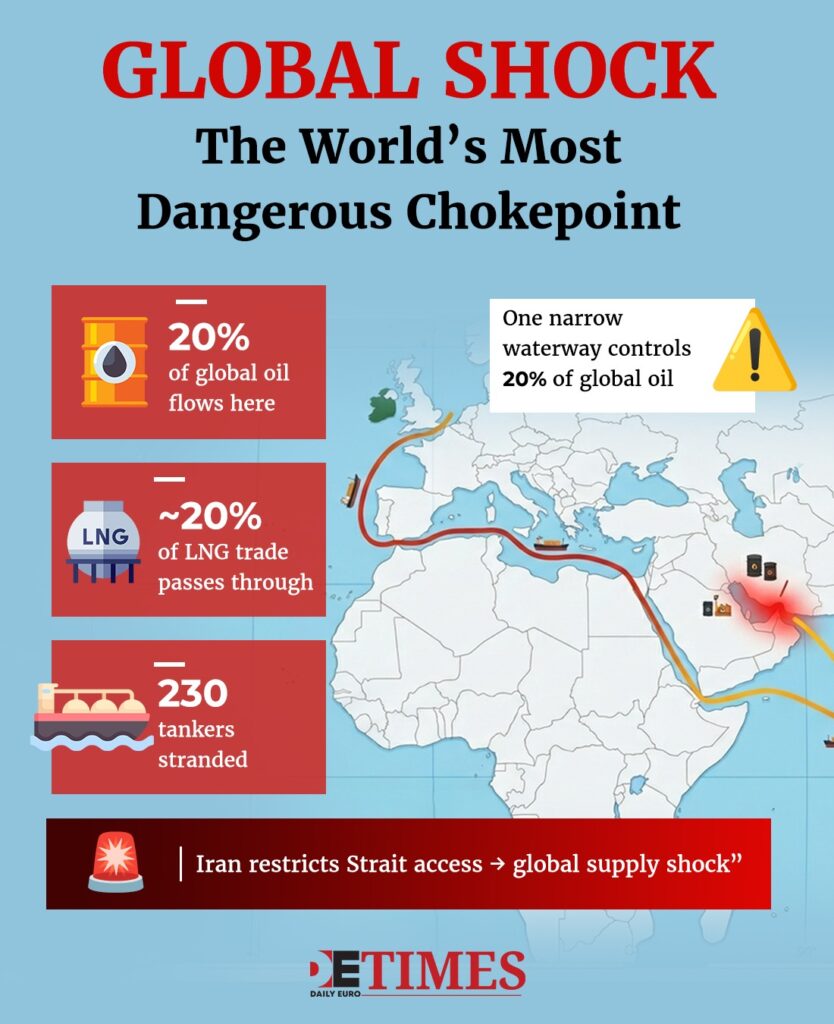
Petrol prices in Ireland jumped 15% above mid-February levels, diesel rose nearly 30%, and home heating oil climbed around 70%, every amount linked to the closure of the Strait of Hormuz. The narrow passage sees about one in five litres of global oil and liquefied natural gas flow through its waters.
On 9 April, Justice Minister Jim O’Callaghan announced that the Defence Forces would assist An Garda Síochána (the state police force) in removing blockades at terminals and refineries, warning protesters of “legal consequences.”
Agriculture Minister Martin Heydon looked very annoyed as he told RTÉ: “What is very clear here is that this is a clear choice between democracy or anarchy, and we have a rule of law in this country.”
The energy shock starting the unrest was linked to the closure of the Strait of Hormuz by Iran’s Islamic Revolutionary Guard Corps. The restriction of oil shipments by more than 90% framed the resulting disruption as the largest ever in the records of the global oil market.
Ireland’s Open Trade as Its Greatest Risk
Ireland stands third on the global Index of Economic Freedom and first for foreign investment inflows, a position earned through decades of open trade.
Taxes account for about 59% of petrol prices in Ireland, a permanent setup long accepted during stable periods and now turned against farmers and hauliers by a geopolitical shock in the Gulf.
Independent Ireland TD Michael Fitzmaurice, who attended the fraught meetings in Portlaoise before Easter, caught the mood: “They feel they’re not being listened to and not represented, and that’s a big problem.”
On 12 April, Micheál Martin announced a €505 million relief package, saying Ireland narrowly avoided a complete redirection of oil tankers: “It made absolutely no sense what was going on.” Emergency Cabinet sessions to rescue energy supplies have superseded typical fiscal prudence.
A Truce That Fixed Very Little
A Pakistani-brokered truce announced on 8 April halted six weeks of strikes between the United States and Iran, but Tehran only agreed to allow shipping through the Strait during a two-week window.
Markets cheered, with crude prices dropping 16% in a day, but the relief lasted only hours.
Abu Dhabi National Oil Company Chief Executive Sultan Al Jaber wrote on LinkedIn on 9 April that “the Strait of Hormuz is not open,” with access “being restricted, conditioned and controlled” and 230 loaded oil tankers stranded inside the Gulf.
International Crisis Group experts judged the truce as genuinely fragile. Washington and Tehran maintained different views on any long agreement. The White House demanded Iran forgo uranium enrichment, but Tehran sought funds and legal control over the waterway.
Energy markets will stay on a structurally higher floor as governments hoard reserves in anticipation of renewed fighting.
Asia Already Burns, Europe Smoulders
Asian economies carry the heaviest immediate risk. In 2024, 84% of oil and 83% of LNG moved through the Strait was bound for Asia, with China, Japan, South Korea, Singapore, India, and Thailand working with near-total need for foreign energy.
The Philippines declared a state of sovereign energy emergency in late March, and Bangladesh resolved to place universities under closure and the military in charge of oil depots.
The energy shock hits first, inflation grows, food prices climb, and political standing erodes. Indonesia’s 1998 crisis evidenced how quickly the chain plays out, as cuts to petrol subsidies helped break the Suharto government.
At the point where a conflict reaches 40 days of age, Daniel Poneman warned it could produce “calamitous effects on Asian growth and political stability” if the blockade stays through the summer.
Europe’s structural weaknesses have exacerbated the current crisis, with gas storage at about 30% capacity after a harsh winter.
The European Central Bank postponed its planned rate cuts in mid-March, raising its 2026 inflation forecast, and economists warned that energy-intensive industries in the United Kingdom and Germany risked permanent loss of output.
Emergency responses were announced in at least 60 states, with about 30 states cutting petrol taxes and 16 Asian governments starting rationing and driving bans.
Ireland’s Trouble is a Warning for All
Ireland built wealth on growth based on exports and foreign investment, making its internal economy very sensitive to global energy price swings.
The carbon tax plan, designed for the stability of calm markets, added a financial multiplier to every barrel of oil that rose in price because of a war made by other powers.
Economies built on trade, from Ireland to the Netherlands to Singapore to South Korea, are learning that one chokepoint 5,000 kilometres away can put army vehicles on O’Connell Street.
South Korean President Lee Jae-myung urged citizens to “save every drop of fuel” in early April and added that the crisis offered “a good opportunity to swiftly and extensively transition to renewable energy.”
Structural weaknesses are being addressed through both energy transitions and geopolitical engagements.
European leaders must engage Gulf producers as the vital trading partners they are. ADNOC’s Sultan Al Jaber put it precisely: “The weaponization of this vital waterway, in any form, cannot stand.”
Keep up with Daily Euro Times for more updates
Read also:
Ireland’s Basic Income for Artists Becomes Permanent
New Troubles: Northern Ireland Vigilante Crisis
Losing the Plot: Why European Farmers are in Revolt