

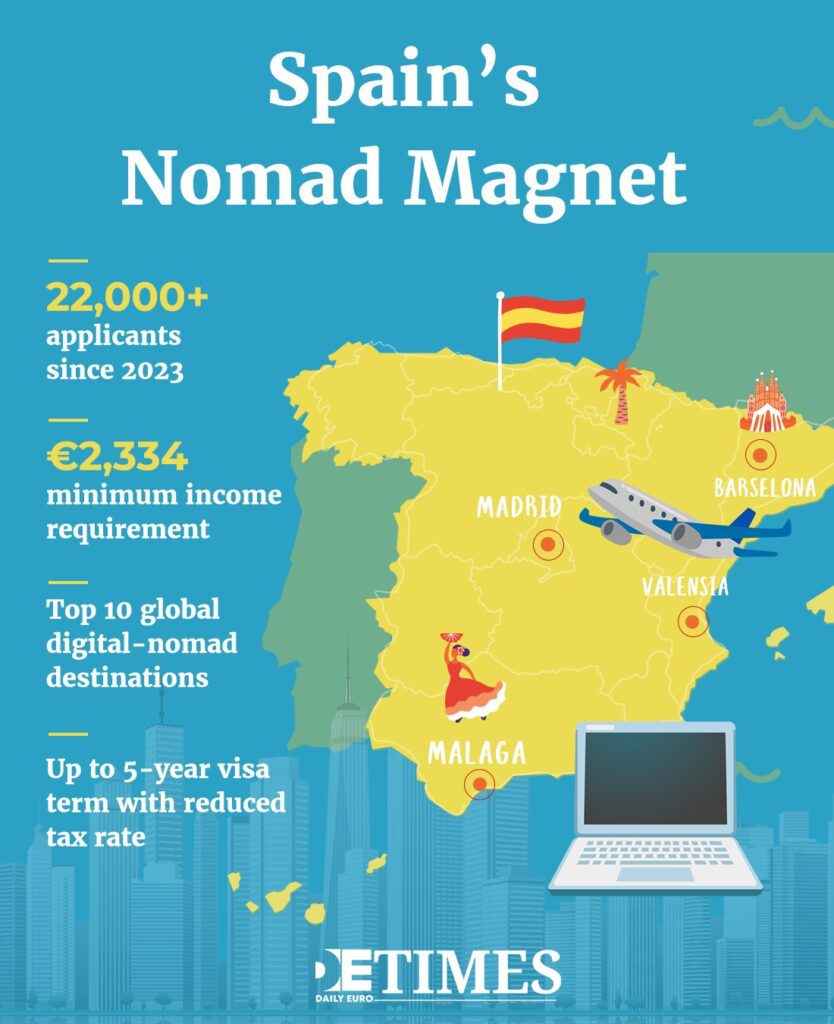
Since Spain launched its Digital Nomad Visa in 2023, the country has become one of the world’s top destinations for remote professionals.
According to 2025 data from the Nomad List and VisaGuide.World, Spain ranks in the global top ten, alongside Portugal, Croatia, and the United Arab Emirates.
The appeal: reliable infrastructure, cultural vibrancy, and a cost of living lower than in northern Europe. The scheme, part of the 2022 Startups Law, allows non-EU citizens earning at least €2,334 per month to stay and work for up to five years on a reduced tax rate. By early 2025, the Ministry of Inclusion and Social Security reported over 22,000 applicants, mostly from the United States, the United Kingdom, and Germany.
Cities such as Barcelona, Valencia, and Málaga have adapted quickly. Co-working spaces fill former storefronts, cafés advertise remote-friendly menus, and new accommodation markets target international workers. Yet beneath the optimism lies a growing imbalance between global mobility and local affordability.
Prosperity with a Price
The benefits of this new economy are undeniable. The influx of digital professionals has revived certain neighbourhoods, boosted local consumption, and expanded Spain’s profile as a hub for creative and tech industries.
But it has also intensified pressure on housing. According to a 2024 report by Idealista, long-term rental prices in Valencia and Málaga rose more than 20 percent in a single year. Short-term furnished apartments now command record prices, often out of reach for local residents.
In Málaga’s central districts, small businesses welcome the influx but worry about displacement. In recent years, demand for digital-nomad accommodation on the Costa del Sol increased 40 percent. Local councils have responded unevenly: Barcelona is tightening short-term rental rules, while Valencia is considering a tourist-stay tax for remote workers who remain beyond 90 days.
The paradox is evident. Spain wanted to attract new residents; it is now struggling to keep housing accessible for its own citizens.
A Regional Mirror
The digital-nomad trend is not confined to Europe. Across the Mediterranean, MENA countries are courting the same mobile workforce.
Morocco, for instance, has emerged as a regional competitor, promoting Casablanca and Marrakech as affordable bases for European freelancers. The Ministry of Tourism reported a rise in medium-term stays in 2024, especially from remote workers seeking lower costs and cultural proximity to Europe. Egypt and Tunisia have begun pilot visa schemes for digital professionals, while the UAE continues to lead with its established Remote Work Visa, positioning Dubai as the region’s innovation capital.
These parallel developments reveal a shared challenge: how to balance openness with sustainability. Rapid inflows of foreign professionals can boost revenue but also inflate local markets and deepen inequality. Whether in Málaga or Marrakech, the question is the same — who truly benefits from this new kind of mobility?
The Uneven Geography of Opportunity
Spain’s Digital Nomad Visa was partly designed to revitalise rural areas suffering depopulation. Yet most visa holders settle along the Mediterranean coast.
Only 4 percent registered in these rural municipalities housing under 20,000 residents in 2024, according to regional data compiled by the National Statistics Institute (INE).
Infrastructure explains part of the gap. High-speed internet and transport links remain concentrated in major cities. But social ecosystems matter too: digital workers tend to cluster where they find cultural familiarity and peer networks. The result is a two-speed Spain; prosperous hubs on one side, quiet interiors on the other.
Similar patterns are emerging across southern Europe and North Africa. Coastal zones attract the bulk of mobile professionals, while interior provinces continue to lose population. The geography of remote work often mirrors old trade routes and prosperity therefore flows where connectivity is strongest.
The Balance Ahead
Spain’s experience offers lessons for the wider region. Remote work can diversify economies, but it must be managed carefully. Without local engagement, nomad communities risk becoming self-contained bubbles. Municipal initiatives in Valencia and Seville now promote cultural exchange projects linking newcomers with residents, small businesses, and language centres.
The European Commission’s 2025 Smart Mobility report urges member states to connect digital-visa policies with local investment and training, ensuring that innovation benefits communities rather than bypassing them. Spain could take the lead by extending this cooperation to its southern neighbours, sharing expertise on sustainable digital infrastructure and housing regulation.
Ultimately, the story of Spain’s nomad boom is not only about technology or lifestyle. It is about belonging. The challenge is to keep cities open without letting them become anonymous.
Freedom, at a Cost
Remote work promised liberation from offices and borders, yet it is quietly redrawing both. Spain’s digital-nomad boom has made its cities more visible, more diverse, and in many ways more fragile. The same is happening in other parts of the Mediterranean, where growth coexists with inequality.
The task ahead is to transform mobility into mutual benefit to ensure that digital freedom enriches the places it touches rather than erasing what made them unique. Spain’s experiment shows that paradise is rarely perfect, but with care and cooperation, it might just be sustainable.
Keep up with Daily Euro Times for more updates!
Read also:
Europeans Want a ‘Secure, Easy-to-Use, and Free Digital Euro
Spilling the Tea on EU Identity Laws
Lagarde Bids for Digital Liberation from Wall Street