
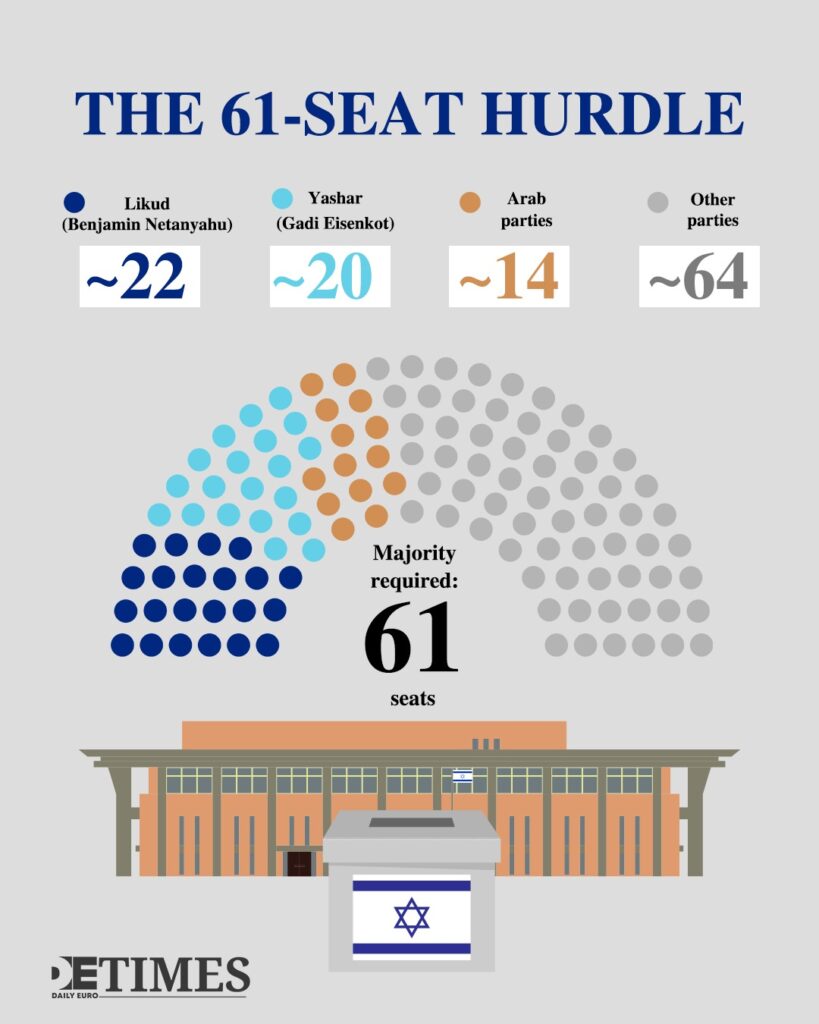
Final television polls published days before Tuesday’s vote put Gadi Eisenkot’s Yashar at about 22 seats and Likud at about 20, and no bloc reaches the 61 needed to govern. Arab parties are projected at roughly 14 seats, which hands them the balance.
Benjamin Netanyahu, 77, is Israel’s longest-serving prime minister. He denies the fraud, breach of trust and bribery charges at home, and he carries an arrest warrant from the International Criminal Court. Eisenkot, a former chief of staff, resigned from the war cabinet after eight months, saying the prime minister lacked a coherent strategy.
Eisenkot might win the largest list. Arab-party seats and votes wasted below the threshold will decide the premiership, and a Netanyahu defeat would alter Israel’s tone far more than its course.
Four Names Dominate the Race
Netanyahu campaigns on security and his closeness to Donald Trump, who has endorsed him, and opponents blame him for failures before 7 October and for the wars that followed.
Eisenkot offers a hawkish moderation. His son and two nephews died fighting in Gaza, and he would become Israel’s first prime minister of Mizrahi descent if he assembles a coalition.
Naftali Bennett, a former prime minister, shares a joint ticket called Together with Yair Lapid, and polls credit it with about 15 seats. Itamar Ben-Gvir’s Otzma Yehudit is polling at about eight seats on its own, a striking gain for a national security minister with convictions on his record.
Avigdor Lieberman’s Yisrael Beytenu and Yair Golan’s Democrats hover near eight and nine seats.
The opposition bloc is a loose coalition of rivals who dislike Netanyahu strongly and trust one another weakly.
The Arab Slate Holds the Balance
Mansour Abbas, leader of Ra’am, announced at the end of August that Yoav Segalovitz, a former police major-general and deputy public security minister, would take second place on his list. The pairing is a first, since no Jewish candidate had joined the slate before.
Segalovitz keeps freedom to vote independently on religion, security and social questions. Ehab Jabareen calls him “a certificate of political usability”, a tool for making Arab seats count after the ballots close.
The Joint List criticised the choice, and Lieberman says Ra’am cannot serve as a coalition partner this time. Abbas has therefore bought acceptability in the Jewish mainstream at a price in Arab goodwill, a gamble that remains unproven.
Thresholds Decide the Count
Every list needs 3.25% of the vote to enter the Knesset. Ofer Winter’s People of Israel averages 2.9% across the final television polls and misses the line in all of them, and a reservists-economic list sits near it. Each wasted vote shrinks the pool of counted ballots and lifts rivals, so a few thousand ballots could swing several seats.
The final poll write-up offers a reminder that “winning the largest number of seats is not the same as securing the premiership.” If Eisenkot tops Likud and falls short of 61, he must persuade Arab parties to back him from outside the cabinet or accept a fragile coalition.
Arab parties won ten to fifteen seats in past elections, so the projected 14 sits near the top of that range. Repeat elections are a possibility, and turnout in Arab towns will count heavily.
Defeat Changes Tone but Barely Course
Observers expect continuity whoever governs. Aron Lund says “Chances are that a successor to Netanyahu would find himself handling the same regional issues using the same tools”.
Rouzbeh Parsi adds that regional capitals “are less concerned with who becomes prime minister”.
A coalition less dependent on Smotrich and Ben-Gvir could be more flexible on Gaza reconstruction and West Bank rhetoric, but Hamas disarmament and Palestinian governance would remain unresolved.
Iran policy would probably keep its form, since Eisenkot and Bennett share the security establishment’s outlook.
An Eisenkot government could reduce friction with Washington and Cairo, which treats displacement across Rafah as a red line.
Partners Take Note
Europe has its own stake. The Netherlands requested a review of the European Union’s Association Agreement with Israel last year, with France and Slovenia backing the request. Kaja Kallas noted the divided views of member states. A less combative government might defuse that dispute without ending it.
Gulf countries, especially those weighing normalisation, might welcome a partner whose coalition does not depend on annexation advocates, although none would act quickly.
Keep up with Daily Euro Times for more updates
Read also:
Israel’s Eisenkot Rises As Polling Wars Rage
Netanyahu’s Campaign Hijacked the Flydubai Cockpit
Jordan Valley: The Middle East’s New Fault Line

