
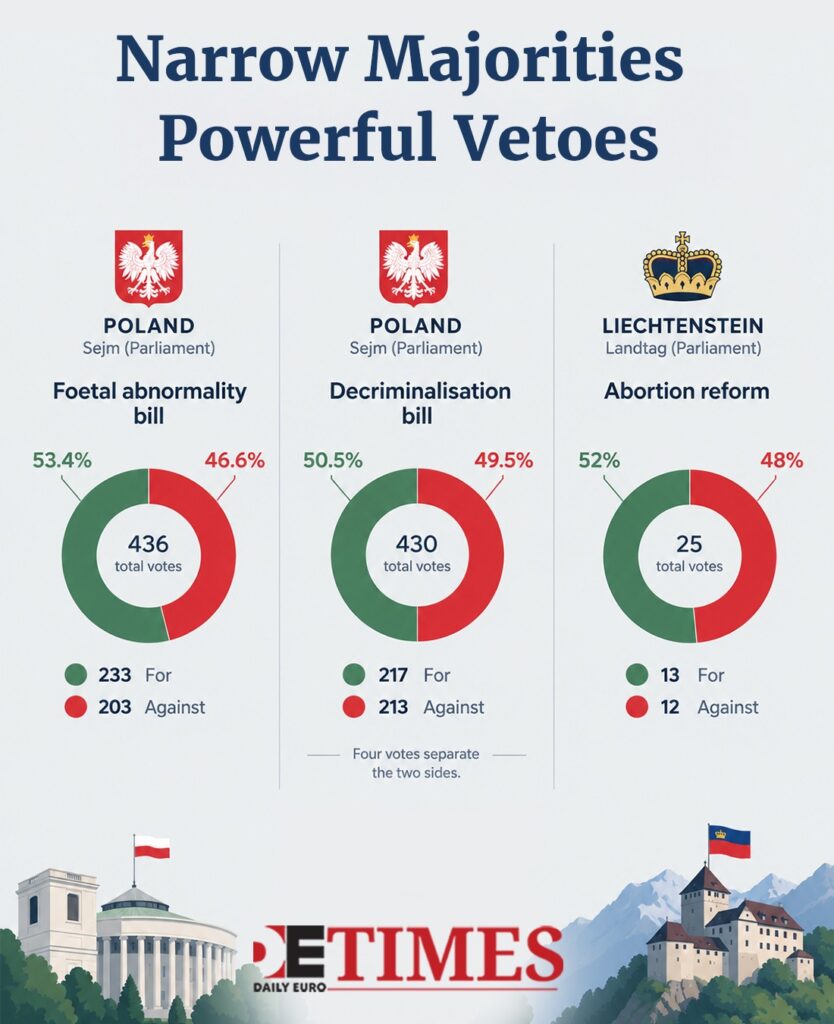
On Tuesday, the Princely House of Liechtenstein announced that Hereditary Prince Alois will not approve a 12-week abortion law that parliament passed on 2 September. The same day, Poland’s lower house, the Sejm, voted 233 to 203 to restore abortion in cases of severe foetal abnormality. In Poland, the bills still need the Senate and then President Karol Nawrocki’s signature, which observers think unlikely.
Poland Restores One Legal Ground
On 20 October, the Sejm passed a bill restoring abortion when tests show a severe, irreversible foetal abnormality, by 233 votes to 203. A second bill, passed by 217 to 213, partly decriminalises helping a woman obtain an illegal abortion, which carries up to three years in prison. The first bill would undo the effect of a 2020 Constitutional Tribunal ruling that removed that ground from a 1993 law.
Neither bill allows abortion on request, which Tusk’s coalition promised when it took office in 2023. Even if both are signed, a report said, Poland would stay among the EU’s most restrictive countries. The Left pressed for the vote by threatening to withhold support for another bill, Archyde reported.
A President Holds the Pen
The bills go next to the Senate, where Tusk’s coalition has an even larger majority, and then to Nawrocki. Notes from Poland reported that Nawrocki, who took office in 2025, has vetoed a record number of government bills and has said he opposes abortion. It therefore looks very unlikely that he will sign either bill. He and the Constitutional Tribunal’s chief justice have also refused to accept five new tribunal judges appointed by the Sejm this year.
Overriding a veto needs a three-fifths majority, far more than the 233 votes the coalition won on its stronger bill. The veto is a legitimate check, since Nawrocki has his own electoral mandate. It also means the 2020 tribunal ruling stands unless the coalition finds votes it does not have.
A Prince Closes the Door in Vaduz
On 2 September, the Landtag voted 13 to 12 for an initiative to decriminalise abortion up to 12 weeks. The initiative had gathered 4,970 signatures, almost five times the 1,000 required, and lawmakers rejected a referendum on it by the same 13 to 12 margin. The constitution gives the prince six months to sanction a law, so his decision came early.
On Tuesday, the Princely House said Alois will not ratify the bill because it would not adequately protect unborn life “as a fundamental legal right”. He is open to lifting the ban on advertising and to better support for women before, during and after pregnancy. Without his signature, the law cannot take effect.
Different Vetoes, Same Effect
The two vetoes rest on different legitimacy, since Nawrocki is an elected president and Alois holds a hereditary office whose sanction power the constitution gives him. Alois threatened the same veto in 2011, before voters rejected a similar proposal with 52 per cent against. Opinion may have moved since: a July Lie-Barometer poll found 62 per cent support, according to Wikipedia’s summary.
The practical effect is similar. Since 2015, women in Liechtenstein can travel abroad to end a pregnancy without criminal charges, but the procedure is not allowed in the principality except in a few cases and is not covered by health insurance, bluewin reported. In Poland, hospitals performed 573 terminations in the first half of 2026, according to the National Health Fund, while the group Aborcyjny Dream Team says it aided nearly 49,000 people this year, Archyde reported. A veto changes where abortions happen, not whether.
Checks Cut Both Ways
Supporters of vetoes say they stop a temporary majority from changing a fundamental question without restraint, and a 217 to 213 vote is a thin majority for a change of this kind. Critics say a veto can override a majority and, in Liechtenstein, nearly 5,000 signatures. Both arguments apply here, which is why the dispute is about the constitution as much as about abortion.
In Vaduz, parliament has been overruled, and in Warsaw it probably will be. A veto can stop a law, but it cannot stop a woman from crossing a border or finding a clinic abroad. Whichever side is right about the constitution, the argument will continue in clinics and across borders, not only in chambers.
Keep up with Daily Euro Times for more updates
Read also:
Pope Leo Brings Catholic Doctrine into France’s Culture Wars
U.S. State Department Funding MAGA Think Tanks Abroad
Pelicot and the Ramifications for Women