

American and Israeli militaries have drafted plans for renewed strikes on Iran, and the reported schedule places the operation after the midterm ballots on the 3rd November election.
Fighters have rehearsed runs over Iraq, and Defence Secretary Pete Hegseth conferred with Benjamin Netanyahu in recent days. Three carrier groups, with Marines, jets and special operations forces, will achieve full readiness early in November.
Eight months of conflict have passed since the first bombardments in February, with Washington blockading Iranian ports and merchant crews absorbing missiles, mines and fire across the Gulf. Trump still withholds approval, and he told reporters something would happen “fairly soon.”
On the reported calendar, renewed fighting belongs after the vote, packaged as a short, intensive operation meant to force concessions. The surrounding indicators, though, describe a region braced for a protracted emergency, and the Gulf’s energy behaviour has already priced one in.
Why the War Waits
The pause has an electoral rationale. American motorists vote first, and planners have weighed sparing refineries to shield petrol prices.
President Donald Trump has repeatedly vetoed proposals for renewed major operations, including a package nearly ready earlier in October, and he has pledged no pre-vote strikes.
Officials speak of one more heavy round pushing Iran’s economy over the brink, a thesis eight months of siege leave unproven.
Netanyahu pressed for an earlier round and failed to win approval.
Tehran Threatens Upward
Iran’s diplomacy keeps a door ajar. Foreign Minister Abbas Araghchi insists “We are just as prepared for diplomacy as we are for war.” Tehran conditions talks with Washington on seven demands, and maritime disputes obstruct progress.
The replies from Tehran point upward and westward. “If provoked, we will hit Europe,” warned Hassan Ghashghavi, a parliamentary commission spokesperson, who threatened European countries with missile strikes should they or regional powers act provocatively.
Ghashghavi also counted seven undersea internet cables beneath Hormuz, and officials promise retaliation against data centres and cable routes. For Europe, the menace touches cloud infrastructure and petrol pumps alike.
Doha Hedges Twice
Across the strait, Qatar spent recent days insuring itself against every outcome. In Doha, ministers from Türkiye, Pakistan, Indonesia and Qatar signed the Badr memorandum, an accord spanning joint defence production, training and research. Its name refers to the full moon, “to signify how the four nations complement one another.”
The accord carries no automatic defence obligations, unlike the Makkah pact among Türkiye, Pakistan and Saudi Arabia from August, and it widens the circle without provoking anyone.
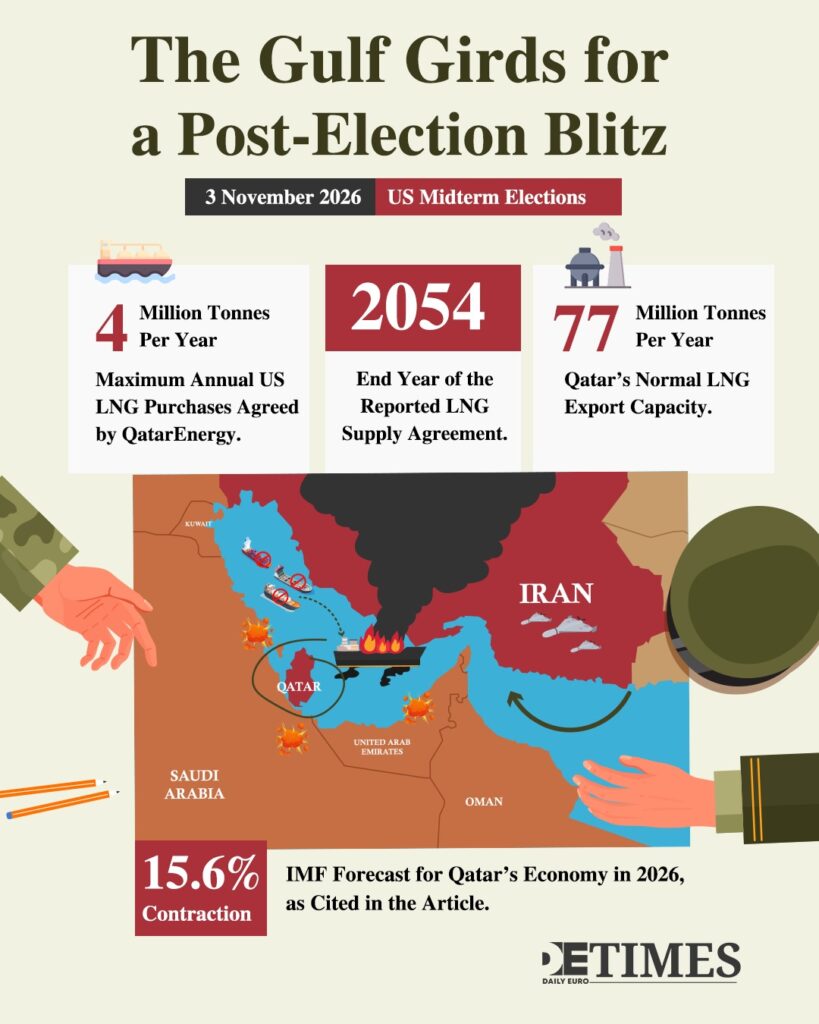
A day later, QatarEnergy agreed to purchase up to 4 million tonnes of American liquefied natural gas yearly through 2054, priced against the Henry Hub benchmark. Iranian missile damage at Ras Laffan in March throttled Qatari output, and the purchase lets Doha honour contracts for customers stranded by disrupted shipments.
Doha normally ships about 77 million tonnes yearly; buying 4 million back across the ocean converts a chokepoint hazard into a trading strategy. The IMF forecasts a 15.6% contraction for the year, so the hedge doubles as commerce.
The Energy Bill Spreads
The war’s expenses spill across the wider region. Iranian forces struck four vessels transferring cargo in the northern Gulf, and three more merchant ships hit mines in the strait. Insurance premiums stay high, and the ceasefire around Hormuz has frayed for weeks.
EU leaders debated emergency energy relief at their summit last week, and petrol shortages collided with France’s budget fight.
For the Gulf, the roles invert. Producers purchase what they once sold, Atlantic terminals gain a decade-long customer, and Gulf sovereigns convert crisis income into industrial pacts.
Cargoes increasingly round the Cape of Good Hope, stretching delivery times to European terminals. European utilities have chased Atlantic and African cargoes, and LNG futures climbed as Gulf deliveries wobbled. QatarEnergy holds a majority stake in the Golden Pass terminal in Texas, so Doha earns on the selling side of its own purchases.
A Short War, Long Echoes
The reported plan promises brevity, as planners hope one intensive round forces concessions, but sceptics recall the first phase, which left Tehran unbowed.
Iranian officials promise widened retaliation, and a coalition of Baloch separatist groups has opened a front in Iran’s southeast, squeezing Tehran on its periphery as on its coast.
Much depends, naturally, on one man’s November mood, and polls rarely read it accurately.
Keep up with Daily Euro Times for more updates
Read also:
Trump’s Iran Whiplash: Oil Markets and Public Sentiment
Qatar Attack Pushes Gulf States Toward European Security
How the Iran Ceasefire is Realigning the Gulf and Europe

