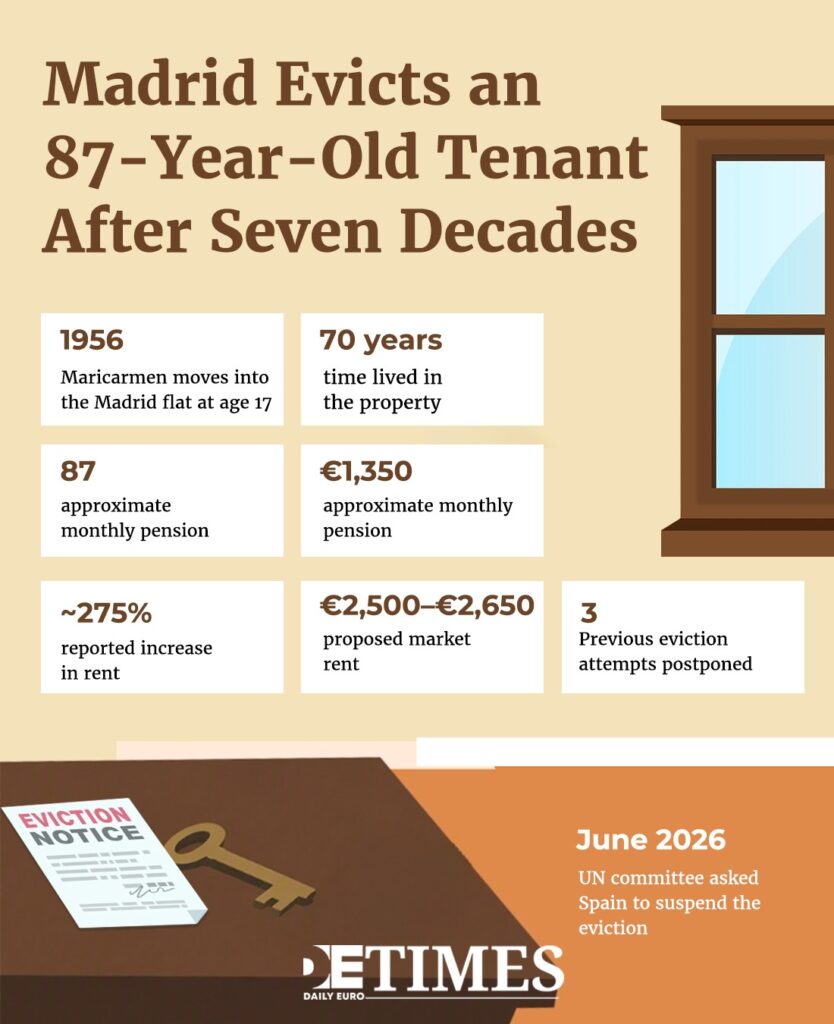
María del Carmen Abascal, known as Maricarmen, was evicted this week from the Madrid flat where she had lived since 1956, after three previous eviction attempts had been postponed.
Police and social services removed the 87-year-old, who has a disability, on a stretcher after giving her roughly 30 minutes to gather essential belongings, while hundreds of protesters outside chanted support and police forcibly cleared demonstrators blocking the entrance. The UN Committee on Economic, Social and Cultural Rights had asked Spain in June to suspend the eviction; the request did not carry domestic legal force, and the eviction went ahead regardless.
The case gathered national attention because almost every element of Spain’s housing crisis sits inside it: an old regulated tenancy, a property sold to an investment company, a steep rent increase, legal uncertainty over succession rights and a tenant whose age made relocation especially severe.
The eviction was lawful. That does not make the wider housing question disappear.
Seventy Years in One Flat
Maricarmen moved into the flat on Alcalde Sainz de Baranda Street with her parents when she was 17. The original rental contract belonged to her father under Spain’s old regulated-rent system, and after his death the tenancy passed to her mother and, after her mother died in 2005, to Maricarmen.
The building changed ownership in 2018 and eventually passed to Urbagestión Desarrollo e Inversión, a property company active in housing, land, offices and hotels.
The legal dispute centred on that second transfer of the tenancy. The company argued that the contract could not legally be inherited twice and had therefore expired, and while a lower court initially sided with Maricarmen, the Supreme Court overturned that ruling in March and recognised the owner’s right to recover the property.
That distinction carries weight: this was not simply a landlord ignoring an existing contract, but a genuine legal dispute over whether a tenancy originating in 1956 remained valid after two successions.
The Alternative Was Unaffordable
Legality nevertheless collided with economic reality. Once the old contract ended, the company sought around €2,500 to €2,650 a month for the flat, a roughly 275 per cent increase according to the Madrid Tenants’ Union, while Maricarmen’s pension was about €1,350.
There was therefore no realistic route for her to remain as an ordinary market-rate tenant.
The owners also rejected attempts at mediation and proposals aimed at keeping her in the property, and her lawyer said the company was not interested in renewing the tenancy even under alternative arrangements. Maricarmen had already survived three attempted evictions, most recently a postponement in June.
The fourth went ahead this week, with police clearing protesters from outside the building while she was eventually removed on a stretcher and later chose to stay temporarily with relatives.
The UN Asked Spain to Stop It
The UN Committee on Economic, Social and Cultural Rights intervened in June, asking Spain to suspend the eviction while Maricarmen’s case was being considered and to ensure she had access to adequate alternative housing.
The request did not overturn the domestic court order, and the eviction ultimately proceeded. That difference between domestic enforceability and international human-rights obligations sits at the centre of the controversy.
Property rights are also rights: an owner cannot reasonably be expected to lose control of a property indefinitely simply because a tenant has lived there for many years, and courts exist precisely to resolve disputes when competing rights collide.
But housing is not an ordinary consumer good either, and removing somebody from a home occupied for seven decades, at 87 and with a disability, carries consequences far beyond changing apartments. The law can decide who owns the flat; it is less capable of deciding what society owes the person leaving it.
A Housing Crisis Beyond One Flat
Madrid City Council says it offered Maricarmen several accommodation alternatives before the eviction, including emergency residential accommodation afterwards, and that she declined those offers and ultimately preferred to stay with relatives.
That complicates the most dramatic version of the story, since the state was not literally offering a choice between remaining in the disputed flat and sleeping on the street. Yet accommodation is not interchangeable: for someone in her late eighties, moving from a lifelong neighbourhood into an emergency residential place can represent a profound loss of independence, familiarity and community even if a roof remains available.
Around 10,000 demonstrators joined the Madrid protest, according to the government delegation, while solidarity actions were called in Barcelona, Seville, Valencia, Málaga and several other cities.
Spain’s major cities have experienced sharp rental increases and growing anxiety around short-term rentals and limited affordable supply, and Madrid averages around three evictions a day according to figures cited around Maricarmen’s case. Most such cases never turn into national stories; Maricarmen’s did because the contrast was unusually stark: seventy years in one home, an old protected tenancy replaced by a market rent beyond her income, and an international body asking for a pause that went unheeded.
Housing Rights Need Somewhere to Lead
Maricarmen’s case should not turn into an argument that elderly tenants can never be evicted. Such a rule would transfer social policy directly onto individual property owners and could create serious consequences of its own.
The stronger conclusion is that vulnerable tenants need somewhere realistic to go before eviction turns into the final step.
That means permanent affordable housing, accessible homes, stronger mediation and clearer mechanisms for cases involving very old tenants rather than emergency accommodation offered at the last minute.
The Supreme Court resolved the ownership dispute. The protests that followed are about something the judgment could not resolve: whether an 87-year-old woman can lose the only home she has known for seven decades and still be said to have been adequately protected. Madrid enforced the property law; the political argument now concerns what should have existed around that law before the police arrived.
Keep up with Daily Euro Times for more updates
Read also:
Ceuta Migrant Women Suffer Sexual Violence, Muted Outrage
Uneven Protection: Religious Freedom in Belgium
Finland’s Return of Asylum Seekers Challenges Dublin Rules